Dust could settle Himalaya debates
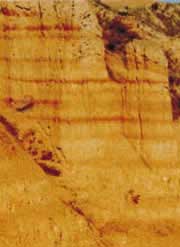
Great loess: layers of ancient dust give clues to mountains’ birth. <br>© Nature <br>
Deserts covered Central Asia as early as 22 million years ago
The great Asian deserts developed 22 million years ago at the latest, 14 million years earlier than had been thought. So concludes a new analysis of Chinese soils, filling in another piece of the puzzle of the Himalayas’ birth.
Today, huge deserts characterize the vast landmasses inside Asia, the largest continent on Earth. Here, cut off by the Himalayas from the humidity of the Indian Ocean and far from any other seas, the climate is extreme. Winters are ice-cold, summers blazing hot and moisture scarce.
But some time between 36 and 22 million years ago, rivers flowed through these desiccated wastelands. The Himalayas had just started pushing up into the skies. And colliding continents had only recently swallowed the ancient equatorial ocean of Tethys, which had separated Eurasia from the fragments of what was once Gondwanaland.
The transition between these very different climates happened at least 22 million years ago, estimate Zhentang Guo of the Chinese Academy of Sciences and co-workers1. At two mountain sites in China’s Qinan basin, just 160 km northeast of the Tibetan plateau, the researchers found 231 layers of ancient, brownish, wind-blown dust, called loess.
The loess was deposited from 22 to 6.2 million years ago between layers of red clay. Each layer contains about 65,000 years’ worth of deposits. Such large layers imply that extensive deserts existed nearby: the Asian interior.
“The deserts would have been relatively cold, like the Gobi today, as opposed to the Sahara,” explains Bill Ruddiman of the University of Virginia, one of the team. Cold, dry, winter monsoon winds transported the desert dusts to their long-term resting place.
The Qinan basin’s stripy landscape was produced by a climate of dry winter monsoons punctuated by moist summer monsoons. The reddish clay layers were produced locally during more humid periods, when weaker winter monsoons meant that desert dust didn’t make it to the Loess plateau, the researchers believe.
“To block the moisture, there must have been some sort of a mountain range in place 22 million years ago”, says Jay Quade, a desert geoscientist at the University of Arizona in Tucson. The existence of the central Asian deserts 22 million years ago offers an independent perspective on the uplift of the Himalayas, the details of which are still controversial.
Before now, little was known about the region’s climate that far back in time. Most of the studies on Chinese loess have centred on the Quaternary period, less than 1.6 million years ago. Previously, the oldest reliably dated loess finds were only about 6 million years old.
References
- Guo, Z. T. et al. Onset of Asian desertification by 22 Myr ago inferred from loess deposits in China. Nature, 416, 159 – 163 , (2002).
Media Contact
All latest news from the category: Earth Sciences
Earth Sciences (also referred to as Geosciences), which deals with basic issues surrounding our planet, plays a vital role in the area of energy and raw materials supply.
Earth Sciences comprises subjects such as geology, geography, geological informatics, paleontology, mineralogy, petrography, crystallography, geophysics, geodesy, glaciology, cartography, photogrammetry, meteorology and seismology, early-warning systems, earthquake research and polar research.


Newest articles

A universal framework for spatial biology
SpatialData is a freely accessible tool to unify and integrate data from different omics technologies accounting for spatial information, which can provide holistic insights into health and disease. Biological processes…

How complex biological processes arise
A $20 million grant from the U.S. National Science Foundation (NSF) will support the establishment and operation of the National Synthesis Center for Emergence in the Molecular and Cellular Sciences (NCEMS) at…
Airborne single-photon lidar system achieves high-resolution 3D imaging
Compact, low-power system opens doors for photon-efficient drone and satellite-based environmental monitoring and mapping. Researchers have developed a compact and lightweight single-photon airborne lidar system that can acquire high-resolution 3D…