



Feeding 9 Billion: Innovations in Agricultural Modeling
Earth's irregular, shorter term wobbles, lasting a week or so, have been more difficult to study, partly because these motions are usually masked by those of more prominent wobbles. Now, scientists in Belgium and France have taken advantage of a quirk in the pattern of large-scale motions and the advent of the Global Positioning System (GPS) to pin down short-term wobbles that occurred from November 2005 through February 2006.
During this period, the Chandler wobble and the annual wobble essentially cancelled each other out, an event that occurs every 6.4 years, allowing the researchers to focus on the short-period wobbles. Over these three and a half months, the pole position traced small loops, ranging in size from that of a sheet of A4 [8-1/2×11 inch] paper down to that of a cell phone, and it remained within a one meter [yard] square during these four months.
Sebastien Lambert of the Royal Observatory of Belgium and colleagues there and at the Paris Observatory took advantage of the opportunity to track short-term wobbles, using newly available GPS data that establish the location of the poles precisely. They then sought to determine why these motions occurred when they did.
In a paper scheduled to be published 1 July in Geophysical Research Letters, they conclude that weather patterns in the northern hemisphere played a significant role. Both the location of high- or low-pressure centers–for example, over Asia or northern Europe–and the relationship of these weather systems to each other played a measurable role in creating, or “exciting,” small, short-term wobbles, they report.
The ocean also affects short-term wobbles, according to Lambert and his colleagues. They were able to correlate oceanic and atmospheric pressure variations with the small observed wobbles during the study period. Although these forces had been credited by previous researchers with maintaining the large Chandler wobble, this was the first time that scientists have been able to demonstrate that day-to-day changes in atmospheric pressure produce a measurable effect on Earth's rotation.
The study was funded by the Belgian Science Policy Office, the Royal Observatory of Belgium, and the Paris Observatory.




Earthquakes in the American state of Utah, the Soultz-sous-Forêts region of France or in the Dutch province of Groningen should not be able to occur even if the subsurface has been exploited for decades. This is because the shallow subsurface behaves in such a way that faults there become stronger as soon as they start moving. At least that is what geology textbooks teach us. And so, in theory, it should not be possible for earthquakes to occur. So why…
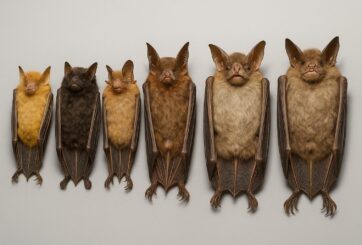
Just in time for Halloween, researchers from the Royal Ontario Museum (ROM), the Field Museum in Chicago, and Lawrence University in Wisconsin have announced the discovery of six new species of bats. These newly identified species, all found in the Philippines, belong to the group known as tube-nosed bats—a fascinating and diverse branch of the mammal family tree. Expanding the Tree of Life Formally recognized as new species through morphological and genetic analysis, this discovery expands the already impressive global…
In a recent study published today in the European Geosciences Union (EGU) journal Biogeosciences, scientists have confirmed that mercury pollution from artisanal and small-scale gold mining (ASGM) is contaminating food crops not through the soil, as previously believed, but directly from the air. Driven by the surging price of gold, which has increased by more than tenfold since 2000, the rapid expansion of unregulated mining in these regions raises urgent questions about food security, human health, and environmental justice The…
A new study from Iceland’s Surtsey island shows that birds carried most of the plants that colonised the island, challenging long-held beliefs that seed or fruit shape determines how plants spread — offering fresh insight into life’s adaptation to c When the volcanic island of Surtsey rose from the North Atlantic Ocean in 1963, it offered scientists a once-in-a-lifetime opportunity to observe how life takes hold on a brand-new and barren land. For decades, ecologists believed that plants’ ability to…
 Feedback
