
Young stars ejecting plasma could give us clues into the Sun’s past Kyoto, Japan — Down here on Earth we don’t usually notice, but the Sun is frequently ejecting huge masses of plasma into space. These are called coronal mass ejections (CMEs). They often occur together with sudden brightenings called flares, and sometimes extend far enough to disturb Earth’s magnetosphere, generating space weather phenomena including auroras or geomagnetic storms, and even damaging power grids on occasion. Scientists believe that when…

In a basement lab on BYU’s campus, mechanical engineering professor Julie Crockett analyzes water as it bounces like a ball and rolls down a ramp.
With the goal of powering these yet-to-be invented devices, UT Austin engineers focused on building a reliable, ultra-high-speed nanomotor that can convert…
Computer simulations play an increasingly important role in the description and development of new materials. Yet, despite major advances in computer…
So-called T-rays, which are light waves too long for human eyes to see, could help airport security guards find chemical and other weapons. They might let…
“Today’s computers are wonderful at bookkeeping and solving scientific problems often described by partial differential equations, but they’re horrible at just…
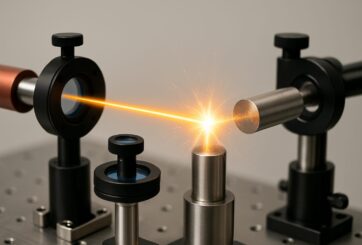
Imperial College London physicists have discovered how to create matter from light – a feat thought impossible when the idea was first theorised 80 years ago.
Researchers have captured stunning images of Saturn’s auroras as the planet’s magnetic field is battered by charged particles from the Sun. The team’s findings…
Astrophysicists at UC San Diego have measured the minute gravitational distortions in polarized radiation from the early universe and discovered that these…
Assembling the puzzles of quantum materials is, in some ways, like dipping a wire hanger into a vat of soapy water, says CIFAR (Canadian Institute for Advanced…
The scientists were able to identify the orbit of the exoplanet, Beta Pictoris b, which sits 63 light years from our solar system, by using the Gemini Planet…
One instrument aboard the spacecraft will study a special component of the Martian atmosphere to help solve this mystery. By studying ions, or small…
In the early hours of May 7, the machine delivered its highest-energy beams ever, 10.5 billion electron-volts (10.5 GeV) through the entire accelerator and up…
Jupiter's trademark Great Red Spot — a swirling storm feature larger than Earth — is shrinking. This downsizing, which is changing the shape of the spot from…
University of Reading researchers found a link between increased thunderstorm activity on Earth and streams of high-energy particles accelerated by the solar…
With the commodification of digital cameras, digital video has become so easy to produce that human beings can have trouble keeping up with it. Among the tools…
In contrast to telescopes stationed in outer space, earth based telescopes inevitably measure interference signals in the atmosphere. In order to filter out…
 Feedback


