
Young stars ejecting plasma could give us clues into the Sun’s past Kyoto, Japan — Down here on Earth we don’t usually notice, but the Sun is frequently ejecting huge masses of plasma into space. These are called coronal mass ejections (CMEs). They often occur together with sudden brightenings called flares, and sometimes extend far enough to disturb Earth’s magnetosphere, generating space weather phenomena including auroras or geomagnetic storms, and even damaging power grids on occasion. Scientists believe that when…

Researchers from Tokyo Metropolitan University have observed the formation of holes that move by themselves in droplets of ionic liquids (IL) sitting inside…
As silicon-based semiconductors reach their performance limits, gallium nitride (GaN) is becoming the next go-to material to advance light-emitting diode (LED)…
The idea of using a liquid medium for computing has been around for decades, and various approaches have been proposed. Among its potential advantages, this…
The way an object reflects light depends not only on its albedo (the percentage of light it reflects) but also on the illumination angle. One particular effect…
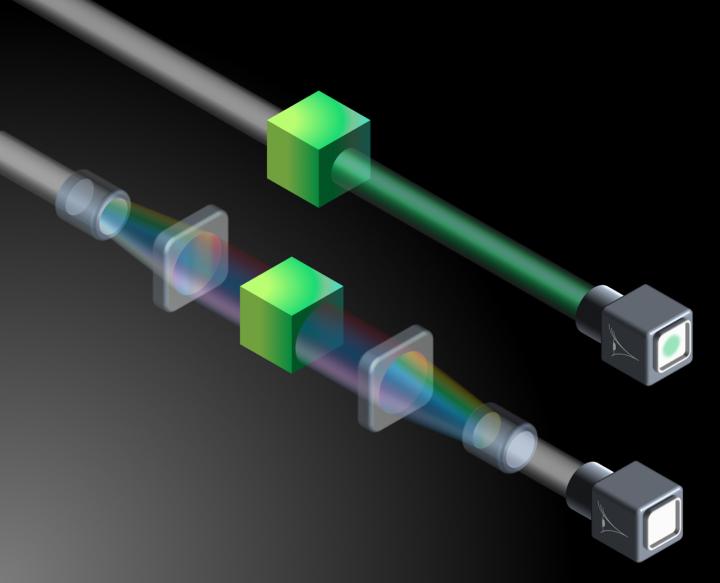
Researchers and engineers have long sought ways to conceal objects by manipulating how light interacts with them. A new study offers the first demonstration of…
These objects, which are referred to as “chiral magnetic bobbers”, are three-dimensional magnetic structures that appear near the surfaces of certain alloys.
A new study now suggests that the branching structure of the former river networks on Mars has striking similarities with terrestrial arid landscapes. This has…
Modern storage technology with ever-smaller and more powerful hard drives cannot function without them: the effects of so-called magnetoresistance ensure that…
The transfer of heat is fundamental to all materials. This new research, published in the journal Science, explored thermal insulators, which are materials…
It is crucial that we prevent the Earth from warming by more than two degrees Celsius compared with the pre-industrial era. This is a key aim of the 2015 Paris…
Who would not want to have a light saber? While the idea from science fiction has sparked our imagination, technical realization of this fantasy is elusive,…
In 2014, astrophysicists discovered a spectral line in observational data from the Herschel Space Telescope and tentatively assigned it to the amide ion. It…
`Oumuamua, the first interstellar object discovered in the Solar System, is moving away from the Sun faster than expected. This anomalous behaviour was…
A system's state is characterised as entangled or quantum correlated if two or more particles cannot be described as a combination of separate, independent…
Nuclei of heavy elements can be produced at minute quantities of a few atoms per second in fusion reactions using powerful particle accelerators. The obtained…
Using one of the fastest supercomputers in the world, the scientists have simulated the matter distribution of the so-called satellite “dwarf” galaxies. These…
 Feedback


