
Young stars ejecting plasma could give us clues into the Sun’s past Kyoto, Japan — Down here on Earth we don’t usually notice, but the Sun is frequently ejecting huge masses of plasma into space. These are called coronal mass ejections (CMEs). They often occur together with sudden brightenings called flares, and sometimes extend far enough to disturb Earth’s magnetosphere, generating space weather phenomena including auroras or geomagnetic storms, and even damaging power grids on occasion. Scientists believe that when…

The new “L-CSC” supercomputer at the GSI Helmholtz Centre for Heavy Ion Research is ranked as the world's most energy-efficient supercomputer. The new…
These are key questions for Prof. Peter Y A Ryan, e-voting expert at the Interdisciplinary Centre for Security, Reliability and Trust (SnT) from the University…
UWE-3 is one of a new generation of experimental satellites developed by the University of Würzburg (short: UWE): This mini-satellite is even more compact and…
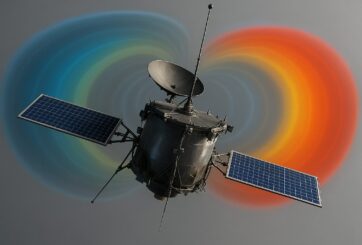
The Van Allen belts are a collection of charged particles, gathered in place by Earth’s magnetic field. They can wax and wane in response to incoming energy…
During a thunderstorm, we all know that it is common to hear thunder after we see the lightning. That’s because sound travels much slower (768 miles per hour)…
Physicists at the University of Kansas have fabricated an innovative substance from two different atomic sheets that interlock much like Lego toy bricks. The…
Several research groups worldwide have shown that it is possible to find out which transactions belong together, even if the client uses different pseudonyms….
Ultracold atomic gases are among the coldest objects in existence. Laser beams can be used to trap atoms inside a vacuum chamber and slow down their motion to…
When they make their way into homes, some species of termites can be destructive pests. Their fungus-harvesting relatives in Africa and Asia, however, are…
The scientists' report is published in Nature Communications, Nov. 20, by Péter Németh, a former ASU visiting researcher (now with the Research Centre of…
Ultra-short and extremely strong X-ray flashes, as produced by free-electron lasers, are opening the door to a hitherto unknown world. Scientists are using…
Red mites are the most common ectoparasites of poultry and cause substantial economic damage worldwide. Scientists at the University of Hohenheim have developed a method to combat red mites which utilizes the fact that the mites are sensitive to heat and that the parasite only visits the host at night for feeding and then hides in dark spaces near the host. The method presents hollow, perforated perches as appropriate hiding places where mites in all states of development are killed through thermal treatment. Because of the purely mechanical nature of the process there is no health risk for personnel. Since temperature and speed of the heating device are regulated by a PLC (programmable logic controller), farm workers are free to carry out other tasks while the treatment takes place.
The invention presented here is a temperature-compensated FBG measurement system based on interferometry. It is characterized by naturally high sensitivity and high dynamic range well in excess of a period of interference. The system makes do with commercially available and cheap components that can be easily combined and implemented.
The inventors here present a novel, highly specialized plasma membrane protein responsible for citrate uptake in cancer cells. This transporter with its function of citrate import is a specific marker for cancer cells and offers therefore a promising target for diagnostic and therapeutic approaches.
As a complete surprise came the discovery that the orbit of G2 matches that of another gas cloud detected a decade ago, suggesting that G2 might actually be…
Using the Advanced Photon Source (APS), a Department of Energy (DOE) Office of Science User Facility, researchers from DOE’s Argonne National Laboratory and…
 Feedback


