
Young stars ejecting plasma could give us clues into the Sun’s past Kyoto, Japan — Down here on Earth we don’t usually notice, but the Sun is frequently ejecting huge masses of plasma into space. These are called coronal mass ejections (CMEs). They often occur together with sudden brightenings called flares, and sometimes extend far enough to disturb Earth’s magnetosphere, generating space weather phenomena including auroras or geomagnetic storms, and even damaging power grids on occasion. Scientists believe that when…

… Twisting to the light of nanoparticles. Physicists at the University of Bath iin the UK observe a new physical effect in chiral (twisted) nanoparticles. Physics researchers at the University of Bath in the UK discover a new physical effect relating to the interactions between light and twisted materials – an effect that is likely to have implications for emerging new nanotechnologies in communications, nanorobotics and ultra-thin optical components. In the 17th and 18th centuries, the Italian master craftsman Antonio…
Scientists take a closer look inside the perfect fluid. Berkeley Lab research brings us closer to understanding how our universe began. Scientists have reported new clues to solving a cosmic conundrum: How the quark-gluon plasma – nature’s perfect fluid – evolved into matter. A few millionths of a second after the Big Bang, the early universe took on a strange new state: a subatomic soup called the quark-gluon plasma. And just 15 years ago, an international team including researchers from…
– new particles of negative mass discovered. Physicists from the University of Regensburg publish results in the internationally renowned journal “Nature Communications” A large international research collaboration led by Dr Kai-Qiang Lin and Professor John Lupton from the Institute of Experimental and Applied Physics at the University of Regensburg has been able to measure the effect of electrons with negative mass in novel semiconductor nanostructures. The international team includes scientists from Berkeley and Yale (USA), Cambridge (England) and Tsukuba (Japan)….
Mushballs – giant, slushy hailstones made from a mixture of ammonia and water – may be responsible for an atmospheric anomaly at Neptune and Uranus that has been puzzling scientists. A study presented by Tristan Guillot at the Europlanet Science Congress (EPSC) 2021 shows that mushballs could be highly effective at carrying ammonia deep into the ice giants’ atmospheres, hiding the gas from detection beneath opaque clouds. Recently, remote observations at infrared and radio wavelengths have shown that Uranus and…
Researchers from Osaka University report a laser-driven neutron source for acquiring non-destructive radiography images. Getting snapshots of systems and processes at precise time points is important to research and development in many fields, including biology, materials science, and engineering. Firing a neutron beam at a material is one way of gaining information; however, this often requires nuclear reactors and specialist facilities. Now, researchers from Osaka University have reported a laser-driven method of simultaneously generating neutrons and X-rays. Their findings are…
Successful project completion demonstrates human-centered LED lighting for industry and office space: The Fraunhofer Institute for Applied Solid State Physics IAF, in cooperation with the Chair of Microelectronics at the Department of Microsystems Engineering (IMTEK) of the University of Freiburg and Hahn-Schickard, has developed reliable, demand-oriented and resource-saving LED lighting for workplace and office applications. The lighting concept includes an intelligent, energy-saving light and luminaire control system geared to the needs of working people. Light is much more than just…
Quarks and gluons are fundamental building blocks of all visible matter in the universe. They’re described by the theory of strong nuclear interactions: quantum chromodynamics, or QCD. But a complete grasp of how observed properties in the universe emerge from these interactions has remained elusive. Much as the understanding of atoms and their structure led to the development of very precise instruments such as atomic clocks, physicists think a better understanding of QCD will accelerate a host of breakthroughs in…
Counterfeit-proof and unique identification shows authenticity of products. Counterfeit-proof product protection and resilient supply chains are the goals of the Fraunhofer SmartID project. The Fraunhofer Institutes for Applied Polymer Research IAP, for Secure Information Technology SIT and for Open Communication Systems FOKUS are developing a novel marking system that can determine the authenticity of products via smart devices even while being offline, i.e. without access to a database. SmartID will be embedded in existing track & trace infrastructures and can…
Psychoacoustic sonification: This term refers to the expression of data in form of sound rather than though visualization. Master’s degree students at the University of Bremen have now used this technology to create an acoustic spirit level, which is available free of charge in the form of the mobile “Tiltification” app. “The mobile app for Android and iOS devices equips your phone with a spirit level. For this, it uses the sensors that are built into virtually every smartphone,” explains…
In semiconductor device applications, there is an increasing demand for semiconductors with very high carrier concentrations. The semiconductor material parameters, namely carrier density and mobility, are what primarily determine device performance. Hence, it is important to accurately characterize the carrier density and mobility of a semiconductor for the development of its device applications. The use of THz waves, or electromagnetic radiation with wavelengths of around 300 µm and frequency of about 1 THz, in the nondestructive testing of semiconductors has…
Physicists design novel quantum material. Smartphones, notebooks and other electronic devices of our everyday life strongly benefit from the ever-increasing miniaturization of semiconductor devices. This development comes however at a price: confining electrons enhances their scattering– cell phones heat up. Topological insulators hold promises for a more efficient and sustainable technology. At odds with conventional semiconductors, the current flows on their boundaries, with scattering becoming prohibited thanks to symmetry reasons. In other words, things stay cool! In 2007 Laurens Molenkamp,…
A long-lasting non-equilibrium phase coexistence in supercritical fluids has been observed by a Korean research team. A team of researchers led by Professor Gunsu S. Yun from POSTECH’s Department of Physics and the Division of Advanced Nuclear Engineering and Professor Dong Eon Kim of the Department of Physics and Max Planck POSTECH/Korea Research Initiative (MPK) has observed the non-equilibrium phase coexistence in supercritical fluids lasting several hours. The researchers explained the phenomenon through a mass transport model at the phase…
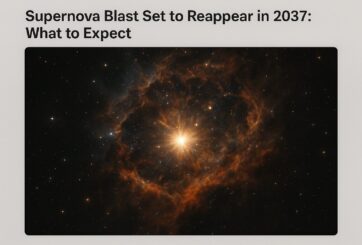
It’s challenging to make predictions, especially in astronomy. There are however, a few forecasts astronomers can depend on, such as the timing of upcoming lunar and solar eclipses and the clockwork return of some comets. Now, looking far beyond the solar system, astronomers have added a solid prediction of an event happening deep in intergalactic space: an image of an exploding star, dubbed Supernova Requiem, which will appear around the year 2037. Although this rebroadcast will not be visible to…
Is the Standard Model of particle physics incorrect at key points? Recently there has been an increase in experimental observations that deviate from the predictions of this widely accepted physical theory. A current study by the University of Bonn now provides even stronger evidence for the existence of “new physics”. The final version of the paper is now published in the journal Physics Letters B. Lead author Chien-Yeah Seng will present the results in mid-October at the fall meeting of…
Forget about online games that promise you a “whole world” to explore. An international team of researchers has generated an entire virtual UNIVERSE, and made it freely available on the cloud to everyone. Uchuu (meaning “Outer Space” in Japanese) is the largest and most realistic simulation of the Universe to date. The Uchuu simulation consists of 2.1 trillion particles in a computational cube an unprecedented 9.63 billion light-years to a side. For comparison, that’s about three-quarters the distance between Earth…
New research integrates the most effective practices for eye tracking in AR eyewear. The eyes have it. They are constantly on the move when viewing scenes in augmented reality (AR). Now, developers of AR headsets and mixed reality systems have become increasingly interested in the ability to track these eye movements with their eyewear, allowing system designers to improve image fidelity and contrast across the field of view without excessive demands on the power of the projection system. This in…
 Feedback


