
Young stars ejecting plasma could give us clues into the Sun’s past Kyoto, Japan — Down here on Earth we don’t usually notice, but the Sun is frequently ejecting huge masses of plasma into space. These are called coronal mass ejections (CMEs). They often occur together with sudden brightenings called flares, and sometimes extend far enough to disturb Earth’s magnetosphere, generating space weather phenomena including auroras or geomagnetic storms, and even damaging power grids on occasion. Scientists believe that when…

Under most conditions, according to a new proof, algorithms on a quantum annealing computer don’t offer quantum speed-up. Recent research proves that under certain conditions, quantum annealing computers can run algorithms—including the well-known Shor’s algorithm—more quickly than classical computers. In most cases, however, quantum annealing does not provide a speed-up compared to classical computing when time is limited, according to a study in Nature Communications. “We proved that you can be sure you will reach a fast solution from the…
Engineers have created intelligent 3D printers that can quickly detect and correct errors, even in previously unseen designs, or unfamiliar materials like ketchup and mayonnaise, by learning from the experiences of other machines. The engineers, from the University of Cambridge, developed a machine learning algorithm that can detect and correct a wide variety of different errors in real time, and can be easily added to new or existing machines to enhance their capabilities. 3D printers using the algorithm could also…
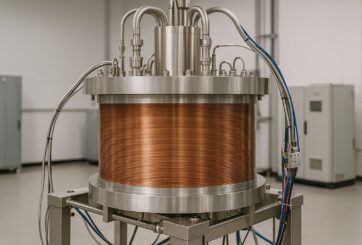
The hybrid magnet at the Steady High Magnetic Field Facility (SHMFF) in Hefei, China set a world record for the highest steady magnetic field by a working magnet when it produced a steady field of 45.22 tesla (T) on Aug. 12. It broke the previous world record of 45 tesla set in 1999 by a hybrid magnet at the National High Magnetic Field Laboratory of the United States. This 45.22-tesla hybrid magnet is composed of a resistive insert nested in…
Below Europa’s thick icy crust is a massive, global ocean where the snow floats upwards onto inverted ice peaks and submerged ravines. The bizarre underwater snow is known to occur below ice shelves on Earth, but a new study shows that the same is likely true for Jupiter’s moon, where it may play a role in building its ice shell. The underwater snow is much purer than other kinds of ice, which means Europa’s ice shell could be much less…
… opens new frontier in quantum science. By using photons and electron spin qubits to control nuclear spins in a two-dimensional material, researchers at Purdue University have opened a new frontier in quantum science and technology, enabling applications like atomic-scale nuclear magnetic resonance spectroscopy, and to read and write quantum information with nuclear spins in 2D materials. As published Monday (Aug. 15) in Nature Materials, the research team used electron spin qubits as atomic-scale sensors, and also to effect the…
A new method for shaping matter into complex shapes, with the use of ‘twisted’ light, has been demonstrated in research at the University of Strathclyde. When atoms are cooled to temperatures close to absolute zero (-273 degrees C), they stop behaving like particles and start to behave like waves. Atoms in this condition, which are known as Bose–Einstein condensates (BECs), are useful for purposes such as realisation of atom lasers, slow light, quantum simulations for understanding the complex behaviour of…
International research team led by Göttingen University controls interaction of charge carriers. An international research team led by the University of Göttingen has detected novel quantum effects in high-precision studies of natural double-layer graphene and has interpreted them together with the University of Texas at Dallas using their theoretical work. This research provides new insights into the interaction of the charge carriers and the different phases, and contributes to the understanding of the processes involved. The LMU in Munich and…
Physicists love to smash particles together and study the resulting chaos. Therein lies the discovery of new particles and strange physics, generated for tiny fractions of a second and recreating conditions often not seen in our universe for billions of years. But for the magic to happen, two beams of particles must first collide. Researchers at the U.S. Department of Energy’s Fermi National Accelerator Laboratory have announced the first successful demonstration of a new technique that improves particle beams. This…
UChicago scientists create method to efficiently calculate quantum phase transitions. From water boiling into steam to ice cubes melting in a glass, we’ve all seen the phenomenon known as a phase transition in our everyday lives. But there’s another type of phase transition that’s much harder to see, but just as stark: quantum phase transitions. When cooled to near absolute zero, certain materials can undergo these quantum phase transitions, which can make a physicist’s jaw drop. The material can flip from being…
In firefighting, the worst flames are the ones you don’t see coming. Amid the chaos of a burning building, it is difficult to notice the signs of impending flashover — a deadly fire phenomenon wherein nearly all combustible items in a room ignite suddenly. Flashover is one of the leading causes of firefighter deaths, but new research suggests that artificial intelligence (AI) could provide first responders with a much-needed heads-up. Researchers at the National Institute of Standards and Technology (NIST), the Hong…
Our modern understanding of the physical world is based on gauge theories: mathematical models from theoretical physics that describe the interactions between elementary particles (such as electrons or quarks) and explain quantum mechanically three of the fundamental forces of nature: the electromagnetic, weak, and strong forces. The fourth fundamental force, gravity, is described by Einstein’s theory of general relativity, which, while not yet understood in the quantum regime, is also a gauge theory. Gauge theories can also be used to…
Stampede2 supercomputer simulates star seeding, heating effects of primordial black holes. Just milliseconds after the universe’s Big Bang, chaos reigned. Atomic nuclei fused and broke apart in hot, frenzied motion. Incredibly strong pressure waves built up and squeezed matter so tightly together that black holes formed, which astrophysicists call primordial black holes. Did primordial black holes help or hinder formation of the universe’s first stars, eventually born about 100 million years later? Supercomputer simulations helped investigate this cosmic question, thanks…
Physics connects seismic data to properties of rocks and sediments. A new analysis of seismic data from NASA’s Mars InSight mission has revealed a couple of surprises. The first surprise: the top 300 meters of the subsurface beneath the landing site near the Martian equator contains little or no ice. “We find that Mars’ crust is weak and porous. The sediments are not well-cemented. And there’s no ice or not much ice filling the pore spaces,” said geophysicist Vashan Wright…
Flexible waterproof sensors can control smart devices, such as lamps, music players. Wearable human-machine interface devices, HMIs, can be used to control machines, computers, music players, and other systems. A challenge for conventional HMIs is the presence of sweat on human skin. In Applied Physics Reviews, by AIP Publishing, scientists at UCLA describe their development of a type of HMI that is stretchable, inexpensive, and waterproof. The device is based on a soft magnetoelastic sensor array that converts mechanical pressure…
Scientists using the Atacama Large Millimeter/submillimeter Array (ALMA)— in which the National Radio Astronomy Observatory (NRAO) is a partner— to study planet formation have made the first-ever detection of gas in a circumplanetary disk. What’s more, the detection also suggests the presence of a very young exoplanet. The results of the research are published in The Astrophysical Journal Letters. Circumplanetary disks are an amassing of gas, dust, and debris around young planets. These disks give rise to moons and other…
Space may look empty, but it contains extreme temperatures, high levels of background radiation, micrometeoroids, and the unfiltered glare of the Sun. In addition, materials and equipment on the outside of the International Space Station are exposed to atomic oxygen (AO) and other charged particles as it orbits the Earth at the very edge of our atmosphere. Only the hardiest materials, equipment, and organisms can withstand this harsh environment, and scientists conducting research on the orbiting laboratory have identified some of them…
 Feedback


