
Young stars ejecting plasma could give us clues into the Sun’s past Kyoto, Japan — Down here on Earth we don’t usually notice, but the Sun is frequently ejecting huge masses of plasma into space. These are called coronal mass ejections (CMEs). They often occur together with sudden brightenings called flares, and sometimes extend far enough to disturb Earth’s magnetosphere, generating space weather phenomena including auroras or geomagnetic storms, and even damaging power grids on occasion. Scientists believe that when…

Scientists from the Max Planck Institute for the Science of Light and the Friedrich-Alexander-Universität Erlangen-Nürnberg in cooperation with Sandia National Laboratories have successfully created photon pairs at several different frequencies using resonant metasurfaces. A photon is the quantum (the minimum amount involved in an interaction) of any form of electromagnetic radiation, such as light. Photons are essential to a number of current research fields and technologies, like quantum state engineering, which in turn represents the cornerstone of all quantum photonic…
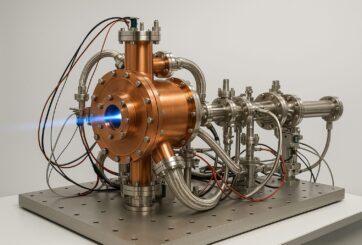
New add-on could enhance the research opportunities at X-ray lasers. The Photo Injector Test Facility at DESY in Zeuthen (PITZ) has reached a major milestone: a free-electron laser (FEL) driven by the photoinjector has generated its first laser light in the Terahertz (THz) wavelength regime. Pulses with a wavelength of about 0.1 millimetres were produced with a repetition rate of up to one Megahertz. The laser is the first high-power Terahertz FEL worldwide working according to the so-called SASE principle,…
AI-based federated diagnostic algorithm efficiently learns across hospitals with data protection compliance. An algorithm developed by researchers from Helmholtz Munich, the Technical University of Munich (TUM) and its University Hospital rechts der Isar, the University Hospital Bonn (UKB) and the University of Bonn is able to learn independently across different medical institutions. The key feature is that it is “self-learning”, i.e. it does not require extensive, time-consuming findings or markings by radiologists in the MRI images. This federated algorithm was…
New optics-on-a-chip device paves the way to helping characterize fast chemical, material, and biological processes. The Science Optical microelectromechanical systems (MEMS) are tiny microchip-size devices that control light and communications. Separately, time-resolved X-ray probes are devices that help scientists study highly transient phenomena. These phenomena are short-lived and involve fast structural and functional changes. Scientists have now developed X-ray optics based on specially designed and fabricated MEMS that can harness extremely short X-ray pulses. The new devices are much smaller…
An international team of researchers led by Charles Cadieux, a Ph.D. student at the Université de Montréal and member of the Institute for Research on Exoplanets (iREx), has announced the discovery of TOI-1452 b, an exoplanet orbiting one of two small stars in a binary system located in the Draco constellation about 100 light-years from Earth. The exoplanet is slightly greater in size and mass than Earth and is located at a distance from its star where its temperature would…
Astronomers frequently observe carbon monoxide in planetary nurseries. The compound is ultra-bright and extremely common in protoplanetary disks — regions of dust and gas where planets form around young stars — making it a prime target for scientists. But for the last decade or so, something hasn’t been adding up when it comes to carbon monoxide observations, says Diana Powell, a NASA Hubble Fellow at the Center for Astrophysics | Harvard & Smithsonian. A huge chunk of carbon monoxide is missing in all observations…
Lasers are everywhere. Devices that use them transmit information and enable the existence of long-distance communications and the internet; they aid doctors performing surgeries and engineers manufacturing advanced tools and technologies; and day-to-day, we encounter lasers as we scan our groceries and watch DVDs. “In the 60-some years since they were invented, lasers have absolutely transformed our lives,” said Giulio Cerullo, a nonlinear optics researcher at Politecnico di Milano in Italy. Today, with the help of new research from Cerullo…
… paves the way to cost-effective satellite-based quantum networks. Researchers demonstrate successful quantum key distribution between space lab and four ground stations. Researchers report an experimental demonstration of a space-to-ground quantum key distribution (QKD) network using a compact QKD terminal aboard the Chinese Space Lab Tiangong-2 and four ground stations. The new QKD system is less than half the weight of the system the researchers developed for the Micius satellite, which was used to perform the world’s first quantum-encrypted virtual…
Spiraling laser light reveals how topological insulators lose their ability to conduct electric current on their surfaces. Topological insulators, or TIs, have two faces: Electrons flow freely along their surface edges, like cars on a superhighway, but can’t flow through the interior of the material at all. It takes a special set of conditions to create this unique quantum state – part electrical conductor, part insulator – which researchers hope to someday exploit for things like spintronics, quantum computing and…
Research team led by Göttingen University observes formation of “dark” moiré interlayer excitons for the first time. An international research team led by the University of Göttingen has, for the first time, observed the build-up of a physical phenomenon that plays a role in the conversion of sunlight into electrical energy in 2D materials. The scientists succeeded in making quasiparticles – known as dark Moiré interlayer excitons – visible and explaining their formation using quantum mechanics. The researchers show how…
Groundbreaking observation from Gemini Observatory suggests this and possibly other colossal stars are less massive than previously thought. By harnessing the capabilities of the 8.1-meter Gemini South telescope in Chile, which is part of the International Gemini Observatory operated by NSF’s NOIRLab, astronomers have obtained the sharpest image ever of the star R136a1, the most massive known star in the Universe. Their research, led by NOIRLab astronomer Venu M. Kalari, challenges our understanding of the most massive stars and suggests…
Researchers from Göttingen (Germany) and Lausanne (Switzerland) have successfully created electron-photon pairs in a controlled way in an electron microscope for the first time. Using a new method, they could precisely detect the involved particles. The findings of the study expand the toolbox of quantum technology. Faster computers, tap-proof communication, better car sensors – quantum technologies have the potential to revolutionize our lives just as once the invention of computers or the internet. Experts worldwide are trying to implement findings…
… at a small fraction of the energy and size of today’s compute platforms. The NeuRRAM chip is the first compute-in-memory chip to demonstrate a wide range of AI applications at a fraction of the energy consumed by other platforms while maintaining equivalent accuracy. An international team of researchers has designed and built a chip that runs computations directly in memory and can run a wide variety of AI applications–all at a fraction of the energy consumed by computing platforms…
Impacts affect the porosity and structure of moons and planets more dramatically than scientists suspected, increasing their potential habitability for life. The harder you hit something – a ball, a walnut, a geode – the more likely it is to break open. Or, if not break open, at least lose a little bit of its structural integrity, the way baseball players pummel new gloves to make them softer and more flexible. Cracks, massive or tiny, form and bear a silent,…
A plasma-based method may one day convert carbon dioxide into oxygen and produce fuels, fertilizers on the red planet. An international team of researchers came up with a plasma-based way to produce and separate oxygen within the Martian environment. It’s a complementary approach to NASA’s Mars Oxygen In-Situ Resource Utilization Experiment, and it may deliver high rates of molecule production per kilogram of instrumentation sent to space. Such a system could play a critical role in the development of life-support…
Ready for its close-up: When scientists unveiled humanity’s historic first image of a black hole in 2019 — depicting a dark core encircled by a fiery aura of material falling toward it — they believed even richer imagery and insights were waiting to be teased out of the data. Simulations predict that, obscured by that bright orange glow, there should exist a thin, bright ring of light created by photons flung around the back of the black hole by its…
 Feedback


