
New study reveals how human astroviruses bind to humans cells and paves the way for new therapies and vaccines Human astroviruses are a leading viral cause of the stomach bug—think vomiting, diarrhea, and fever. It often impacts young children and older adults, leading to vicious cycles of sickness and malnutrition, particularly for those in low and middle income countries. It’s very commonly found in wastewater studies, meaning it’s frequently circulating in communities. As of now, there are no vaccines for…

Using bacteria of the Bartonella henselae species, researchers from Goethe University, Frankfurt University Hospital, the Paul Ehrlich Federal Institute for Vaccines and Biomedicines in Langen, and the University of Oslo demonstrated for the first time that antibodies can prevent certain surface proteins of bacterial pathogens from entering host cells. The findings are important for the development of new drugs against highly resistant infectious agents. Infections, especially those with highly resistant pathogens, pose a significant threat to human health. It is…
MHH research team has published current review on hepatocellular carcinoma (HCC) in The Lancet. Hepatocellular carcinoma (HCC) is one of the most common cancers worldwide. In Germany, there are currently around 9,000 new HCC diagnoses per year, and almost 8,000 people affected do not survive the disease. Before the tumour develops in the liver, the organ is often already damaged by chronic inflammation. The “traditional” causes of chronic liver damage include, in particular, infections with hepatitis viruses or excessive alcohol…
Better than opiates: Researchers at FAU use adrenaline receptors for highly-effective analgesics. New substances that activate adrenalin receptors instead of opioid receptors have a similar pain relieving effect to opiates, but without the negative aspects such as respiratory depression and addiction. This is the result of research carried out by an international team of researchers led by the Chair of Pharmaceutical Chemistry at Friedrich-Alexander-Universität Erlangen-Nürnberg (FAU). Their findings, which have now been published in the renowned scientific journal Science, are…
The Unc5-GPC3 complex: proteins and a glyidic envelope. During brain development, neurons have to migrate long distances through complex environments until they reach their final destination. In order to find guidance, they must establish several interactions —which are still hard to study— between their receptors and the surrounding molecules. Now, a paper published in the prestigious journal Cell has identified how two different proteins, the neuronal receptor Unc5 and the molecule Glipican 3 (GPC3), collaborate decisively in the guidance of…
… and treat them in groundbreaking study. Researchers at Penn State have successfully 3D bioprinted breast cancer tumors and treated them in a breakthrough study to better understand the disease that is one of the leading causes of mortality worldwide. A scientific first, the achievement lays the foundation for precision fabrication of tumor models. The advancement will enable future study and development of anti-cancer therapies without the use of “in vivo” — or “in animal” — experimentation. “This will help…
Many of the drugs we utilize in modern medicine are naturally produced by microbes. Penicillin, an antibiotic derived from certain molds, is one of the most notable natural products due to its recognition as one of the biggest advances in medicine and human health. As DNA sequencing has become cheaper and faster, scientists now have access to hundreds of thousands of microbial genomes and the natural products they produce. However, Doug Mitchell (MMG), the John and Margaret Witt Professor of…
This is the main conclusion of a new study involving ICM-CSIC that proves that these microorganisms contribute directly to the export and sequestration of carbon in the deep ocean. A new study recently published in The ISME journal in which the Institut de Ciències del Mar (ICM-CSIC) has participated has revealed that diazotrophs, a group of marine cyanobacteria that are able to convert nitrogen gas (N2) from the atmosphere into nutrients for primary producers in the ocean, contribute directly to…
Omnipose is trained to recognize bacteria of all shapes and sizes in mixed bacterial cultures. Omnipose, a deep learning software, is helping to solve the challenge of identifying varied and miniscule bacteria in microscopy images. It has gone beyond this initial goal to identify several other types of tiny objects in micrographs. The UW Medicine microbiology lab of Joseph Mougous and the University of Washington physics and bioengineering lab of Paul A. Wiggins tested the tool. It was developed by…
The technique could significantly accelerate drug discovery and precision medicine. The journey between identifying a potential therapeutic compound and Food and Drug Administration approval of a new drug can take well over a decade and cost upwards of a billion dollars. A research team at the CUNY Graduate Center has created an artificial intelligence model that could significantly improve the accuracy and reduce the time and cost of the drug development process. Described in a newly published paper in Nature…
Neurons that sense pain protect the gut from inflammation and associated tissue damage by regulating the microbial community living in the intestines, according to a study from researchers at Weill Cornell Medicine. The researchers, whose report appears Oct. 14 in Cell, found in a preclinical model that pain-sensing neurons in the gut secrete a molecule called substance P, which appears to protect against gut inflammation and related tissue damage by boosting the population of beneficial microbes in the gut. The…
Why are cancers of the adrenal glands1 more common among women? Why are prognoses worse for them? A team of scientists led by a CNRS researcher answers these questions in an article published on 14 October 2022 in Science Advances. They demonstrate that, in male mice, there is greater recruitment of immune cells known as macrophages, which can eliminate tumour cells. Hence, aggressive tumour progression is scarcely seen in male mice; while in female miles, macrophages do not slow the growth…
Changing the trafficking of the glucagon receptor in the liver regulates its metabolic signaling. Helmholtz Munich researchers identify a novel mechanism to modify glucagon receptor signaling outcomes by altering its intracellular localization. A group of researchers from the Helmholtz Munich Institute for Diabetes and Cancer (IDC) have unraveled a new strategy to alter glucagon receptor signaling in the liver by changing its intracellular trafficking. Glucagon is a peptide hormone, that is responsible for glucose balance and thus the regulation of…
Cancer cells use an unusual mechanism to migrate into new tissue and form metastases there. The same process probably also keeps some immune cells on their toes. This is the result of a recent study led by the University of Bonn. According to the study, certain structures, the centrioles, increase in number. This makes it easier for them to maintain their direction and thus migrate more quickly to the lymph nodes, where they activate other immune cells. The results have…
Photosystem I in plants shows a hitherto unknown face / Molecular examination with maximum precision. Researchers from Münster and Stockholm show for the first time that photosystem I in plants can also occur as dimers. They have examined this protein complex in a previously unseen degree of precision. Photosynthesis is the most important basis of life on Earth. In it, plants and single-cell algae use the energy of sunlight and convert this energy into sugar and biomass. In this process,…
Researchers discover a hidden order in seemingly random connections between neurons. In the brain, our perception arises from a complex interplay of neurons that are connected via synapses. But the number and strength of connections between certain types of neurons can vary. Researchers from the University Hospitals Bonn, Mainz and Munich, together with a research team from the Max Planck Institute for Brain Research in Frankfurt, as part of the DFG-funded Priority Program “Computational Connectomics” (SPP2041), have now discovered that…
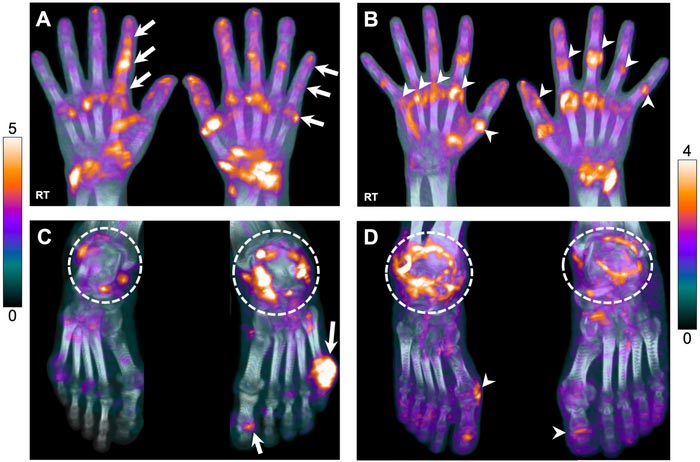
Total body PET/CT scans can successfully visualize systemic joint involvement in patients with autoimmune arthritis, according to new first-in-human research published in the October issue of The Journal of Nuclear Medicine. The total body PET/CT scans showed high agreement with standard joint-by-joint rheumatological evaluation and a moderate to strong correlation with rheumatological outcome measures. Autoimmune inflammatory arthritides (AIA)—such as psoriatic arthritis and rheumatoid arthritis—are chronic, systemic conditions that cause joint inflammation, joint destruction and pain. According to the Centers for Disease…
 Feedback


