
High-performance laser offers a new kind of light source for multiphoton microscopy, requiring only 10 mW of power to image tissue at depths of over 600 µm. Two-photon microscopy (2PM) plays a reliably efficient role in noninvasive deep-tissue imaging in biomedical investigation. Since the invention of the two-photon microscope at the end of the 20th century, there has been a steady flow of related research advancing 2PM—from fluorophores to imaging methods and applications—in the fields of biochemistry and medicine. How…
Biomedical engineers and medical researchers at UNSW Sydney have independently made discoveries about embryonic blood stem cell creation that could one day eliminate the need for blood stem cell donors. The achievements are part of a move in regenerative medicine towards the use of ‘induced pluripotent stem cells’ to treat disease, where stem cells are reverse engineered from adult tissue cells rather than using live human or animal embryos. But while we have known about induced pluripotent stem cells since…
New nanoparticle shape can greatly enhance signals from multiple separate biomarkers at once, accurately detecting head and neck cancers without biopsies to improve global health. Researchers at Duke University have developed a unique type of nanoparticle called a “nanorattle” that greatly enhances light emitted from within its outer shell. Loaded with light scattering dyes called Raman reporters commonly used to detect biomarkers of disease in organic samples, the approach can amplify and detect signals from separate types of nanoprobes without…
World’s tiniest plumbing could one day funnel drugs to individual human cells. Working on microscopic pipes only a millionth as wide as a single strand of human hair, Johns Hopkins University researchers have engineered a way to ensure that these tiniest of pipes are safe from the tiniest of leaks. Leak-free piping, made with nanotubes that self-assemble, self-repair, and can connect themselves to different biostructures, is a significant step toward creating a nanotube network that one day might deliver specialized…
Chip mimics inhalation and exhalation, allowing scientists to study flow patterns in the bronchial network. Alveoli are the basic functional units of the human respiratory system, acting as tiny air sacs that exchange gases. Air inhaled through the mouth and nose flows into the lungs through the branched structure of the bronchial tubes, and the alveoli appear in the deep sections of this network. To fully understand and treat respiratory diseases, it is important to determine the flow pattern of…
Ultrasound color Doppler twinkling may aid the detection of certain biopsy markers in metastatic axillary nodes that resume normal morphology after neoadjuvant systemic therapy. According to ARRS’ American Journal of Roentgenology (AJR), ultrasound color Doppler twinkling may aid the detection of certain biopsy markers in metastatic axillary nodes that resume normal morphology after neoadjuvant systemic therapy. Noting that certain breast biopsy markers exhibited actionable twinkling (i.e., sufficient confidence to rely solely on twinkling for target localization) in cadaveric breast, “twinkling…
A Greifswald research team from the Centre of Excellence ZIK plasmatis at the Leibniz Institute for Plasma Science and Technology e.V. (INP) was able to demonstrate for the first time in laboratory experiments the inactivation of corona viruses by physical plasma. The new method promises innovative therapies for the corona pandemic and other infectious diseases. Physical plasma, the so-called fourth state of matter, has been finding its way into medicine for several years. Clinical successes are increasingly being recorded, particularly…
Less risk, less costs: New method for the detection of alcohols combines zero- to ultralow-field nuclear magnetic resonance with the SABRE-Relay hyperpolarization technique. Nuclear magnetic resonance (NMR) is an analytical tool with a wide range of applications, including the magnetic resonance imaging that is used for diagnostic purposes in medicine. However, NMR often requires powerful magnetic fields to be generated, which limits the scope of its use. Researchers working at Johannes Gutenberg University Mainz (JGU) and the Helmholtz Institute Mainz…
Researchers from Osaka University and collaborating partners have used single-molecule electron-transfer kinetics to identify point mutations in mRNA. This development might facilitate treatment of glioma and other diseases. Standard medical imaging readily detects most solid brain cancers, one third of which are gliomas. Unfortunately, two complex surgeries are often necessary. But now, researchers from Japan may have devised a way to perform the initial biopsy, lab tests, and subsequent tumor removal during one surgical procedure. During the first operation for…
Expected to improve results for meniscal reconstruction surgery. The knee meniscus is an important tissue that protects the joint; if the meniscus is damaged—by sports injury or aging–it often does not heal on its own. There are two surgical methods for treating a torn meniscus: repair with a suture and graft or removal. Because removing the meniscus leads to further damage, the graft surgery is preferred for meniscus reconstruction. In countries where donated meniscal allograft is unavailable the patient’s own…
Biologically inspired camera achieves diverse functional dental imaging with high dynamic range, 3D depth, and autofluorescence. Conventional dental photography technology has had a limitation in using inconvenient tools such as mirrors and cheek retractors. Dentists require basic teeth images from various angles, such as right/left buccal and maxillary/mandibular occlusal, for dental health inspection. To acquire these images, patients feel discomfort because dentists must put a mirror into the mouth to capture the reflected teeth image through a handheld camera. Information…
A great success for robotic microsurgery not only in Münster but worldwide. A team led by Dr. Maximilian Kückelhaus and Prof. Tobias Hirsch from the Centre for Musculoskeletal Medicine at the University of Münster has carried out the first completely robot-supported microsurgical operations on humans. It is a great success for robotic microsurgery not only in Münster but worldwide – both for medicine and for science: a team led by scientists Dr. Maximilian Kückelhaus and Prof. Tobias Hirsch from the…
The device senses and wirelessly transmits signals related to pulse, sweat, and ultraviolet exposure, without bulky chips or batteries. Wearable sensors are ubiquitous thanks to wireless technology that enables a person’s glucose concentrations, blood pressure, heart rate, and activity levels to be transmitted seamlessly from sensor to smartphone for further analysis. Most wireless sensors today communicate via embedded Bluetooth chips that are themselves powered by small batteries. But these conventional chips and power sources will likely be too bulky for…
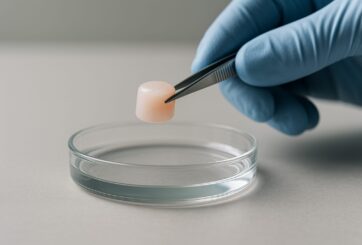
Lab-made cartilage gel outperforms the real thing. Human clinical trials may begin as soon as next year. Over-the-counter pain relievers, physical therapy, steroid injections — some people have tried it all and are still dealing with knee pain. Often knee pain comes from the progressive wear and tear of cartilage known as osteoarthritis, which affects nearly one in six adults — 867 million people — worldwide. For those who want to avoid replacing the entire knee joint, there may soon…
The stickiness of medical adhesives can be controlled by ultrasound, researchers find. Researchers have discovered that they can control the stickiness of adhesive bandages using ultrasound waves and bubbles. This breakthrough could lead to new advances in medical adhesives, especially in cases where adhesives are difficult to apply such as on wet skin. “Bandages, glues, and stickers are common bioadhesives that are used at home or in clinics. However, they don’t usually adhere well on wet skin. It’s also challenging…
New technique could relieve pain for individuals with various chronic and neurological conditions. A University of Minnesota Twin Cities-led team has found that electrical stimulation of the body combined with sound activates the brain’s somatosensory or “tactile” cortex, increasing the potential for using the technique to treat chronic pain and other sensory disorders. The researchers tested the non-invasive technique on animals and are planning clinical trials on humans in the near future. The paper is published in the Journal of…
 Feedback


