
The high level of reactive oxygen species (ROS) in the rheumatoid arthritis (RA) microenvironment and its persistent inflammatory nature can promote damage to joints, bones, and the synovium. Strategies that integrate effective RA microenvironment regulation with imaging-based monitoring could lead to improvements in the diagnosis and treatment of RA. A joint research team from the Shenzhen Institute of Advanced Technology of the Chinese Academy of Sciences and the University of Texas at Austin has proposed a new strategy that can…
Scientists at Swansea University developing a platform that would use Artificial Intelligence to speed up the process of detecting biomarkers in biofluids have shown that the concept could work. It would mean faster test results for health conditions such as cardiovascular disorders, joint quality, and Alzheimer’s. This new diagnostic tool could revolutionise the healthcare sector due to the application of a form of artificial intelligence (AI) – machine learning (ML). The implementation of ML has meant it is possible, for the first time, for results to…
A new highly selective PET imaging agent can detect the presence of overexpressed monoamine oxidase-B (MAO-B) in cognitively unimpaired individuals with high beta amyloid (Aβ)—one of the earliest signs of Alzheimer’s disease—according to research published in the October issue of The Journal of Nuclear Medicine. The radiotracer, 18F-SMBT-1, allows for a better understanding of the role of inflammation in Alzheimer’s disease, which can enable more accurate staging and prognosis at earlier stages. Brain inflammation that accompanies Alzheimer’s disease involves reactive astrocytes, which…
Omnipose is trained to recognize bacteria of all shapes and sizes in mixed bacterial cultures. Omnipose, a deep learning software, is helping to solve the challenge of identifying varied and miniscule bacteria in microscopy images. It has gone beyond this initial goal to identify several other types of tiny objects in micrographs. The UW Medicine microbiology lab of Joseph Mougous and the University of Washington physics and bioengineering lab of Paul A. Wiggins tested the tool. It was developed by…
The technique could significantly accelerate drug discovery and precision medicine. The journey between identifying a potential therapeutic compound and Food and Drug Administration approval of a new drug can take well over a decade and cost upwards of a billion dollars. A research team at the CUNY Graduate Center has created an artificial intelligence model that could significantly improve the accuracy and reduce the time and cost of the drug development process. Described in a newly published paper in Nature…
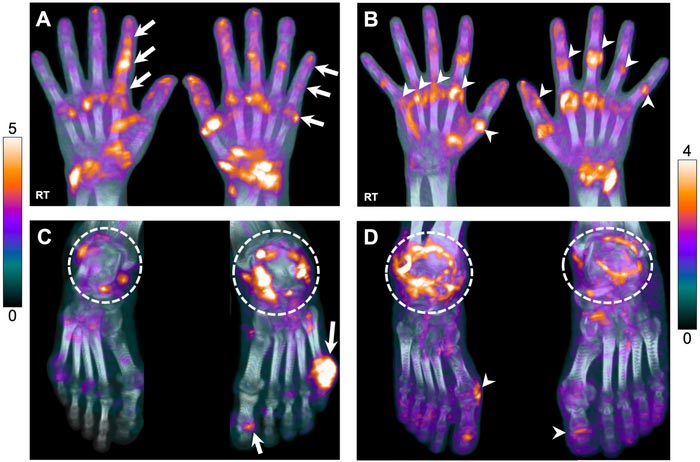
Total body PET/CT scans can successfully visualize systemic joint involvement in patients with autoimmune arthritis, according to new first-in-human research published in the October issue of The Journal of Nuclear Medicine. The total body PET/CT scans showed high agreement with standard joint-by-joint rheumatological evaluation and a moderate to strong correlation with rheumatological outcome measures. Autoimmune inflammatory arthritides (AIA)—such as psoriatic arthritis and rheumatoid arthritis—are chronic, systemic conditions that cause joint inflammation, joint destruction and pain. According to the Centers for Disease…
Nahtlos, an Empa spin-off, has received 1 million Swiss francs in a first round of financing from a network of business angels from Switzerland and Liechtenstein and from the Startfeld Foundation. With this funding, Nahtlos aims to drive the market entry of its newly developed textile-based electrode for medical applications. Over the past two years, Nahtlos, an Empa spin-off, has developed novel textile-based electrodes for recording heart activity (electrocardiogram, ECG) – for example, to detect atrial fibrillation – and for…
Cooperation between radiotherapy and cardiology: MHH experts achieve success with innovative treatment method. Radiotherapy – most people think of it as the treatment of cancer. At the Hannover Medical School (MHH), radiation is now being used to help patients with cardiac arrhythmias. High-precision radiation from linear accelerators is used to treat the exact spot in the heart muscle that is responsible for the arrhythmia. The procedure is relatively new and is only carried out in a few clinics in Germany….
An efficient contrast agent method for MRI imaging developed by Max Planck researcher Stefan Gloeggler raises hopes of being able to distinguish tumors from healthy tissue on the basis of their metabolic activity. The ForTra gGmbH für Forschungstransfer of the Else Kroener-Fresenius Foundation (ForTra) and the European Research Council (ERC) are now providing funding to further develop the method for clinical patient studies. Cancer cells consume vast amounts of energy: They grow and divide much faster and more frequently than…
Collaborators have pioneered the CMU Array, a new type of microelectrode array for brain computer interface platforms. Carnegie Mellon University researchers have pioneered the CMU Array—a new type of microelectrode array for brain computer interface platforms. It holds the potential to transform how doctors are able to treat neurological disorders. 3D printed at the nanoscale, the ultra-high-density microelectrode array (MEA) is fully customizable. This means that one day, patients suffering from epilepsy or limb function loss due to stroke could…
Assessing nanoparticles with medical engineering. What happens when we breathe in nanoparticles emitted by a laser printer, for example? Could these nanoparticles damage the respiratory tract or perhaps even other organs? To answer these questions, Fraunhofer researchers are developing the “NanoCube” exposure device. The Nanocube’s integrated multi-organ chip set up in the laboratory of the Technical University of Berlin (TU Berlin) and by its spin-off organization “TissUse” detects interaction between nanoparticles and lung cells, the uptake of nanoparticles into the…
A capsule that tunnels through mucus in the GI tract could be used to orally administer large protein drugs such as insulin. One reason that it’s so difficult to deliver large protein drugs orally is that these drugs can’t pass through the mucus barrier that lines the digestive tract. This means that insulin and most other “biologic drugs” — drugs consisting of proteins or nucleic acids — have to be injected or administered in a hospital. A new drug capsule…
Researchers and entrepreneurs from Jena are winning hearts – literally. Together with the start-up NovaPump from Jena and the Jena University Hospital, the Fraunhofer Institute for Applied Optics and Precision Engineering IOF has developed innovative heart valves and pumps. On the occasion of World Heart Day on September 29, we look back on the history of a long-standing and cordial cooperation. The human heart performs extraordinary feats day after day. It supplies tissues and organs with the necessary amount of…
… protects healthy tissue. Novel therapy option shown to extend the lifespan and improve quality of life for certain patients. UC San Diego Health is the first hospital system in San Diego to offer a new, highly targeted and precisely placed radiation therapy that delays tumor regrowth while protecting healthy tissue in patients with brain cancer. “As the only academic medical center in the region, UC San Diego Health is committed to offering patients with brain cancer the most innovative…
First, pause and take a deep breath. When we breathe in, our lungs fill with oxygen, which is distributed to our red blood cells for transportation throughout our bodies. Our bodies need a lot of oxygen to function, and healthy people have at least 95% oxygen saturation all the time. Conditions like asthma or COVID-19 make it harder for bodies to absorb oxygen from the lungs. This leads to oxygen saturation percentages that drop to 90% or below, an indication…
When two drugs were delivered in one nanoparticle rather than separately, the treatment worked better in mice. Over the past 30 years, progress in early detection and treatment of cancer has helped reduce the overall death rate by more than 30%. Pancreatic cancer, however, has remained difficult to treat. Only 1 in 9 people survive five years after diagnosis, in part because this cancer is protected by biological factors that help it resist treatment. In hopes of turning the tide,…
 Feedback


