



Feeding 9 Billion: Innovations in Agricultural Modeling
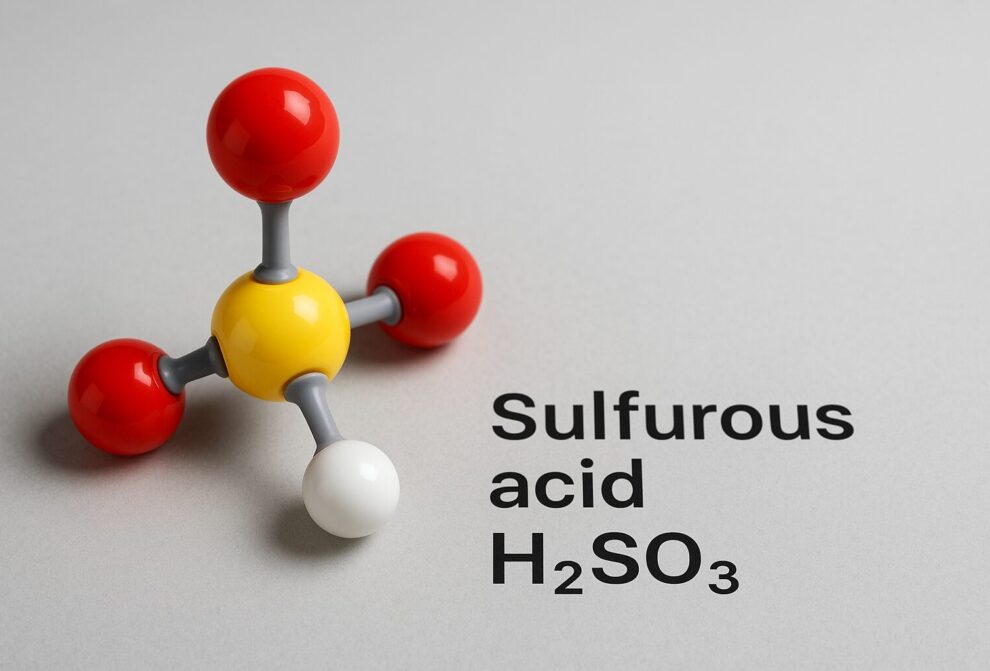
AI Generated Image
Once again, the atmosphere amazes us with its diverse chemical processes. For the first time, researchers at the Leibniz Institute for Tropospheric Research (TROPOS) in Leipzig have demonstrated the existence of sulfurous acid (H2SO3) under atmospheric conditions in the gas phase. The results were published in the journal Angewandte Chemie.
A combination of natural and anthropogenic sources impacts the chemistry of the atmosphere. However, the principal natural source of the atmospheric sulfur is biogenic activity. Humans contribute to the total sulfur emission through the combustion of coal and petroleum (ca 90%).
In contrast to the well-known sulfuric acid (H2SO4), sulfurous acid (H2SO3) is considered as compound that is difficult or impossible to access (produce). Textbooks suggest the possible formation of H2SO3 in aqueous sulfur dioxide (SO2) solution, although its existence in isolated form is considered impossible. However, despite great efforts using various spectroscopic methods, the experimental detection of H2SO3 in aqueous SO2 solution has so far been unsuccessful. Only the corresponding bases bisulphite HSO3- and sulphite SO32- were detectable.
The only experimental detection of H2SO3 to date was achieved by Helmut Schwarz’s team at TU Berlin in 1988 using in-situ generation in a mass spectrometer. An extremely short lifetime under vacuum conditions in the range of 10 microseconds and more was estimated.
Theoretical calculations suggested the formation of H2SO3 as a possible reaction product of the gas-phase reaction of OH radicals, which are formed in the troposphere primarily from ozone and water molecules in the presence of UV radiation, with dimethyl sulfide (DMS). DMS is mainly produced by biological processes in the sea and is the largest biogenic sulfur source for the atmosphere, producing around 30 million tonnes annually.
The possible reaction pathway to H2SO3 starting from the DMS was investigated experimentally in the laboratory at TROPOS in Leipzig. The formation of H2SO3 in the gas phase was clearly demonstrated in flow reactors for atmospheric conditions. Under the experimental conditions, the sulfurous acid remained stable for half a minute regardless of the humidity. Longer residence times could not yet be investigated with the existing experimental setup. Therefore, H2SO3 could also exist sufficiently long enough in the atmosphere and have an influence on the chemical processes. The observed yield was even somewhat greater than theoretically assumed. “It was very impressive to see the clear H2SO3 signals in the spectrometer for a compound that had been assumed to be possibly “non-existent”,” says Dr Torsten Berndt from TROPOS, who came up with the idea and carried out the experiments.
The new reaction pathway was then implemented in a global chemistry-climate model. The associated model simulations showed that around 8 million tons of H2SO3 are formed globally every year. “This pathway produces about 200 times more mass of H2SO3 than the direct formation of sulfuric acid (H2SO4) from dimethyl sulfide in the atmosphere. The new results can contribute to a better understanding of the atmospheric sulfur cycle,” add the scientists responsible for global modelling, Dr Andreas Tilgner and Dr Erik Hoffmann.
As with many research findings, many new interesting questions arise here too: Once formed in the gas phase, sulfurous acid appears to have at least a certain stability. However, the lifetime with regard to the reaction with trace gases in the atmosphere is still completely unclear. The reaction with water vapour has also not yet been satisfactorily clarified. “Much more research is needed in further optimised experiments in order to sufficiently clarify the significance of H2SO3,” adds Dr Torsten Berndt.
The detection of H2SO3 is another example of the discovery of new reaction pathways and the experimental proof of compounds that were previously only theoretically proposed or difficult to access. This is made possible by the interplay of optimised reaction control combined with highly sensitive detection methods. For example, a mass spectrometer with a detection limit of 104 molecules of a product per cubic centimetre at atmospheric pressure was used in this study, i.e. it is possible to detect a specific molecule in a mixture of 1015 molecules (1 quadrillion molecules). Ever-improving methods will allow an even deeper insight into reaction processes and thus contribute to an even better understanding of atmospheric chemistry and all other areas of chemistry.
Further information and links:
DFG project: Towards a better DMS oxidation mechanism (ADOniS)
https://gepris.dfg.de/gepris/projekt/495046770?context=projekt&task=showDeta…;
Direct path of sulphuric acid formation in the atmosphere without SO2 (press release, 30/08/2023)
https://www.tropos.de/aktuelles/pressemitteilungen/details/direkter-weg-der-schw…
New findings on the largest natural source of sulphur in the atmosphere (press release, 18/11/2019)
https://www.tropos.de/aktuelles/pressemitteilungen/details/neue-erkenntnisse-zur…
Free jet flow system
https://www.tropos.de/forschung/grossprojekte-infrastruktur-technologie/technolo…
Wissenschaftliche Ansprechpartner:
Dr Torsten Berndt/ Dr Erik H. Hoffmann/ Dr Andreas Tilgner
Research Associate, Atmospheric Chemistry Department (ACD), Leibniz Institute for Tropospheric Research (TROPOS), Leipzig
Phone +49-341-2717-7032, -7389, -7178
https://www.tropos.de/institut/ueber-uns/mitarbeitende
and
Prof Dr Hartmut Herrmann
Head, Atmospheric Chemistry Department (ACD), Leibniz Institute for Tropospheric Research (TROPOS), Leipzig
Phone +49-341-2717-7024
https://www.tropos.de/institut/ueber-uns/mitarbeitende/hartmut-herrmann
or
Tilo Arnhold, TROPOS Public Relations
Phone +49 341 2717-7189
http://www.tropos.de/aktuelles/pressemitteilungen/
Originalpublikation:
T. Berndt, E. H. Hoffmann, A. Tilgner, H. Herrmann (2024): Gasphasenbildung von Schwefliger Säure (H2SO3) in der Atmosphäre / Gas-Phase Formation of Sulfurous Acid (H2SO3) in the Atmosphere. Angew. Chem. Int. ed. 2024, 63, e202405572. https://doi.org/10.1002/anie.202405572
(Online: 14 July 2024)
DE = https://onlinelibrary.wiley.com/doi/epdf/10.1002/ange.202405572
EN = https://onlinelibrary.wiley.com/doi/epdf/10.1002/anie.202405572
The research was funded by the German Research Foundation (DFG) as part of the ADOniS project (HE 3086/53-1) and supported with resources from the German Climate Computing Centre (DKRZ; project no. bb1128). Publication as an open access publication was made possible and realised by the DEAL project
More Information:
https://www.tropos.de/en/current-issues/press-releases/details/schweflige-saeure…
When exposed to high concentrations of sulfur, trees and plants are affected through foliage damage and stunted growth. SO2 and other sulfur oxides can react with other compounds in the atmosphere, causing fine particle formation that reduces visibility. Additionally, sulfur possesses chemical properties that can damage or blemish stone and other materials.
Sulfur is considered one of the vital nutrients for plant growth. It is needed for basic functions such as lifecycle completion, which directly shapes the overall plant yields. Sulphur is present in the soil in three forms: organic, sulfur minerals, and sulfate. Unfortunately, over the years, the amount of sulfur in the soil has decreased by 34–86 % between the years 2000 and 2020.
Although sulfur, as a macroelement, is indispensable for the environment, excessive amounts can prove to be unfavorable. Fossil fuel combustion and acid rain can lead to soil degradation and the death of forest ecosystems. Moreover, the identification of H₂SO₃ in the atmosphere underscores the need for rigorous research. Understanding the role of natural processes and human activities in the formation of sulfur can help mitigate adverse environmental repercussions.
An interdisciplinary approach is of the utmost necessity to unravel the intricacies of sulfur composition in the atmosphere. Environmental challenges such as acid rain can cause havoc to plants and humans alike. Hence, a continuous, comprehensive study is needed to understand how natural processes and human influence sulfur formation and environmental impacts.
Powered by  the revolutionary project management tool




The appearance of a hot sauce or pepper doesn’t reveal whether it’s mild or likely to scorch someone’s taste buds. So, researchers made an artificial tongue to quickly detect spiciness. Inspired by milk’s casein proteins, which bind to capsaicin and relieve the burn of spicy foods, the researchers incorporated milk powder into a gel sensor. The prototype, reported in ACS Sensors, detected capsaicin and pungent-flavored compounds (like those behind garlic’s zing) in various foods. “Our flexible artificial tongue holds tremendous…
Unless you’ve owned reptiles, you might not know that many of them “pee” crystals. Researchers publishing in the Journal of the American Chemical Society investigated the solid urine of more than 20 reptile species and found spheres of uric acid in all of them. This work reveals how reptiles uniquely package up and eliminate crystalline waste, which could inform future treatments for human conditions that also involve uric acid crystals: kidney stones and gout. Most living things have some sort…
Enabled by a new high-resolution mapping technique, the findings overturn a long-held belief that the genome loses its 3D structure when cells divide CAMBRIDGE, MA — Before cells can divide, they first need to replicate all of their chromosomes, so that each of the daughter cells can receive a full set of genetic material. Until now, scientists had believed that as division occurs, the genome loses the distinctive 3D internal structure that it typically forms. Once division is complete, it…
Researchers at Chalmers University of Technology in Sweden and the US space agency NASA have made an unexpected discovery that challenges one of the basic rules of chemistry and provides new knowledge about Saturn’s enigmatic moon Titan. In its extremely cold environment, normally incompatible substances can still be mixed. This discovery broadens our understanding of chemistry before the emergence of life. Scientists have long been interested in Saturn’s largest, orange-coloured moon as its evolution can teach us more about our…
 Feedback
