
Computational materials science experts at the U.S. Department of Energy’s Ames Laboratory enhanced an algorithm that borrows its approach from the nesting habits of cuckoo birds, reducing the search time for new high-tech alloys from weeks to mere seconds. The scientists are investigating a type of alloys called high-entropy alloys, a novel class of materials that are highly sought after for a host of unusual and potentially beneficial properties. They are lightweight in relation to their strength, fracture-resistant, highly corrosion…
Scientists show ultrasonication is a cost-effective approach to enhance the properties of magnesium diboride superconductors. Superconductivity already has a variety of practical applications, such as medical imaging and levitating transportation like the ever-popular maglev systems. However, to ensure that the benefits of applied superconductors keep spreading further into other technological fields, we need to find ways of not only improving their performance, but also making them more accessible and simpler to fabricate. In this regard, magnesium diboride (MgB2) has attracted…
TU-scientists develop new material for tomorrow’s technology Smartphones with large glass housings and displays are impressive, but they are also very prone to get cracked and scratched. To prevent these kinds of damages, a material combining the hardness of diamond and the deformability of metals would be ideal – and is indeed considered the holy grail of structural materials. Professor Gerold Schneider of the Hamburg University of Technology and other Hamburg materials researchers, together with colleagues in Berkeley, California, have…
Development of flexible thermoelectric devices with maximized flexibility and high efficiency; enabling mass production with high yield by automated process, commercialization of self-powered wearable devices. A thermoelectric device is an energy conversion device that utilizes the voltage generated by the temperature difference between both ends of a material; it is capable of converting heat energy, such as waste heat from industrial sites, into electricity that can be used in daily life. Existing thermoelectric devices are rigid because they are composed…
A team led by University of Minnesota Twin Cities researchers has discovered a groundbreaking one-step process for creating materials with unique properties, called metamaterials. Their results show the realistic possibility of designing similar self-assembled structures with the potential of creating “built-to-order” nanostructures for wide application in electronics and optical devices. The research was published and featured on the cover of Nano Letters, a peer-reviewed scientific journal published by the American Chemical Society. In general, metamaterials are materials made in the…
In a surprising discovery, Princeton physicists have observed an unexpected quantum behavior in an insulator made from a material called tungsten ditelluride. This phenomenon, known as quantum oscillation, is typically observed in metals rather than insulators, and its discovery offers new insights into our understanding of the quantum world. The findings also hint at the existence of an entirely new type of quantum particle. The discovery challenges a long-held distinction between metals and insulators, because in the established quantum theory…
Concept of high entropy alloys provides a discovery platform for new superconductors. Researchers from Tokyo Metropolitan University mixed and designed a new, high entropy alloy (HEA) superconductor, using extensive data on simple superconducting substances with a specific crystal structure. HEAs are known to preserve superconducting characteristics up to extremely high pressures. The new superconductor, Co0.2Ni0.1Cu0.1Rh0.3Ir0.3Zr2, has a superconducting transition at 8K, a relatively high temperature for an HEA. The team’s approach may be applied to discovering new superconducting materials with…
A materials scientist at Friedrich Schiller University Jena, Germany has been awarded a prestigious “ERC Proof of Concept Grant” from the European Research Council to further develop and refine a process that enables thermal toughening of very thin glass. For decades, the process of thermal tempering has played a major role in increasing the strength of glass and thus guaranteeing greater durability. With this technique, conventional glass sheets are strengthened in a simple and highly efficient way. This has made…
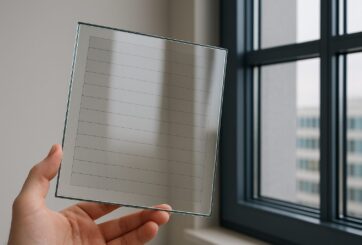
How tomorrow’s windows will generate electricity A new study led by scientists from Incheon National University in Korea shows how to make a fully transparent solar cell. Five years after the Paris climate agreement, all eyes are on the world’s progress on the road to a carbon-free future. A crucial part of this goal involves the energy transition from fossil fuels to renewable sources, such as sun, water, wind and wave energy. Among those, solar energy has always held the…
High-performance fibres that have been exposed to high temperatures usually lose their mechanical properties undetected and, in the worst case, can tear precisely when lives depend on them. For example, safety ropes used by fire brigades or suspension ropes for heavy loads on construction sites. Empa researchers have now developed a coating that changes color when exposed to high temperatures through friction or fire. The firefighter runs into the burning building and systematically searches room by room for people in…
Diamond is the hardest material in nature. But out of many expectations, it also has great potential as an excellent electronic material. A joint research team led by City University of Hong Kong (CityU) has demonstrated for the first time the large, uniform tensile elastic straining of microfabricated diamond arrays through the nanomechanical approach. Their findings have shown the potential of strained diamonds as prime candidates for advanced functional devices in microelectronics, photonics, and quantum information technologies. The research was…
Nature has figured out how to make great membranes. Biological membranes let the right stuff into cells while keeping the wrong stuff out. And, as researchers noted in a paper just published by the journal Science, they are remarkable and ideal for their job. But they’re not necessarily ideal for high-volume, industrial jobs such as pushing saltwater through a membrane to remove salt and make fresh water for drinking, irrigating crops, watering livestock or creating energy. Can we learn from…
Electrons inhabit a strange and topsy-turvy world. These infinitesimally small particles have never ceased to amaze and mystify despite the more than a century that scientists have studied them. Now, in an even more amazing twist, physicists have discovered that, under certain conditions, interacting electrons can create what are called “topological quantum states.” This finding, which was recently published in the journal Nature, has implications for many technological fields of study, especially information technology. Topological states of matter are particularly…
Rice lab finds van der Waals force can deform nanoscale silver for optics, catalytic use. You have to look closely, but the hills are alive with the force of van der Walls. Rice University scientists found that nature’s ubiquitous “weak” force is sufficient to indent rigid nanosheets, extending their potential for use in nanoscale optics or catalytic systems. Changing the shape of nanoscale particles changes their electromagnetic properties, said Matt Jones, the Norman and Gene Hackerman Assistant Professor of Chemistry…
Study: Nanotube films come in 466 colours, could be used in electronics, solar panels. Nanomaterials researchers in Finland, the United States and China have created a colour atlas for 466 unique varieties of single-walled carbon nanotubes. The nanotube colour atlas is detailed in a study in Advanced Materials about a new method to predict the specific colors of thin films made by combining any of the 466 varieties. The research was conducted by researchers from Aalto University in Finland, Rice…
In a step toward making more accurate and uniform 3D-printed parts such as personalized prosthetics and dental materials, researchers at the National Institute of Standards and Technology (NIST) have demonstrated a method of measuring the rate at which microscopic regions of a liquid raw material harden into a solid plastic when exposed to light. NIST’s custom atomic force microscope (AFM) with a nanometer-scale, cylinder-shaped tip revealed that the complex process of curing resins, as they react under light to form…
 Feedback


