
Middleweight matchup to provide control data in exploration of new form of matter
Scientists searching for evidence that a particle accelerator at the U.S. Department of Energy’s Brookhaven National Laboratory has created a new form of matter not seen since the Big Bang and eager to study its properties have begun using a new experimental probe, collisions between two beams of copper ions. The use of intermediate size nuclei is expected to result in intermediate energy density
How do you remember your own name? Is it possible ever to forget it? The memory trace, or engram, “feels” like it is stored permanently in the brain and it will never be forgotten.
Indeed, the current view of memory is that, at the molecular level, new proteins are manufactured, in a process known as translation, and it is these newly synthesized proteins that subsequently stabilize the changes underlying the memory. Thus, every new memory results in a permanent representation in
Engineering researchers at the University of California, San Diego are using the shell of a seaweed-eating snail as a guide in the development of a new generation of bullet-stopping armor. The colorful oval shell of the red abalone is highly prized as a source of nacre, or mother-of-pearl, jewelry, but the UCSD researchers are most impressed by the shell’s ability to absorb heavy blows without breaking.
In a paper published in the Jan. 15 issue of Materials Science and Engin
14 January 2005, after its seven-year journey through the Solar System on board the Cassini spacecraft, ESA’s Huygens probe has successfully descended through the atmosphere of Titan, Saturn’s largest moon, and safely landed on its surface.
The first scientific data arrived at the European Space Operations Centre (ESOC) in Darmstadt, Germany, this afternoon at 17:19 CET. Huygens is mankind’s first successful attempt to land a probe on another world in the outer Solar System. “This
Imagine an entire chemistry laboratory reduced to the size of a postage stamp. It could happen.
While others may think big, Texas A&M University physicists Don Naugle and co-worker Igor Lyuksyutov are thinking small – as in micro small. They have successfully managed to levitate micron-sized fluids using magnets, which could lead to new advances in medicine, chemistry, chemical engineering and other related fields. By using small magnets on a postage-stamp sized chip, Naugle an
An article appearing in the January 2005 issue of Brain, Behavior and Immunity suggests that developing depression while on interferon-alpha plus ribavirin may impact how well the medications work.
In a study conducted in the Department of Psychiatry and Behavioral Sciences at Emory University School of Medicine, Charles L. Raison, MD, Andrew Miller, MD, and colleagues, observed that patients who develop depressive symptoms during interferon-alpha plus ribavirin therapy were signi
New results may lead to advances in nanotechnology, molecular electronics
Scientists from the U.S. Department of Energy’s Brookhaven National Laboratory, Bar-Ilan University, and Harvard University have grown ultrathin films of organic chain molecules on the surface of liquid mercury and discovered that the molecules form ordered structures. Similar to sixty years ago when fundamental studies of silicon paved the way to the semiconductor-electronics age, these results help to build
Researchers at New York University have developed a model of the intra-cellular mammalian biological clock that reveals how rapid interaction of molecules with DNA is necessary for producing reliable 24-hour rhythms. They also found that without the inherent randomness of molecular interactions within a cell, biological rhythms may dampen over time. These findings appeared in the most recent issue of the Proceedings of the National Academy of Sciences (PNAS).
Daniel Forger, a
Risks of underground expansion often poorly studied; modeling floods, tsunamis essential to planning
The rapid and extensive underground expansion of mega-cities – for subways, malls, parking and public utilities – takes place often with too little knowledge of associated risks and too few plans to minimize the effects of a natural disaster, United Nations University experts warn.
With growing land pressures in cities (which contain about 50% of all people today, see
Surgeons are using a revolutionary implant to help rebuild the faces of children injured in accidents or born with serious defects.
Scientists from The University of Nottingham have teamed up with Russian researchers to create the honeycomb-like polymer which readily bonds with bone without causing adverse reactions.It is currently undergoing clinical trials in Moscow where it has been used on around fifty children aged from eighteen months to 18 years. Among the patients who have
Mutations in mitochondrial DNA (mtDNA) play an important role in the development of prostate cancer, according to research by scientists at Emory University School of Medicine and the University of California, Irvine. The findings are published online this week in the Proceedings of the National Academy of Sciences (PNAS). Mitochondrial DNA, which is separate from nuclear DNA, is found in the hundreds of mitochondria located in the cytoplasm outside of each cell’s nucleus. The mitochondria o
More than 250 new examples of England’s finest array of prehistoric rock art carvings, sited close to the Scottish border, have been discovered by archaeologists compiling a unique database.
Now over one thousand of the ’cup and ring’ carvings can be admired on a new website, which carries 6,000 images and is said to be the most comprehensive of its kind in the world. The site, which goes live today, includes the 250 panels unearthed during a two-and-a-half year t
A new study says some iron nanoparticles may be effective in cleaning up carbon tetrachloride in contaminated groundwater
Researchers at Oregon Health & Science University’s OGI School of Science & Engineering, in collaboration with Pacific Northwest National Laboratory (PNL) and the University of Minnesota, have discovered that at least one type of nano-sized iron may be useful in cleaning up carbon tetrachloride contamination in groundwater. The new discovery was published
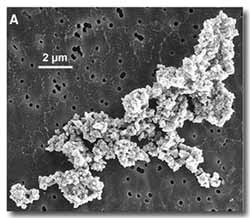
Carbon and silicate grains in interplanetary dust particles are helping scientists solve a 40-year-old astronomical mystery.
Using a transmission electron microscope, researchers from Lawrence Livermore National Laboratory have detected a 5.7-electron volt or 2175 Å (angstrom) wavelength feature in interstellar grains that were embedded within interplanetary dust particles (IDPs). They found that this feature is carried by carbon and amorphous silicate grains that are abundant in
The second Duke University-led expedition since 1999 to a deep underwater canyon will take geologists to another place in the eastern Pacific Ocean where new sea floor was forged out of volcanic lava within the past several million years.
The Pito Deep trough, positioned as deep as 19,600 feet below the ocean’s surface just west of Easter Island, will offer scientists a rare chance to study the internal geology of such ocean floor crust making processes.
The internal g
USC/Norris Comprehensive Cancer Center oncologists are testing the effectiveness of a new drug against pancreatic cancer that targets the cancer from two directions.
In their National Cancer Institute-sponsored phase II clinical trial, researchers are evaluating how well BAY 43-9006 works alone and paired with gemcitabine, today’s standard chemotherapy for pancreatic cancer. Heinz-Josef Lenz, M.D., associate professor of medicine at the Keck School of Medicine of USC, is p
 Feedback


