
New study finds that the nutritional value of prey within a single species can widely vary, offering key insights for food web dynamics and ecosystem change The hunt is on and a predator finally zeroes in on its prey. The animal consumes the nutritious meal and moves on to forage for its next target. But how much prey does a predator need to consume? Following a period of massive starvation among animals living along the California coast, University of California…
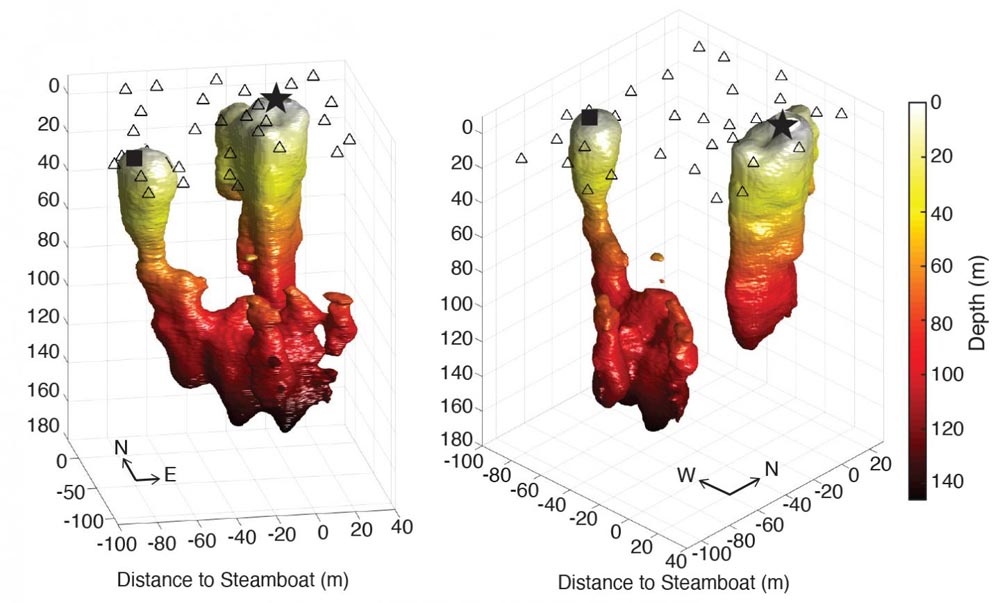
When Steamboat Geyser, the world’s tallest, started erupting again in 2018 in Yellowstone National Park after decades of relative silence, it raised a few tantalizing scientific questions. Why is it so tall? Why is it erupting again now? And what can we learn about it before it goes quiet again? The University of Utah has been studying the geology and seismology of Yellowstone and its unique features for decades, so U scientists were ready to jump at the opportunity to…

High-resolution model reveals new insights With the help of highly resolved realistic model simulations physicists at the Leibniz Institute for Baltic Sea Research (IOW) have succeeded in depicting the so-called submesoscale dynamics in the Eastern Gotland Basin – deepest of the large basins of the central Baltic Sea. Thus, the researchers gained the opportunity to investigate these highly dynamic phenomena, which – although being known for decades through satellite images – are up to now only scarcely studied and poorly…
Colorado State University researchers provide the most detailed accounting to date of the industry’s greenhouse gas emissions. It’s no secret that the United States’ $13 billion cannabis industry is big business. Less obvious to many is the environmental toll this booming business is taking, in the form of greenhouse gas emissions from commercial, mostly indoor production. A new study by Colorado State University researchers provides the most detailed accounting to date of the industry’s carbon footprint, a sum around which…
Water levels in the world’s ponds, lakes and human-managed reservoirs rise and fall from season to season. But until now, it has been difficult to parse out exactly how much of that variation is caused by humans as opposed to natural cycles. Analysis of new satellite data published March 3 in Nature shows fully 57 percent of the seasonal variability in Earth’s surface water storage now occurs in dammed reservoirs and other water bodies managed by people. “Humans have a…
To investigate humans’ impact on freshwater resources, scientists have now conducted the first global accounting of fluctuating water levels in Earth’s lakes and reservoirs – including ones previously too small to measure from space. The research, published March 3 in the journal Nature, relied on NASA’s Ice, Cloud and land Elevation Satellite 2 (ICESat-2), launched in September 2018. ICESat-2 sends 10,000 laser light pulses every second down to Earth. When reflected back to the satellite, those pulses deliver high-precision surface…
Scientists regularly use remote sensing drones and satellites to record how climate change affects permafrost thaw rates — methods that work well in barren tundra landscapes where there’s nothing to obstruct the view. But in boreal regions, which harbor a significant portion of the world’s permafrost, obscuring vegetation can stymy even the most advanced remote sensing technology. In a study published in January, researchers in Germany and at the University of Alaska Fairbanks’ Geophysical Institute developed a method of using…
The agricultural cultivation of the staple food of rice harbours the risk of possible contamination with arsenic that can reach the grains following uptake by the roots. In their investigation of over 4,000 variants of rice, a Chinese-German research team under the direction of Prof. Dr Rüdiger Hell from the Centre for Organismal Studies (COS) of Heidelberg University and Prof. Dr Fang-Jie Zhao of Nanjing Agricultural University (China) discovered a plant variant that resists the toxin. Although the plants thrive…
In an exceptionally broad and elaborate study, biologists from the University of Würzburg investigated the biodiversity of flowering fields planted as part of agri-environmental schemes. Due to modern agriculture, biodiversity across many species groups is in decline. Over the last three decades, attempts have been made to counteract this with agri-environmental schemes at various levels – from the national federal state to EU-wide programmes. Not only out of appreciation of nature, but also because many species fulfil important functions for…
Stevens uses machine learning-driven techniques to develop a long-awaited tool that better reveals the health of Earth’s oceans and the impacts of climate change. Researchers at Stevens Institute of Technology have developed a new machine learning-powered platform, known as OC-SMART, that can process ocean color in satellite images 10 times faster than the world’s leading platform. The work, which will be adopted by NASA, is one of the first machine learning-based platforms in ocean color analysis that can process both…
New insights into behaviour, sinks and reduction measures. In order to assess the impact of microplastics on the oceans, it is necessary to know their quantity and their behaviour in the sea. So far, this knowledge is still incomplete because of a high analytical effort and high costs. For the Baltic Sea, comprehensive calculations of microplastics emissions are now available for urban pathways. Together with 3D-model simulations they provide new insights into transport, behaviour and deposition of microplastics in the…
During glacial periods, the sea level falls, because vast quantities of water are stored in the massive inland glaciers. To date, however, computer models have been unable to reconcile sea-level height with the thickness of the glaciers. Using innovative new calculations, a team of climate researchers led by the Alfred Wegener Institute has now managed to explain this discrepancy. The study, which was recently published in the journal Nature Communications, could significantly advance research into our planet’s climate history. During…
A new study identifies nine specific large-scale weather patterns that influence extreme precipitation over the Mediterranean. Making use of this connection between localized extremes and large-scale weather variability can help to better predict heavy rainfall up to three weeks ahead. Researchers at the European Centre for Medium-Range Weather Forecasts (ECMWF, UK) and TU Bergakademie Freiberg (Germany) presented their results in the current issue of the International Journal of Climatology. Extreme rainfall has devastating consequences for societies and economies. Locations around…
Tübingen geoscientists show how biological soil crusts prevent soil from being washed away Every year, billions of tons of valuable soil are lost worldwide through erosion, much of it deposited in bodies of water that fill with sand or silt as a result. Soil losses measured in Germany range from 1.4 to 3.2 tons per hectare per year; in extreme weather, the figure can be as high as fifty tons. Geoscientists at the University of Tübingen have now shown how…
New study proves A research team from the Fraunhofer Institute for Environmental, Safety and Energy Technology UMSICHT was commissioned by the Medical Remanufacturing company Vanguard AG to investigate the positive environmental impact of medical remanufacturing using certified processes rather than disposing of these products. At the AMDR (Association of Medical Device Reprocessors) round table on March 11, co-author Anna Schulte will explain the details of the recently published study. A circular economy should make it possible to extract fewer fossil…
Fractured rocks of impact craters have been suggested to be suitable environments for deep colonization of microbial communities. In a new study published in Communications Earth & Environment, a team of researchers shows that fungi has colonized deep parts of the largest impact crater in Europe, the Siljan impact structure, Sweden. Intriguingly, the fungi seem to have been fueling methane production in the crater. At the scenic Swedish lake of Siljan, an impressive impact structure of more than 50 km…
Bremen consortium develops innovative docking system for underwater robots. How can inaccessible places on the Earth, such as the deep sea, as well as those on other planets be investigated? Extreme goals present extreme challenges for the technology used. These are more serious than just corrosion or resistance to unusual pressures. For example, the new technological solutions will enable communication with and supply of energy to underwater robots by way of an innovative docking system. Toward this end, a consortium…
 Feedback


