
New study finds that the nutritional value of prey within a single species can widely vary, offering key insights for food web dynamics and ecosystem change The hunt is on and a predator finally zeroes in on its prey. The animal consumes the nutritious meal and moves on to forage for its next target. But how much prey does a predator need to consume? Following a period of massive starvation among animals living along the California coast, University of California…

Through global-scale seismic imaging of Earth’s interior, research led by The University of Alabama revealed a layer between the core and the mantle that is likely a dense, yet thin, sunk ocean floor, according to results published today in Science Advances. Seen only in isolated patches previously, the latest data suggests this layer of ancient ocean floor may cover the core-mantle boundary. Subducted underground long ago as the Earth’s plates shifted, this ultra-low velocity zone, or ULVZ, is denser than…
Study is first to document reefwide dynamics of viruses that infect coral symbionts. The breathtaking colors of reef-building corals come from photosynthetic algae that live inside the corals. A groundbreaking three-year study has found that viruses may increase their attacks on these symbiotic algae during marine heat waves. Few studies have examined how heat and other forms of stress affect coral virus outbreaks, and fewer still have looked at the reef-scale dynamics of those outbreaks. The study published online today…
– achievements after first half of the project work. For the future decrease of carbon footprints in electromobility, the production of traction batteries has to become “greener”. In improving the electronic conductivity of battery cathodes carbon plays a critical role and thus is essential to achieve fast charging and discharging rates. The HiQ-CARB project, funded by EIT RawMaterials under the Horizon Europe Program started in 2021 to make the supply with high-quality conductive additives more sustainable, with low carbon footprint…
Even supposedly adaptable mammal species face increased risk of extinction. They are small, have a high reproductive output and live in the forests of Madagascar. During the 5-month rainy season, offspring are born and a fat pad is created to survive the cool dry season when food is scarce. But what happens when the rainy season becomes drier and the dry season warmer? Can mouse lemurs adapt to climate change thanks to their high reproductive output? Researchers from the German…
Greener insulation reduces environmental impact of foam products. Rigid foam boards used to insulate buildings can prevent energy loss, making homes more efficient at keeping warm or cool. The advantages in energy efficiency, however, are undercut by environmental concerns over polystyrene products. Blowing agents used in foam production, such as hydrocarbons and hydrofluoroolefins, end up in the atmosphere and contribute to global warming. Scientists at Oak Ridge National Laboratory developed a competitive, eco-friendly alternative made without harmful blowing agents. The nontoxic thermoplastic…
Can nuclear physics improve the prediction of earthquakes? That is the goal of the European research project artEmis, in which the GSI Helmholtzzentrum für Schwerionenforschung is participating together with twelve other institutes. Within the framework of artEmis, which is supported by an EU grant (Euratom) of two million euros until 2027, the foundation for a reliable early warning system for earthquakes is to be laid. A network of sensors measuring radon levels and other parameters in selected water sources in…
If climate change causes more rain, this promotes the weathering of rocks and thus the erosion of the soil. The dissolved substances reach the sea via rivers. A new model from Helmholtz-Zentrum Hereon shows: The process has an impact on CO2 storage there. If global emissions of greenhouse gases increase sharply, as they have in the past, this increases the ability to bind them. When emissions are low, the opposite happens. The study looked at the factors that favor sequestration…
Lunar surface water has attracted much attention due to its potential for in-situ resource utilization by future lunar exploration missions and other space missions. Now, a research group led by Prof. HU Sen from the Institute of Geology and Geophysics (IGG) of the Chinese Academy of Sciences (CAS) has found that impact glass beads in Chang’e-5 (CE5) lunar soils contain some water. Detailed studies show that these glass beads are likely a new water reservoir on the Moon, recording the dynamic…
What impact do rusting World War II munitions have on the marine environment? Researchers from the EU project North Sea Wrecks (NSW) dived to World War II wrecks in the North Sea and analyzed samples. In a public symposium on April 19 and 20 at the Alfred Wegener Institute, Helmholtz Centre for Polar and Marine Research (AWI), the EU project led by the German Maritime Museum (DSM) / Leibniz Institute of Maritime History will present results after four and a…
Institute of Geosciences at Kiel University hosts the 15th International Conference on Archaeological Prospecting (ICAP2023) Spades, trowels and brushes are the classic tools of archaeology. To this day, they are indispensable for excavations. But in the meantime, high-precision prospection technologies such as georadar, magnetic field measurements, seismics or lidar lasers have become at least as important for the study of past epochs. Not only do they help to prepare excavations, but with additional data they themselves considerably expand our knowledge…
Volcanic relics scattered throughout the Australian landscape are a map of the northward movement of the continent over a ‘hotspot’ inside the Earth, during the last 35 million years. University of Queensland researchers Dr Tamini Tapu, Associate Professor Teresa Ubide and Professor Paulo Vasconcelos discovered how these relics reveal the inner structure of the Australian volcanoes became increasingly complex as the hotspot’s magma output decreased. Dr Al-Tamini Tapu, whose PhD project at UQ’s School of Earth and Environmental Sciences formed the basis of this study, said the…
The lack of uniform analytical standards currently prevents the comparability of data on microplastics in the environment. Researchers from the University of Bayreuth and the Alfred Wegener Institute, Helmholtz Centre for Polar and Marine Research (AWI) have now, for the first time, compared two automated analysis procedures for microplastic data with regard to the results. Significant deviations were found especially for small particles with comparatively high hazard potential. The study, published in the journal Analytical and Bioanalytical Chemistry, shows that…
The first study into the biological response of the upper ocean in the wake of South Pacific cyclones could help predict the impact of warming ocean temperatures, New Zealand researchers believe. Dr Pete Russell, of the University of Otago’s Department of Marine Science, and Dr Christopher Horvat, of the University of Auckland’s Department of Physics, have published a study on the oceanic biological effect of Cyclone Oma which passed near Vanuatu in 2019. “While Oma was a relatively benign cyclone,…
Fake seeds can cost farmers more than two-thirds of expected crop yields and threaten food security. Trackable silk labels could help. Average crop yields in Africa are consistently far below expected, and one significant reason is the prevalence of counterfeit seeds whose germination rates are far lower than those of the genuine ones. The World Bank estimates that as much as half of all seeds sold in some African countries are fake, which could help to account for crop production…
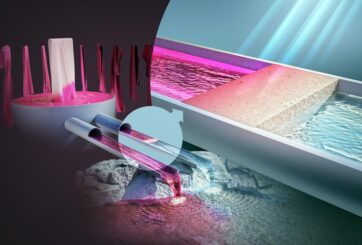
Researchers at Chalmers University of Technology, Sweden, have developed a new method that can easily purify contaminated water using a cellulose-based material. This discovery could have implications for countries with poor water treatment technologies and combat the widespread problem of toxic dye discharge from the textile industry. Clean water is a prerequisite for our health and living environment, but far from a given for everyone. According to the World Health Organization, WHO, there are currently over two billion people living…
The Thünen Institute of Forest Ecosystems publishes for the first time national forest maps of Germany based on current satellite imagery and terrestrial data from the 2012 National Forest Inventory. The Thünen Institute now offers interactive forest maps through the Thünen Atlas (http://atlas.thuenen.de), which provide a nationwide overview of the stocked forest area – i.e. the area on which trees grow – and the dominant tree species. They are not limited to being important sources of information for public authorities,…
 Feedback


