
New study finds that the nutritional value of prey within a single species can widely vary, offering key insights for food web dynamics and ecosystem change The hunt is on and a predator finally zeroes in on its prey. The animal consumes the nutritious meal and moves on to forage for its next target. But how much prey does a predator need to consume? Following a period of massive starvation among animals living along the California coast, University of California…

Researchers at Istituto Italiano di Tecnologia – IIT and University of Milan-Bicocca have demonstrated the efficacy of a natural substance in protecting coral from the damage caused by climate change. Researchers at Istituto Italiano di Tecnologia (Italian Institute of Technology – IIT) and Università degli Studi di Milano-Bicocca (University of Milan-Bicocca), in cooperation with Acquario di Genova (Genoa Aquarium) in Italy, have recently published a study in ACS Applied Materials and Interfaces, which demonstrates the efficacy of curcumin, a natural…
Research team led by Göttingen University compares form and function of island and mainland plants. Oceanic islands provide useful models for ecology, biogeography and evolutionary research. Many ground-breaking findings – including Darwin’s theory of evolution – have emerged from the study of species on islands and their interplay with their living and non-living environment. Now, an international research team led by the University of Göttingen has investigated the flora of the Canary Island of Tenerife. The results were surprising: the…
… on Earth and icy worlds. Scientists at the University of Texas Institute for Geophysics (UTIG) have developed a radar technique that lets them image hidden features within the upper few feet of ice sheets. The researchers behind the technique said that it can be used to investigate melting glaciers on Earth as well as detect potentially habitable environments on Jupiter’s moon Europa. The near-surface layers of ice sheets are difficult to study with airborne or satellite ice-penetrating radar because…
A research group from Nagoya University has accurately simulated air turbulence occurring on clear days around Tokyo using Japan’s fastest supercomputer. They then compared their findings with flight data to create a more accurate predictive model. The research was reported in the journal Geophysical Research Letters. Although air turbulence is usually associated with bad weather, an airplane cabin can shake violently even on a sunny and cloudless day. Known as clear air turbulence (CAT), these turbulent air movements can occur…
The Belgian research vessel RV Belgica is currently underway in the waters of Iceland. Two researchers from the University of Bonn are also on board. The goal of the mission is to better understand a natural thermostat of the Earth: the weathering of rocks at the bottom of the sea. This process binds carbon dioxide from the atmosphere. It may also be possible to use it in the fight against climate change. Even rocks don’t live forever: contact with air,…
A new technique uses remote images to gauge the strength of ancient and active rivers beyond Earth. Rivers have flowed on two other worlds in the solar system besides Earth: Mars, where dry tracks and craters are all that’s left of ancient rivers and lakes, and Titan, Saturn’s largest moon, where rivers of liquid methane still flow today. A new technique developed by MIT geologists allows scientists to see how intensely rivers used to flow on Mars, and how they…
Seasonal temperature fluctuations only have an indirect influence on the bacterial community in wastewater / study published in ‘Water Research’. The community of microbial predators influences the composition of the bacterial community in wastewater. This explains seasonal variations in the microbial community that affect the efficiency of water treatment. This is the result of a study conducted by Nils Heck and PD Dr Kenneth Dumack from the University of Cologne’s Institute of Zoology. The study has been published under the…
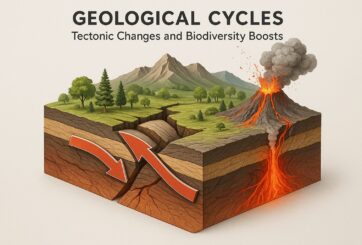
Tectonic changes alter sea levels that can create breeding grounds for life. Movement in the Earth’s tectonic plates indirectly triggers bursts of biodiversity in 36‑million-year cycles by forcing sea levels to rise and fall, new research has shown. Researchers including geoscientists at the University of Sydney believe these geologically driven cycles of sea level changes have a significant impact on the diversity of marine species, going back at least 250 million years. As water levels rise and fall, different habitats…
Researchers at the Paul Scherrer Institute PSI and ETH Zurich have performed calculations to work out how air traffic could become climate-neutral by 2050. They conclude that simply replacing fossil aviation fuel with sustainable synthetic fuels will not be enough. Air traffic would also have to be reduced. The researchers are publishing their results today in the journal Nature Communications. The European Union aims to be climate neutral by 2050, a target that was set by the European Parliament in…
Sulphuric acid is the world’s most used chemical. It is an important reagent used in many industries and it is used in the manufacture of everything from paper, pharmaceuticals and cosmetics to batteries, detergents and fertilisers. It is therefore a worldwide challenge that sulphuric acid often contains one of the most toxic substances – mercury. Researchers at Chalmers University of Technology, Sweden, have now developed a method that can reduce the levels of mercury in sulphuric acid by more than…
Prof. Dr. Christoph Helbig, Chair of Ecological Resource Technology at the University of Bayreuth, is investigating framework conditions and measures for the circular economy on an international level in his latest project, using the example of electronics and electric vehicle batteries. The goal is to come up with concrete proposals for a more efficient and environmentally friendly circular economy. Together with the Fraunhofer Institute for Systems and Innovation Research and partner universities in Turkey, Taiwan, Japan and Thailand, Prof. Dr….
Constructor University scientist conducts research off the coast of Brazil. A team of 60 international researchers on board the French research vessel “Marion Dufresne” is currently investigating the presence of gas hydrates, fluid venting and slope failures in the submarine sediments off the coast of Brazil to track the effects of climate change. Dr. Vikram Unnithan, Professor of Geosciences at Constructor University in Bremen, is the only scientist from a German university to join the first leg of the research…
The rise in atmospheric carbon dioxide (CO2) concentration is a primary catalyst for global warming, and an estimated one fifth of the atmospheric CO2 originates from soil sources. This is partially attributed to the activity of microorganisms, including bacteria, fungi, and other microorganisms that decompose organic matter in the soil utilizing oxygen, such as deceased plant materials. During this process, CO2 is released into the atmosphere. Scientists refer to it as heterotrophic soil respiration. Based on a recent study published…
Step aside self-driving cars, self-driving boats are here — and they can do more than take you on a cruise. Researchers at The University of Texas at El Paso have constructed a fully autonomous boat that can carry out bathymetric surveys — surveys of the depth and terrain of bodies of water like oceans, rivers and lakes. The team hopes the robotic boat can help simplify the survey process, which usually takes a crew of individuals to complete, as well as assist…
…on surface of Mars’ Utopia Basin. A joint research team led by Prof. DU Aimin from the Institute of Geology and Geophysics of the Chinese Academy of Sciences (IGGCAS) has found extremely weak magnetic fields during the Zhurong rover’s first 1-km traverse on Mars. This indicates no detectable magnetization anomalies below Zhurong’s landing site. This work was published in Nature Astronomy on June 19. The researchers utilized two fluxgate magnetometers aboard the Zhurong rover to conduct the first magnetic field…
– resistant to a bacterial disease outbreak in Africa. The “Healthy Crops” international research consortium led by Professor Dr Wolf B. Frommer from Heinrich Heine University Düsseldorf (HHU) is developing disease-resistant rice varieties. In the scientific journal eLife, the authors now report on the discovery of a recent bacterial outbreak in Tanzania – and describe how they modified an African rice variety to make it resistant to the pathogen. Bacterial blight of rice, which is caused by the bacterium Xanthomonas…
 Feedback


