



Feeding 9 Billion: Innovations in Agricultural Modeling
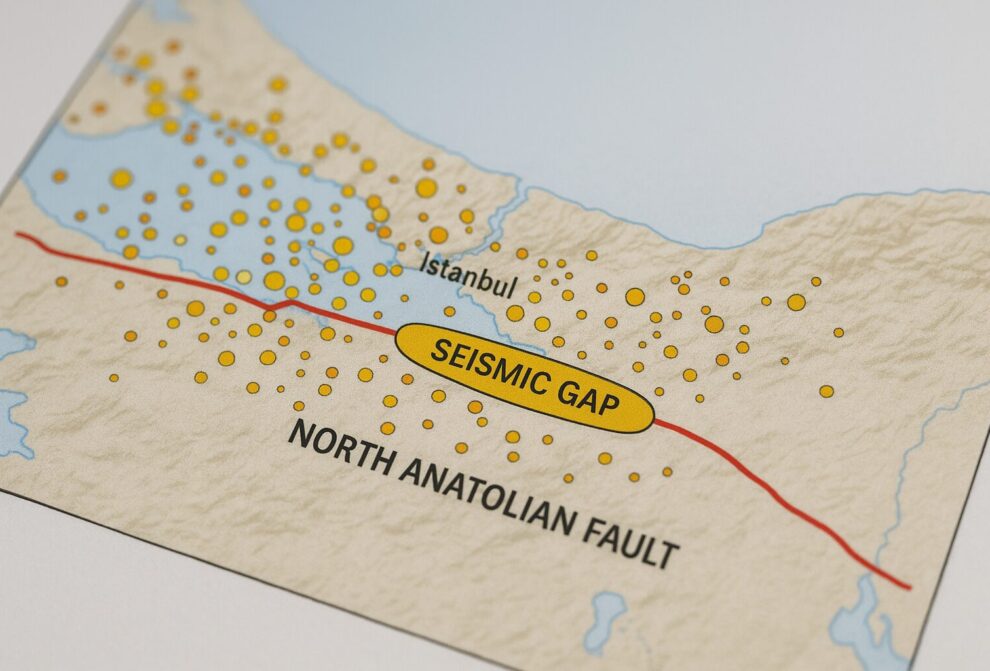
AI Generated Image
Earthquake researchers have now identified a 30 kilometers long and ten kilometers deep area along the North Anatolian fault zone just south of Istanbul that could be the starting point for a strong earthquake.
Despite adopting advanced technology, scientists still find it difficult to predict mammoth earthquakes. To identify an earthquake, three elements must be defined:
1. The date and time
2. The location
3. The magnitude
Precursors such as mini earthquakes, abnormal behavior of animals, and increased amounts of radon in local waters, along with recurring patterns, help to forecast potential earthquakes. However, they may not be entirely accurate and reliable.
The group of seismologists including Professor Marco Bohnhoff of the GFZ German Research Centre for Geosciences reported in the current online issue of the scientific journal /Nature/ (Nature Communications,DOI: 10.1038/ncomms2999) that this potential earthquake source is only 15 to 20 kilometers from the historic city center of Istanbul.
During the 2023 earthquake, more than 22,000 people were confirmed dead, and scores of others were found injured. Registered at 7.8 magnitude on the Richter scale, the earthquake tore through 00km (62 miles) of fault line, leaving a wreckage of buildings and houses.
Since Turkey is known for having volatile tectonic plates, several areas in the country are prone to being struck by earthquakes.
The cities below lie on the seismic lines in Turkey, exposing them to potentially devastating earthquakes:
1. Istanbul
2. Izmir
3. Antalya
4. Bursa
5. Gaziantep
The Istanbul-Marmara region of northwestern Turkey with a population of more than 15 million faces a high probability of being exposed to an earthquake of magnitude 7 or more. To better understand the processes taking place before a strong earthquake at a critically pressurized fault zone, a seismic monitoring network was built on the Princes Islands in the Sea of Marmara off Istanbul under the auspices of the Potsdam based Helmholtz Centre GFZ together with the Kandilli Earthquake Observatory in Istanbul. The Princes Islands offer the only opportunity to monitor the seismic zone running below the seafloor from a distance of few kilometers.
The now available data allow the scientists around GFZ researcher Marco Bohnhoff to come to the conclusion that the area is locked in depth in front of the historic city of Istanbul: “/The block we identified reaches ten kilometers deep along the fault zone and has displayed no seismic activity since measurements began over four years ago. This could be an indication that the expected Marmara earthquake could originate there/”, says Bohnhoff.
This is also supported by the fact that the fracture zone of the last strong earthquake in the region, in 1999, ended precisely in this area – probably at the same structure, which has been impeding the progressive shift of the Anatolian plate in the south against the Eurasian plate in the north since 1766 and building up pressure. The results are also being compared with findings from other fault zones, such as the San Andreas Fault in California, to better understand the physical processes before an earthquake.
Currently, the GFZ is intensifying its activity to monitor the earthquake zone in front of Istanbul. Together with the Disaster and Emergency Management Presidency of Turkey AFAD, several 300 meter deep holes are currently being drilled around the eastern Marmara Sea, into which highly sensitive borehole seismometers will be placed. With this /Geophysical borehole Observatory at the North Anatolian Fault/ GONAF, measurement accuracy and detection threshold for microearthquakes are improved many times over. In addition, the new data also provide insights on the expected ground motion in the event of an earthquake in the region. Bohnhoff: “/Earthquake prediction is scientifically impossible. But studies such as this provide a way to better characterize earthquakes in advance in terms of location, magnitude and rupture progression, and therefore allow a better assessment of damage risk/.”
Marco Bohnhoff, Fatih Bulut, Georg Dresen, Peter E. Malin, Tuna Eken, Mustafa Aktar: “/An earthquake gap south of Istanbul/”, Nature,DOI: 10.1038/ncomms2999, 18.06.2013)
Images in printable resolution:
http://www.gfz-potsdam.de/portal/gfz/Public+Relations/M40-Bildarchiv/Bildergalerie+Erdbebengefahr+Tuerkei
Franz Ossing
Helmholtz Centre Potsdam
GFZ German Research Centre for Geosciences
Deutsches GeoForschungsZentrum
– Head, Public Relations –
Telegrafenberg
14473 Potsdam / Germany
e-mail: ossing@gfz-potsdam.de
Tel. ++49 (0)331-288 1040
Fax ++49 (0)331-288 1044
Identification of seismic gaps and high-risk areas is crucial for the prediction of earthquakes. Ongoing monitoring processes, public education, and adherence to safety measures help in being socially aware and adequately prepared for destructive calamities such as earthquakes.




Earthquakes in the American state of Utah, the Soultz-sous-Forêts region of France or in the Dutch province of Groningen should not be able to occur even if the subsurface has been exploited for decades. This is because the shallow subsurface behaves in such a way that faults there become stronger as soon as they start moving. At least that is what geology textbooks teach us. And so, in theory, it should not be possible for earthquakes to occur. So why…

Just in time for Halloween, researchers from the Royal Ontario Museum (ROM), the Field Museum in Chicago, and Lawrence University in Wisconsin have announced the discovery of six new species of bats. These newly identified species, all found in the Philippines, belong to the group known as tube-nosed bats—a fascinating and diverse branch of the mammal family tree. Expanding the Tree of Life Formally recognized as new species through morphological and genetic analysis, this discovery expands the already impressive global…
In a recent study published today in the European Geosciences Union (EGU) journal Biogeosciences, scientists have confirmed that mercury pollution from artisanal and small-scale gold mining (ASGM) is contaminating food crops not through the soil, as previously believed, but directly from the air. Driven by the surging price of gold, which has increased by more than tenfold since 2000, the rapid expansion of unregulated mining in these regions raises urgent questions about food security, human health, and environmental justice The…
A new study from Iceland’s Surtsey island shows that birds carried most of the plants that colonised the island, challenging long-held beliefs that seed or fruit shape determines how plants spread — offering fresh insight into life’s adaptation to c When the volcanic island of Surtsey rose from the North Atlantic Ocean in 1963, it offered scientists a once-in-a-lifetime opportunity to observe how life takes hold on a brand-new and barren land. For decades, ecologists believed that plants’ ability to…
 Feedback
