



Feeding 9 Billion: Innovations in Agricultural Modeling

AI Generated Image
Tokyo, Japan – Researchers from Tokyo Metropolitan University have traced the genetic origins of a now extinct plant population from Nishinoshima, a remote volcanic island known for its frequent eruptions that periodically wipe out vegetation. Their analysis revealed that while the plants likely originated from a nearby island, their genetic makeup displayed unique traits shaped by a phenomenon known as the “founder’s effect.” The findings provide rare insight into the earliest stages of ecosystem formation in isolated environments.
Part of the Ogasawara Island chain, Nishinoshima lies about 1,000 kilometers south of mainland Tokyo. The island experiences regular volcanic activity, and major eruptions in 2013 destroyed nearly all its plant life. While devastating, these events also offer scientists a chance to study how new life establishes itself after such natural “resets” on a completely isolated landmass.
A team led by Professor Koji Takayama of Tokyo Metropolitan University, formerly of Kyoto University, examined samples of common purslane (Portulaca oleracea) collected from Nishinoshima in 2019, just before an eruption wiped out nearly all vegetation on the island. Although the species is widespread across tropical and temperate regions globally, the Nishinoshima population is now extinct.
The researchers analyzed these rare samples alongside 254 other specimens taken from 51 populations across Japan and Guam. By comparing chloroplast DNA and conducting a genome-wide survey of nuclear DNA, they built a phylogenetic “family tree” of the species.
The analysis showed that the Nishinoshima population was most closely related to plants from nearby Chichijima, another volcanic island. However, the Nishinoshima specimens also displayed distinct genetic traits. The team concluded that they likely descended from only a small number of individuals, creating a strong genetic skew known as the founder’s effect.
Seeds of common purslane are tiny, flat, and less than a millimeter in size, allowing them to be dispersed by wind, birds, or ocean currents. Yet the study suggests that successful colonization on Nishinoshima has been extremely rare. The pronounced founder’s effect, combined with evidence of genetic drift—where random events like typhoons and eruptions, rather than natural selection, shape genetic changes—highlights how challenging survival is in such isolated settings.
“This work is a first glimpse into the phylogenetics of a now extinct population,” the researchers noted. The study underscores how isolated islands can serve as natural laboratories, offering insight into how plant populations first establish, adapt, and recover after catastrophic events. Understanding these processes may also shed light on how ecosystems rebuild after natural disasters.
This research was supported by KAKENHI (JP23K23945, JP23K20303, JP21KK0131) Grants-in-Aid from the Japan Society for the Promotion of Science (JSPS), the Environment Research and Technology Development Fund (JPMEERF20204006) of the Environmental Restoration and Conservation Agency of Japan, Environmental Surveys by the Ministry of the Environment, and the Eco-LOGIC-al Network Project of The Tokyo Metropolitan Government.
Original Publication
Authors: Hiroshi Noda, Tomoyuki Nakano, Kazuto Kawakami, Takashi Kamijo, Mari Marutani, Michael Angelo Paragas Fernandez and Koji Takayama.
Journal: Plant Systematics and Evolution
DOI: 10.1007/s00606-025-01957-y
Article Title: Origin of populations of Portulaca oleracea on Nishinoshima, an active volcanic oceanic island
Article Publication Date: 28-Jul-2025
Original Source: https://link.springer.com/article/10.1007/s00606-025-01957-y
The genetic analysis shows that the populations of Portulaca oleracea on Nishinoshima are closely related to those on Chichijima Island, indicating that Chichijima likely served as a source for the Nishinoshima populations.
The seeds of Portulaca oleracea are small and lightweight, which allows them to be easily dispersed by wind, birds, or ocean currents, making bird dispersal a likely mechanism for colonization on Nishinoshima.
There are two distinct genetic groups of Portulaca oleracea in Japan: a southern group that includes populations from Wakayama to Guam, and a northern group from Hokkaido to Kyushu, suggesting that these groups have been reproductively isolated from each other.




Earthquakes in the American state of Utah, the Soultz-sous-Forêts region of France or in the Dutch province of Groningen should not be able to occur even if the subsurface has been exploited for decades. This is because the shallow subsurface behaves in such a way that faults there become stronger as soon as they start moving. At least that is what geology textbooks teach us. And so, in theory, it should not be possible for earthquakes to occur. So why…
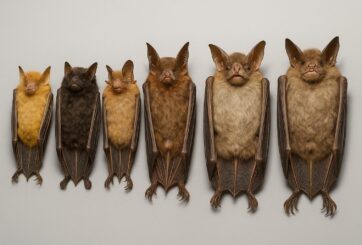
Just in time for Halloween, researchers from the Royal Ontario Museum (ROM), the Field Museum in Chicago, and Lawrence University in Wisconsin have announced the discovery of six new species of bats. These newly identified species, all found in the Philippines, belong to the group known as tube-nosed bats—a fascinating and diverse branch of the mammal family tree. Expanding the Tree of Life Formally recognized as new species through morphological and genetic analysis, this discovery expands the already impressive global…
In a recent study published today in the European Geosciences Union (EGU) journal Biogeosciences, scientists have confirmed that mercury pollution from artisanal and small-scale gold mining (ASGM) is contaminating food crops not through the soil, as previously believed, but directly from the air. Driven by the surging price of gold, which has increased by more than tenfold since 2000, the rapid expansion of unregulated mining in these regions raises urgent questions about food security, human health, and environmental justice The…
A new study from Iceland’s Surtsey island shows that birds carried most of the plants that colonised the island, challenging long-held beliefs that seed or fruit shape determines how plants spread — offering fresh insight into life’s adaptation to c When the volcanic island of Surtsey rose from the North Atlantic Ocean in 1963, it offered scientists a once-in-a-lifetime opportunity to observe how life takes hold on a brand-new and barren land. For decades, ecologists believed that plants’ ability to…
 Feedback
