



Feeding 9 Billion: Innovations in Agricultural Modeling
Around 4.5 billion years ago, Jupiter rapidly expanded into the giant planet we see today. Its immense gravity disturbed the orbits of rocky and icy planetesimals—small bodies that resembled today’s asteroids and comets. These high-speed collisions caused their rocky material to melt, producing floating droplets of molten rock known as chondrules. These droplets, preserved in meteorites, offer vital clues to the early history of the solar system.
For the first time, researchers from Nagoya University in Japan and the Italian National Institute for Astrophysics (INAF) have determined how these chondrules formed and used them to establish the timing of Jupiter’s birth. Their study, published in Scientific Reports, demonstrates that the size and cooling rates of chondrules were controlled by the water contained within colliding planetesimals. This evidence directly links chondrule formation to planetary growth.
Chondrules—tiny spheres between 0.1 and 2 millimeters wide—were incorporated into asteroids during the solar system’s formation. Fragments of these asteroids eventually reached Earth as meteorites, preserving these structures for modern study.
“When planetesimals collided with each other, water instantly vaporized into expanding steam. This acted like tiny explosions and broke apart the molten silicate rock into the tiny droplets we see in meteorites today,” said Professor Sin-iti Sirono, co-lead author from Nagoya University’s Graduate School of Earth and Environmental Sciences.
He added: “Previous formation theories couldn’t explain chondrule characteristics without requiring very specific conditions, while this model requires conditions that naturally occurred in the early solar system when Jupiter was born.”
Using advanced computer models, the team simulated Jupiter’s growth and its gravitational influence on rocky, water-rich planetesimals. The results reproduced realistic chondrule properties that matched meteorite samples.
“We compared the characteristics and abundance of simulated chondrules to meteorite data and found that the model spontaneously generated realistic chondrules. The model also shows that chondrule production coincides with Jupiter’s intense accumulation of nebular gas to reach its massive size. As meteorite data tell us that peak chondrule formation took place 1.8 million years after the solar system began, this is also the time at which Jupiter was born,” explained Dr. Diego Turrini, co-lead author and senior researcher at INAF.
The study not only establishes Jupiter’s age but also introduces a method to trace the timeline of planet formation. Researchers note that the chondrule production linked to Jupiter was too brief to explain the variety of ages observed in meteorites. This suggests that other giant planets, such as Saturn, also triggered chondrule formation during their birth.
By studying chondrules across different ages, scientists can reconstruct the birth order of planets and gain insights into planetary systems beyond our own. These findings hint that similar violent processes may be common in other star systems.
This research was supported by JSPS KAKENHI Grant Number 25K07383, the Italian Space Agency (ASI-INAF contracts 2016-23-H.0 and 2021-5-HH.0), and the European Research Council via the Horizon 2020 Framework Programme ERC Synergy “ECOGAL” Project GA-855130.
Original Publication
Authors: Sin-iti Sirono and Diego Turrini.
Journal: Scientific Reports
DOI: 10.1038/s41598-025-12643-x
Method of Research: Computational simulation/modeling
Article Title: Chondrule formation by collisions of planetesimals containing volatiles triggered by Jupiter’s formation
Article Publication Date: 25-Aug-2025
Jupiter’s formation causes dynamical excitation of planetesimals, which are small bodies in the solar nebula. This means that as Jupiter grows, it influences the movement and behavior of these planetesimals, leading to changes in their orbits and potential collisions.
Collisions between planetesimals are significant because they lead to mass loss and can produce melt. The study shows that the number of collisions and the impact velocities increase during Jupiter’s migration, which results in more intense collisional evolution and higher mass loss from the planetesimal disk.
The gas in the solar nebula interacts with the planetesimals, affecting their movement and collision outcomes. Gas drag slows down larger planetesimals and influences their dynamical evolution, which is crucial for understanding how they collide and produce melt during the early solar system’s formation.




Earthquakes in the American state of Utah, the Soultz-sous-Forêts region of France or in the Dutch province of Groningen should not be able to occur even if the subsurface has been exploited for decades. This is because the shallow subsurface behaves in such a way that faults there become stronger as soon as they start moving. At least that is what geology textbooks teach us. And so, in theory, it should not be possible for earthquakes to occur. So why…
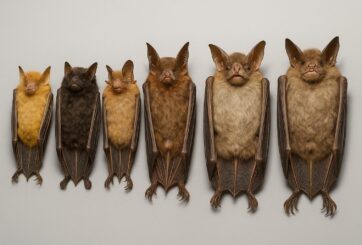
Just in time for Halloween, researchers from the Royal Ontario Museum (ROM), the Field Museum in Chicago, and Lawrence University in Wisconsin have announced the discovery of six new species of bats. These newly identified species, all found in the Philippines, belong to the group known as tube-nosed bats—a fascinating and diverse branch of the mammal family tree. Expanding the Tree of Life Formally recognized as new species through morphological and genetic analysis, this discovery expands the already impressive global…
In a recent study published today in the European Geosciences Union (EGU) journal Biogeosciences, scientists have confirmed that mercury pollution from artisanal and small-scale gold mining (ASGM) is contaminating food crops not through the soil, as previously believed, but directly from the air. Driven by the surging price of gold, which has increased by more than tenfold since 2000, the rapid expansion of unregulated mining in these regions raises urgent questions about food security, human health, and environmental justice The…
A new study from Iceland’s Surtsey island shows that birds carried most of the plants that colonised the island, challenging long-held beliefs that seed or fruit shape determines how plants spread — offering fresh insight into life’s adaptation to c When the volcanic island of Surtsey rose from the North Atlantic Ocean in 1963, it offered scientists a once-in-a-lifetime opportunity to observe how life takes hold on a brand-new and barren land. For decades, ecologists believed that plants’ ability to…
 Feedback
