



Feeding 9 Billion: Innovations in Agricultural Modeling
Roughly 390 million years ago, marine animals began inhabiting deeper parts of the ocean that had previously been unlivable. A new study shows this expansion was enabled by a permanent rise in deep-ocean oxygen, linked to the aboveground spread of woody plants—the precursors of Earth’s first forests.
This increase in oxygen availability coincided with a surge in the diversification of jawed fish (gnathostomes), the ancestors of most vertebrates alive today. The findings suggest that oxygen not only enabled but also shaped major evolutionary transitions in marine life.
“It’s known that oxygen is a necessary condition for animal evolution, but the extent to which it is the sufficient condition that can explain trends in animal diversification has been difficult to pin down,” said Michael Kipp, co-lead author and assistant professor of earth and climate sciences at Duke University’s Nicholas School of the Environment. “This study gives a strong vote that oxygen dictated the timing of early animal evolution, at least for the appearance of jawed vertebrates in deep-ocean habitats.”
Earlier research suggested that ocean oxygenation happened once, around 540 million years ago at the start of the Paleozoic Era. However, growing evidence points to a multi-phase process, with shallow waters oxygenating first, followed by deeper environments much later.
To pinpoint when oxygen levels rose, the team studied sedimentary rocks formed in deep seawater. They focused on selenium isotopes, which shift in distinctive ways depending on oxygen concentrations.
Where oxygen levels are sufficient to support animal life, the ratio of heavy to light selenium isotopes varies widely. In low-oxygen environments, the ratio is more stable. By measuring these ratios in ancient rock samples, the researchers reconstructed ocean oxygen levels across hundreds of millions of years.
The team analyzed 97 rock samples dating back 252–541 million years, collected from ancient continental shelf environments across five continents. The results revealed two major oxygenation events:
“The selenium data tell us that the second oxygenation event was permanent. It began in the Middle Devonian and persisted in our younger rock samples,” said co-lead author Kunmanee “Mac” Bubphamanee, Ph.D. candidate at the University of Washington.
The Middle Devonian oxygenation coincided with a period of major ecological change sometimes called the mid-Paleozoic marine revolution. Jawed fishes and other marine animals began expanding into deeper waters, increasing in diversity and body size.
This transformation overlapped with the spread of woody plants on land. “Our thinking is that, as these woody plants increased in number, they released more oxygen into the air, which led to more oxygen in deeper ocean environments,” Kipp said.
The earlier Cambrian oxygenation event, in contrast, appears to have been short-lived. “What seems clear is that the drop in oxygen after that initial pulse hindered the spread and diversification of marine animals into those deeper environments of the outer continental shelves,” Kipp explained.
Although the study focuses on ancient oceans, its relevance extends to modern concerns.
“Today, there’s abundant ocean oxygen in equilibrium with the atmosphere. But in some locations, ocean oxygen can drop to undetectable levels. Some of these zones occur through natural processes. But in many cases, they’re driven by nutrients draining off continents from fertilizers and industrial activity that fuel plankton blooms that suck up oxygen when they decay,” Kipp said.
“This work shows very clearly the link between oxygen and animal life in the ocean. This was a balance struck about 400 million years ago, and it would be a shame to disrupt it today in a matter of decades.”
Funding support came from an NSF Graduate Research Fellowship, the Agouron Institute Postdoctoral Fellowship, and the NASA Astrobiology Institute’s Virtual Planetary Laboratory.
Original Publication
Authors: Kunmanee Bubphamanee, Michael A. Kipp, Jana Meixnerová, Eva E. Stüeken, Linda C. Ivany, Alexander J. Bartholomew, Thomas J. Algeo, Jochen J. Brocks, Tais W. Dahl, Jordan Kinsley, François L. H. Tissot and Roger Buick.
Journal: Proceedings of the National Academy of Sciences
DOI: 10.1073/pnas.2501342122
Method of Research: Experimental study
Subject of Research: Animals
Article Title: Mid-Devonian ocean oxygenation enabled the expansion of animals into deeper-water habitats




Earthquakes in the American state of Utah, the Soultz-sous-Forêts region of France or in the Dutch province of Groningen should not be able to occur even if the subsurface has been exploited for decades. This is because the shallow subsurface behaves in such a way that faults there become stronger as soon as they start moving. At least that is what geology textbooks teach us. And so, in theory, it should not be possible for earthquakes to occur. So why…
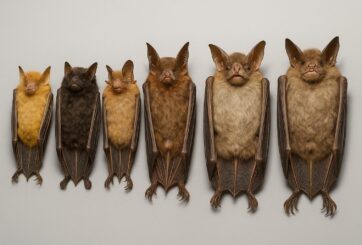
Just in time for Halloween, researchers from the Royal Ontario Museum (ROM), the Field Museum in Chicago, and Lawrence University in Wisconsin have announced the discovery of six new species of bats. These newly identified species, all found in the Philippines, belong to the group known as tube-nosed bats—a fascinating and diverse branch of the mammal family tree. Expanding the Tree of Life Formally recognized as new species through morphological and genetic analysis, this discovery expands the already impressive global…
In a recent study published today in the European Geosciences Union (EGU) journal Biogeosciences, scientists have confirmed that mercury pollution from artisanal and small-scale gold mining (ASGM) is contaminating food crops not through the soil, as previously believed, but directly from the air. Driven by the surging price of gold, which has increased by more than tenfold since 2000, the rapid expansion of unregulated mining in these regions raises urgent questions about food security, human health, and environmental justice The…
A new study from Iceland’s Surtsey island shows that birds carried most of the plants that colonised the island, challenging long-held beliefs that seed or fruit shape determines how plants spread — offering fresh insight into life’s adaptation to c When the volcanic island of Surtsey rose from the North Atlantic Ocean in 1963, it offered scientists a once-in-a-lifetime opportunity to observe how life takes hold on a brand-new and barren land. For decades, ecologists believed that plants’ ability to…
 Feedback
