



Feeding 9 Billion: Innovations in Agricultural Modeling
The senior lecturer in the Department of Chemistry at the University of York is already involved in a unique monitoring station in the Tropics, and the £70,000 Leverhulme Prize will allow her to lead a new project in the Arctic.
The International Polar Year project will examine the atmospheric effect of frost-flowers, the delicate ice crystals that form on sea ice and emit halogens, bromine and iodine, into the atmosphere.
Scientists from the UK, Germany and Canada will test the theory that the combination of high surface area and high salinity in the frost flowers leads to the release of the halogens, which then interact resulting in the depletion of ozone and mercury in the troposphere.
Dr Carpenter said the project would be based at a Canadian research station in Hudson Bay for two months in spring 2008 with the team working in an air-conditioned portable laboratory.
“It’s a big field experiment which is going to be logistically very difficult to do. We have to go out there in February and March because of the combination of cold temperatures and sunlight, so I shall spend some of the Prize on teaching relief,” she said.
“We are hoping for temperatures of minus 20 to 30 degrees Celsius — there are huge floats of frost flowers in those conditions. Our overall aim is to develop an improved understanding of Arctic chemistry and emissions, and their effect and feedbacks on atmospheric chemistry and climate””.
The Arctic project will run in parallel with the Dr Carpenter’s work at the atmospheric monitoring station established in September on the Cape Verde Islands in the Atlantic. With German scientists at a nearby oceanography station, she is studying how atmospheric chemistry affects the ocean and vice-versa.




Earthquakes in the American state of Utah, the Soultz-sous-Forêts region of France or in the Dutch province of Groningen should not be able to occur even if the subsurface has been exploited for decades. This is because the shallow subsurface behaves in such a way that faults there become stronger as soon as they start moving. At least that is what geology textbooks teach us. And so, in theory, it should not be possible for earthquakes to occur. So why…
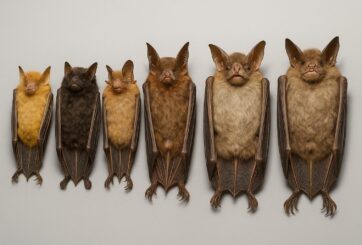
Just in time for Halloween, researchers from the Royal Ontario Museum (ROM), the Field Museum in Chicago, and Lawrence University in Wisconsin have announced the discovery of six new species of bats. These newly identified species, all found in the Philippines, belong to the group known as tube-nosed bats—a fascinating and diverse branch of the mammal family tree. Expanding the Tree of Life Formally recognized as new species through morphological and genetic analysis, this discovery expands the already impressive global…
In a recent study published today in the European Geosciences Union (EGU) journal Biogeosciences, scientists have confirmed that mercury pollution from artisanal and small-scale gold mining (ASGM) is contaminating food crops not through the soil, as previously believed, but directly from the air. Driven by the surging price of gold, which has increased by more than tenfold since 2000, the rapid expansion of unregulated mining in these regions raises urgent questions about food security, human health, and environmental justice The…
A new study from Iceland’s Surtsey island shows that birds carried most of the plants that colonised the island, challenging long-held beliefs that seed or fruit shape determines how plants spread — offering fresh insight into life’s adaptation to c When the volcanic island of Surtsey rose from the North Atlantic Ocean in 1963, it offered scientists a once-in-a-lifetime opportunity to observe how life takes hold on a brand-new and barren land. For decades, ecologists believed that plants’ ability to…
 Feedback
