



Feeding 9 Billion: Innovations in Agricultural Modeling
Instantaneous ice ages, grapefruit-size hail and tidal waves – all courtesy of global warming – are being served up as Memorial Day weekend entertainment in movie theaters.
The side order: A little scientific food for thought.
“The Day After Tomorrow,” a star-studded movie that paints a vivid picture of global climatic catastrophe, is a simplistic look at the complex and real issue of a potential outcome of global warming, said David Skole, professor and director of MSU’s Center for Global Change and Earth Observations.
“This is a complicated problem – it’s not like a movie where it’s catastrophic overnight, but there is some science behind it,” Skole said. “It stems from abrupt climate change. Changes in storm frequency and intensity; changes in water availability; changes of pests and related disease – that’s the story.”
Scientists across the globe, including Skole, struggle to better quantify and understand local impacts of changes in global climate patterns. Skole has been a member of the Academies of Science committee to review the U.S. Climate Change Science Program.
“We must not forget the literary license which Hollywood takes in making such films,” Skole said. “While they do a lot to enhance viewer appeal, I think there is some scientific basis in the topic, even if the details are sometimes way wrong. It’s important to note that a movie can get away with these wild depictions precisely because the science of abrupt climate change is only in its infancy.”
Contact: David Skole, professor and director of MSU’s Center for Global Change and Earth Observations, (517) 355-1778, skole@msu.edu, www.globalchange.msu.edu/facstaff/skole.html, www.globalchange.msu.edu/facstaff/skole.html




Earthquakes in the American state of Utah, the Soultz-sous-Forêts region of France or in the Dutch province of Groningen should not be able to occur even if the subsurface has been exploited for decades. This is because the shallow subsurface behaves in such a way that faults there become stronger as soon as they start moving. At least that is what geology textbooks teach us. And so, in theory, it should not be possible for earthquakes to occur. So why…
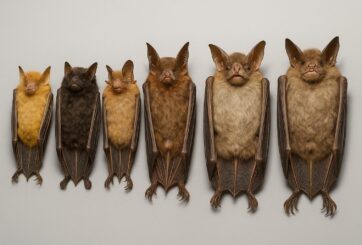
Just in time for Halloween, researchers from the Royal Ontario Museum (ROM), the Field Museum in Chicago, and Lawrence University in Wisconsin have announced the discovery of six new species of bats. These newly identified species, all found in the Philippines, belong to the group known as tube-nosed bats—a fascinating and diverse branch of the mammal family tree. Expanding the Tree of Life Formally recognized as new species through morphological and genetic analysis, this discovery expands the already impressive global…
In a recent study published today in the European Geosciences Union (EGU) journal Biogeosciences, scientists have confirmed that mercury pollution from artisanal and small-scale gold mining (ASGM) is contaminating food crops not through the soil, as previously believed, but directly from the air. Driven by the surging price of gold, which has increased by more than tenfold since 2000, the rapid expansion of unregulated mining in these regions raises urgent questions about food security, human health, and environmental justice The…
A new study from Iceland’s Surtsey island shows that birds carried most of the plants that colonised the island, challenging long-held beliefs that seed or fruit shape determines how plants spread — offering fresh insight into life’s adaptation to c When the volcanic island of Surtsey rose from the North Atlantic Ocean in 1963, it offered scientists a once-in-a-lifetime opportunity to observe how life takes hold on a brand-new and barren land. For decades, ecologists believed that plants’ ability to…
 Feedback
