
At the 2016 meeting of the American Geophysical Union (AGU), researchers from the Monterey Bay Aquarium Research Institute (MBARI) will be presenting a new…
An international team of scientists, including researchers from the University of Chicago, has made the rare discovery of a planetary system with a host star…
The total shoreline of the world's lakes is more than four times longer than the global ocean coastline. And if all the water in those lakes were spread over…
Plate tectonics, the idea that the surface of the Earth is made up of plates that move apart and come back together, has been used to explain the locations of…
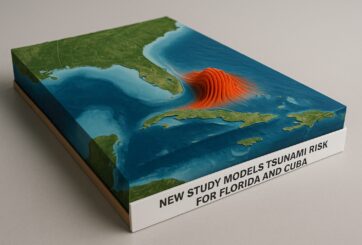
While the Caribbean is not thought to be at risk for tsunamis, a new study by researchers at the University of Miami (UM) Rosenstiel School of Marine and…
The University of California, Berkeley's worldwide network of smartphone earthquake detectors has recorded nearly 400 earthquakes since the MyShake app was…
The Atmospheric Infrared Sounder or AIRS instrument measures temperature data in infrared light. At NASA's Jet Propulsion Laboratory in Pasadena, California, a…
The thinning is related to the cooling of Earth's interior prompted by the splitting of the supercontinent Pangaea, which broke up into the continents that we…
Global concentrations of methane, a powerful greenhouse gas and cause of climate change, are now growing faster in the atmosphere than at any other time in the…
About 90 percent of precipitation over land depends on the formation of ice crystals in clouds, which fall down due to their increasing weight. But water in…
Because H atoms are very light, they can easily overcome a planet's gravitational force and permanently escape into interplanetary space. The ongoing…
Fully developed tropical cyclones — variously called hurricanes, typhoons or cyclones, depending on their region–can grow as wide as several hundred miles…
“It looks like a triple whammy–a warm ocean, a warm atmosphere, and a wind pattern all working against the ice in the Arctic,” said NSIDC director Mark…
Completed in 2011, the core is packed with information, but it's also packed with noise and error, making the climate story hard to read. Figuring out whether…

New research published in the journal Nature Geosciences shows that the Bay of Bengal, located in the northeastern Indian Ocean, also hosts a “dead zone” of an…
AIM studies noctilucent clouds in order to better understand the mesosphere, and its connections to other parts of the atmosphere, weather and climate. We…
 Feedback


