
The Belgian research vessel RV Belgica is currently underway in the waters of Iceland. Two researchers from the University of Bonn are also on board. The goal of the mission is to better understand a natural thermostat of the Earth: the weathering of rocks at the bottom of the sea. This process binds carbon dioxide from the atmosphere. It may also be possible to use it in the fight against climate change. Even rocks don’t live forever: contact with air,…
A new technique uses remote images to gauge the strength of ancient and active rivers beyond Earth. Rivers have flowed on two other worlds in the solar system besides Earth: Mars, where dry tracks and craters are all that’s left of ancient rivers and lakes, and Titan, Saturn’s largest moon, where rivers of liquid methane still flow today. A new technique developed by MIT geologists allows scientists to see how intensely rivers used to flow on Mars, and how they…
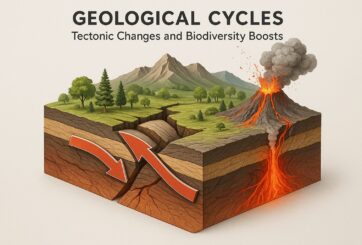
Tectonic changes alter sea levels that can create breeding grounds for life. Movement in the Earth’s tectonic plates indirectly triggers bursts of biodiversity in 36‑million-year cycles by forcing sea levels to rise and fall, new research has shown. Researchers including geoscientists at the University of Sydney believe these geologically driven cycles of sea level changes have a significant impact on the diversity of marine species, going back at least 250 million years. As water levels rise and fall, different habitats…
Constructor University scientist conducts research off the coast of Brazil. A team of 60 international researchers on board the French research vessel “Marion Dufresne” is currently investigating the presence of gas hydrates, fluid venting and slope failures in the submarine sediments off the coast of Brazil to track the effects of climate change. Dr. Vikram Unnithan, Professor of Geosciences at Constructor University in Bremen, is the only scientist from a German university to join the first leg of the research…
The rise in atmospheric carbon dioxide (CO2) concentration is a primary catalyst for global warming, and an estimated one fifth of the atmospheric CO2 originates from soil sources. This is partially attributed to the activity of microorganisms, including bacteria, fungi, and other microorganisms that decompose organic matter in the soil utilizing oxygen, such as deceased plant materials. During this process, CO2 is released into the atmosphere. Scientists refer to it as heterotrophic soil respiration. Based on a recent study published…
Step aside self-driving cars, self-driving boats are here — and they can do more than take you on a cruise. Researchers at The University of Texas at El Paso have constructed a fully autonomous boat that can carry out bathymetric surveys — surveys of the depth and terrain of bodies of water like oceans, rivers and lakes. The team hopes the robotic boat can help simplify the survey process, which usually takes a crew of individuals to complete, as well as assist…
…on surface of Mars’ Utopia Basin. A joint research team led by Prof. DU Aimin from the Institute of Geology and Geophysics of the Chinese Academy of Sciences (IGGCAS) has found extremely weak magnetic fields during the Zhurong rover’s first 1-km traverse on Mars. This indicates no detectable magnetization anomalies below Zhurong’s landing site. This work was published in Nature Astronomy on June 19. The researchers utilized two fluxgate magnetometers aboard the Zhurong rover to conduct the first magnetic field…
Subsoils are the largest storehouses for carbon, as well as one of the most important sources of carbon dioxide in the atmosphere. Global warming is accelerating the decomposition of soil humus. It is also affecting the waxy and woody compounds which help plants store carbon in their leaves and roots and were previously thought to be stable. These are the findings of a study conducted by researchers from the University of Zurich’s Department of Geography in the Sierra Nevada National…
The ground beneath Antarctica’s most vulnerable glacier has been mapped for the first time, by a team that includes a Swansea expert, helping scientists to better understand how it is being affected by climate change. Analysis of the geology below the Thwaites Glacier in West Antarctica shows there is less sedimentary rock than expected – a finding that could affect how the ice slides into the ocean in the coming decades. The glacier, which is the size of Great Britain…
The skies aircraft fly through are bumpier today than four decades ago, scientists have found, after producing a new analysis showing that turbulence has increased as the climate changed. New research from the University of Reading shows that clear-air turbulence, which is invisible and hazardous to aircraft, has increased in various regions around the world. At a typical point over the North Atlantic – one of the world’s busiest flight routes – the total annual duration of severe turbulence increased by 55% from 17.7 hours in 1979 to 27.4 hours in 2020, the research found. Moderate turbulence increased by 37% from 70.0 to…
The movement between continental and oceanic plates at the bottom of the sea, so-called megathrust earthquakes, generates the strongest earth tremors and the most dangerous tsunamis. How and when they occur, however, has been poorly understood so far, since the ocean floor is difficult to access for measurements. Thanks to new technologies, an international research team, in which Prof. James Foster from the Institute of Geodesy at the University of Stuttgart was also involved, was able to take measurements to…
USU geoscientists probe geochemistry, microbial diversity of Peruvian hot springs. Heather Upin, Dennis Newell report microbial community composition is distinctly different in two tectonic settings. South America’s Andes Mountains, the world’s longest mountain range and home to some of the planet’s highest peaks, feature thousands of hot springs. Driven by plate tectonics and fueled by hot rock and fluids, these thermal discharges vary widely in geochemistry and microbial diversity. Utah State University geoscientists, along with colleagues from Montana State University,…
How do they influence the development of coral islands? Coral islands are in danger of slowly sinking in the face of rising sea levels. In a new study, researchers from the Leibniz Centre for Tropical Marine Research (ZMT) found that sea level may not be the only factor playing a role in the fate of threatened islands. In recent years, alarming reports have accumulated about the slow sinking of coral islands, especially in the Pacific. Tropical coral islands are formed…
Seismologists use supercomputer to reveal complex dynamics of multi-fault earthquake systems. On the morning of July 4, 2019, a magnitude 6.4 earthquake struck the Searles Valley in California’s Mojave Desert, with impacts felt across Southern California. About 34 hours later on July 5, the nearby city of Ridgecrest was struck by a magnitude 7.1 earthquake, a jolt felt by millions across the state of California and throughout neighboring communities in Arizona, Nevada, and even Baja California, Mexico. Known as the…
Acoustic signals can be effectively used for monitoring glacial runoff and provide a cheaper and more accessible alternative to existing methods. Glaciers have been melting and shrinking at an alarming rate, raising the sea-level and causing outburst floods. Scientists are monitoring this change to gauge the meltwater contribution to the ocean and freshwater resources across the globe while also keeping an eye on the risk of glacial flooding. However, glacio-hydrological monitoring is a luxury not every country can afford. The…
… found to disrupt satellite signals halfway around the world. An international team has used satellite- and ground-based ionospheric observations to demonstrate that an air pressure wave triggered by volcanic eruptions could produce an equatorial plasma bubble (EPB) in the ionosphere, severely disrupting satellite-based communications. Their findings were published in the journal Scientific Reports. The ionosphere is the region of the Earth’s upper atmosphere where molecules and atoms are ionized by solar radiation, creating positively charged ions. The area with…
 Feedback


