



Feeding 9 Billion: Innovations in Agricultural Modeling
Central Asia, located in the heart of the Eurasian continent, has experienced significant climatic shifts in recent decades, characterized by warming and increased humidity. This trend contrasts sharply with the global pattern of drought-induced tree growth decline, making Central Asia a unique region for studying the impacts of climate change on forest ecosystems.
Alpine forests in this region are critical for regional water reserves and ecological stability and are the origins of many inland rivers such as Amu Darya and Syr Darya. Researchers from Yunnan University, China, in collaboration with international partners, used a comprehensive tree-ring network comprising 128 conifer chronologies from Central Asian alpine forests to assess tree radial growth patterns in this region. The study, published in Forest Ecosystems, reveals a significant positive trend in tree growth since the 20th century. This growth acceleration is attributed to low-latitude warming, which enhances regional temperatures and precipitation, thereby promoting tree growth.
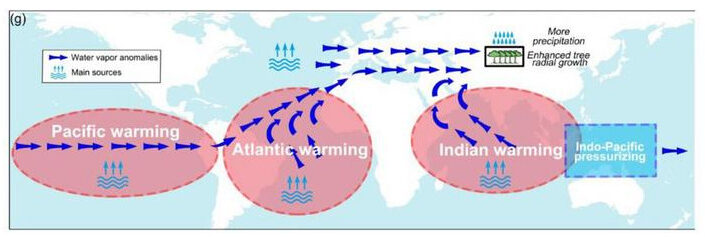
Dr. Feng Chen, the corresponding author, explained, “Our findings indicate that warming centers in the Indian Ocean, the central-east Pacific Ocean, and the Atlantic Ocean significantly influence atmospheric circulation patterns, leading to increased moisture transport to Central Asia. This results in higher regional precipitation and improved tree growth conditions.”
The study’s projections, based on the Coupled Model Intercomparison Project 6 (CMIP6) and the Vaganov-Shashkin-Lite (VS-Lite) model, suggest that tree radial growth rates will continue to rise in the future. However, the projections also reveal that climate changes could become more extreme and happen more often. “The damaging risks of severe drought cannot be ignored,” the study noted. Even during periods of drought and extreme weather, trees in alpine forests still managed to grow, indicating an inherent adaptive capacity. However, damages caused by extreme droughts are irreversible. Meanwhile, whether this resilience will stay sustainable under continued climate stress remains uncertain. Particularly, more severe climate scenarios may lead to decoupling signs between warming and enhanced growth.
This study provides critical insights into the dynamic relationship between climate change and tree growth in Central Asian alpine forests, offering a unique perspective on how changes in one part of the world can have far-reaching effects on ecosystems in distant regions. For better understanding and mitigating future impacts, future studies on enhanced modeling approaches and continuous climatic monitoring are required.
This study was supported by Excellent Research Group Program for Tibetan Plateau Earth System (continuation grant NSFC project No. 41988101), the National Natural Science Foundation of China (Nos. U1803341 and 32061123008), the National Key R&D Program of China (No. 2018YFA0606401), and the National Youth Talent Support Program.
Original Publication
Authors: Shijie Wang, Feng Chen, Youping Chen, Max C.A. Torbenson, Jan Esper, Xiaoen Zhao, Mao Hu, Heli Zhang, Weipeng Yue and Honghua Cao.
Journal: Forest Ecosystems
DOI: 10.1016/j.fecs.2025.100330
Article Title: Greening of Eurasia’s center driven by low-latitude climate warming
Article Publication Date: 11-Apr-2025
Media Contact
Mengdi Li
Tsinghua University Press
limd@tup.tsinghua.edu.cn
Office: 86-108-347-0580
Expert Contact
Feng Chen
Yunnan Key Laboratory of International Rivers and Transboundary Eco-Security, Institute of International Rivers and Eco-Security, Yunnan University, Kunming 650504, China
feng653@163.com
Tree rings provide a historical record of growth, allowing researchers to analyze how temperature and precipitation changes over time have impacted tree health and forest ecosystems in regions like Central Asia.
CMIP6 plays a crucial role in climate research by offering standardized models that help predict future climate scenarios, which can inform conservation strategies and policy-making regarding forest management and sustainability.
The VS-Lite model helps researchers simulate tree growth under various climatic scenarios, enabling them to assess how factors like warming temperatures and increased precipitation can enhance or hinder forest resilience in changing climates.
Source: EurekAlert!




Earthquakes in the American state of Utah, the Soultz-sous-Forêts region of France or in the Dutch province of Groningen should not be able to occur even if the subsurface has been exploited for decades. This is because the shallow subsurface behaves in such a way that faults there become stronger as soon as they start moving. At least that is what geology textbooks teach us. And so, in theory, it should not be possible for earthquakes to occur. So why…

Just in time for Halloween, researchers from the Royal Ontario Museum (ROM), the Field Museum in Chicago, and Lawrence University in Wisconsin have announced the discovery of six new species of bats. These newly identified species, all found in the Philippines, belong to the group known as tube-nosed bats—a fascinating and diverse branch of the mammal family tree. Expanding the Tree of Life Formally recognized as new species through morphological and genetic analysis, this discovery expands the already impressive global…
In a recent study published today in the European Geosciences Union (EGU) journal Biogeosciences, scientists have confirmed that mercury pollution from artisanal and small-scale gold mining (ASGM) is contaminating food crops not through the soil, as previously believed, but directly from the air. Driven by the surging price of gold, which has increased by more than tenfold since 2000, the rapid expansion of unregulated mining in these regions raises urgent questions about food security, human health, and environmental justice The…
A new study from Iceland’s Surtsey island shows that birds carried most of the plants that colonised the island, challenging long-held beliefs that seed or fruit shape determines how plants spread — offering fresh insight into life’s adaptation to c When the volcanic island of Surtsey rose from the North Atlantic Ocean in 1963, it offered scientists a once-in-a-lifetime opportunity to observe how life takes hold on a brand-new and barren land. For decades, ecologists believed that plants’ ability to…
 Feedback
