



Feeding 9 Billion: Innovations in Agricultural Modeling
A fossilized sea creature that lived more than 500 million years ago is offering fresh insights into the evolutionary history of arthropods—the most diverse and successful group of animals on Earth.
The study, published in Nature Communications, addresses one of the last major enigmas of arthropod evolution: the division between mandibulates (insects, crustaceans, centipedes, and millipedes) and chelicerates (spiders, scorpions, and related species).
Researchers have determined that Jianfengia multisegmentalis, a segmented marine creature, represents an early ancestor of mandibulates, overturning earlier assumptions that it belonged to the chelicerate lineage.
Led by Regents Professor Nicholas Strausfeld from the University of Arizona’s Department of Neuroscience, the team reconstructed minute details of Jianfengia’s fossilized nervous system. Their findings show a brain structure closely resembling that of modern crustaceans such as shrimp and crayfish.
“These megacheirans didn’t have antennules, which are antenna-like appendages that are common to crustaceans, insects and centipedes. Instead we see these strange, quite sturdy head appendages that were specialized for reaching and clasping things,” Strausfeld said.
These specialized appendages, known as “great appendages,” had long been thought to indicate a relationship with chelicerates. However, the new neurological evidence instead places Jianfengia firmly within mandibulate ancestry.
Two exceptionally well-preserved fossils, Jianfengia multisegmentalis and Alalcomenaeus, both dating to around 525 million years ago, were traditionally grouped together as chelicerates.
The new study, however, distinguishes their evolutionary roles:
“Our results demonstrate that close examination of fossilized neural remains can provide powerful data indicating evolutionary relationships impossible to obtain just from features of the exoskeleton,” Strausfeld noted.
Co-author Frank Hirth, professor at King’s College London, emphasized the remarkable continuity revealed by these fossils:
“The organization of their fossilized brains perfectly aligns with that of living arthropods, suggesting that their ancient genetic and developmental constituents are extraordinarily robust, yet diverse, which may explain why arthropods are the most successful inhabitants of this planet.”
The study also confirmed that the “great appendages” in Jianfengia were precursors of the segmented antennules seen in modern mandibulates, while in Alalcomenaeus they evolved into the pincer-like fangs of spiders and scorpions.
The first Jianfengia fossil was discovered in 1984 by co-author Xianguang Hou at the Yunnan Key Laboratory for Palaeobiology, Yunnan University. The Cambrian fossil beds near Kunming, China, are among the world’s richest sources of early animal life.
Strausfeld highlighted the exceptional preservation of neural structures:
“What we saw was unexpected: the brain looks really modern, comparable to that of a living crustacean. In one specimen we even could peer into the compound eyes and look down some of its facets to see fossilized ‘cone cells’ that supported the photoreceptors.”
To further validate Jianfengia’s classification, co-author David Andrew of Lycoming College constructed evolutionary trees based on neural traits. His analyses repeatedly placed Jianfengia at the base of mandibulate ancestry, while Alalcomenaeus belonged within chelicerates.
“In chelicerates, these ‘great appendages’ shrunk, so they eventually became the spider fangs. In mandibulates, evolution modified them into segmented antennules,” Strausfeld explained.
Evidence from living ostracods, small marine crustaceans with antennules tipped with claspers, further supports this evolutionary link.
Original Publication
Authors: Nicholas J. Strausfeld, David R. Andrew, Xianguang Hou and Frank Hirth.
Journal: Nature Communications
DOI: 10.1038/s41467-025-62849-w
Method of Research: Data/statistical analysis
Subject of Research: Not applicable
Article Title: Brain anatomy of the Cambrian fossil Jianfengia multisegmentalis informs euarthropod phylogeny
Article Publication Date: 28-Aug-2025
Original Source: https://news.arizona.edu/news/ancient-signpost-minute-fossils-tell-big-story-about-arthropod-evolution
The research showed that the brains of ancient arthropods, like those from the Cambrian period, have a complex structure that helps us understand how modern arthropod brains evolved.
The findings suggest that the classification of arthropods may need to be revised, as new evidence indicates that some groups are more closely related than previously thought.
Studying ancient arthropods helps scientists uncover the origins of key features in modern species, providing insights into their evolutionary history and biological functions.




Earthquakes in the American state of Utah, the Soultz-sous-Forêts region of France or in the Dutch province of Groningen should not be able to occur even if the subsurface has been exploited for decades. This is because the shallow subsurface behaves in such a way that faults there become stronger as soon as they start moving. At least that is what geology textbooks teach us. And so, in theory, it should not be possible for earthquakes to occur. So why…
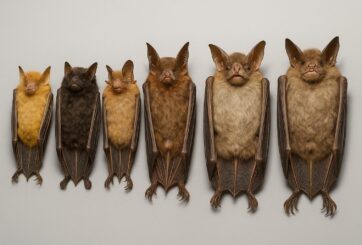
Just in time for Halloween, researchers from the Royal Ontario Museum (ROM), the Field Museum in Chicago, and Lawrence University in Wisconsin have announced the discovery of six new species of bats. These newly identified species, all found in the Philippines, belong to the group known as tube-nosed bats—a fascinating and diverse branch of the mammal family tree. Expanding the Tree of Life Formally recognized as new species through morphological and genetic analysis, this discovery expands the already impressive global…
In a recent study published today in the European Geosciences Union (EGU) journal Biogeosciences, scientists have confirmed that mercury pollution from artisanal and small-scale gold mining (ASGM) is contaminating food crops not through the soil, as previously believed, but directly from the air. Driven by the surging price of gold, which has increased by more than tenfold since 2000, the rapid expansion of unregulated mining in these regions raises urgent questions about food security, human health, and environmental justice The…
A new study from Iceland’s Surtsey island shows that birds carried most of the plants that colonised the island, challenging long-held beliefs that seed or fruit shape determines how plants spread — offering fresh insight into life’s adaptation to c When the volcanic island of Surtsey rose from the North Atlantic Ocean in 1963, it offered scientists a once-in-a-lifetime opportunity to observe how life takes hold on a brand-new and barren land. For decades, ecologists believed that plants’ ability to…
 Feedback
