



Feeding 9 Billion: Innovations in Agricultural Modeling
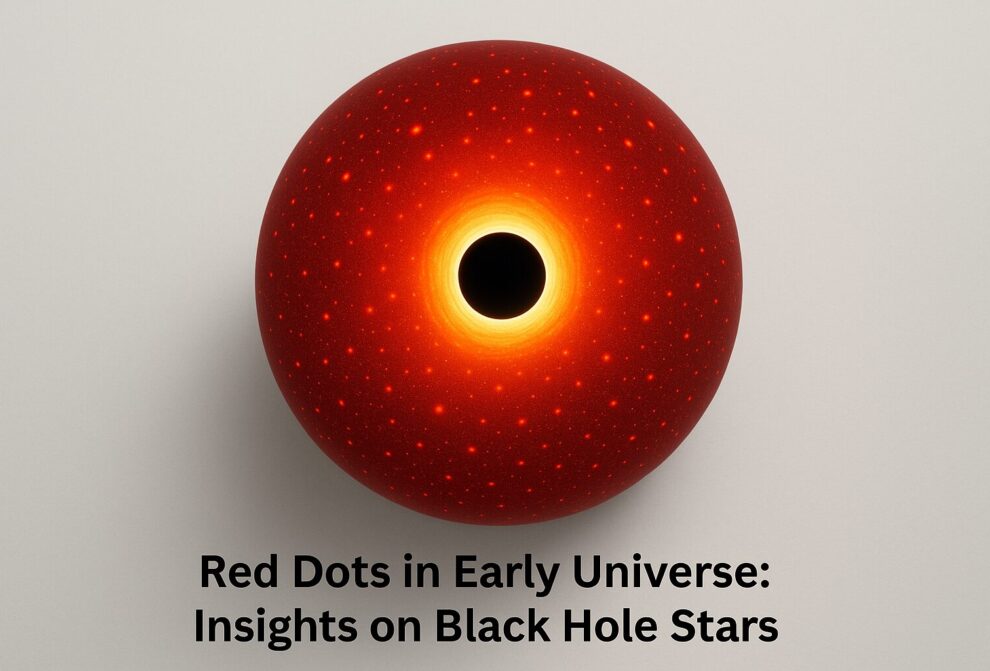
AI Generated Image
UNIVERSITY PARK, Pa. — Tiny crimson specks discovered by NASA’s James Webb Space Telescope (JWST) could represent an entirely new class of cosmic object — massive black holes wrapped in star-like atmospheres — offering fresh insights into how the first galaxies may have formed.
When JWST began sending data in 2022, astronomers were startled by the presence of tiny “little red dots” scattered across the early universe. Initially, researchers, including a team from Penn State, proposed that these objects might be ancient galaxies—fully developed just 500 to 700 million years after the Big Bang, despite being as mature as the present-day Milky Way, which is about 13.6 billion years old.
Because such fully formed galaxies at that early epoch would defy existing models of cosmic evolution, the researchers nicknamed these objects “universe breakers.”
In a new study published on Sept. 12 in Astronomy & Astrophysics, an international collaboration of astronomers and physicists, including Penn State scientists, offers a radically different interpretation. They suggest these red dots might not be galaxies at all, but rather “black hole stars” — giant spheres of gas powered by supermassive black holes at their centers.
According to the team, these objects emit light like stars but are fueled not by nuclear fusion, but by the rapid consumption of surrounding matter by central black holes. The inflowing matter converts to energy, producing an intense glow.
“Basically, we looked at enough red dots until we saw one that had so much atmosphere that it couldn’t be explained as typical stars we’d expect from a galaxy,” said Joel Leja, the Dr. Keiko Miwa Ross Mid-Career Associate Professor of Astrophysics at Penn State and co-author of the study. “It’s an elegant answer really, because we thought it was a tiny galaxy full of many separate cold stars, but it’s actually, effectively, one gigantic, very cold star.”
Cold stars emit very little visible light, glowing mainly in red or near-infrared wavelengths. While gas near black holes is usually extremely hot—millions of degrees Celsius—the emission from these mysterious dots appears dominated by cold gas. This unusual signature resembles that of low-mass, cold stars, not typical galactic structures.
JWST, the most powerful space telescope ever built, can detect light from the universe’s earliest stars and galaxies. Leja noted that the telescope essentially allows scientists to see back about 13.5 billion years. Soon after it launched, researchers around the world began spotting these unexpectedly massive red dots, which appeared far denser than existing galaxy models could explain.
“The night sky of such a galaxy would be dazzlingly bright,” said Bingjie Wang, now a NASA Hubble Fellow at Princeton University who worked on the study as a postdoctoral researcher at Penn State. “If this interpretation holds, it implies that stars formed through extraordinary processes that have never been observed before.”
To unlock the mystery, the team spent nearly 60 hours of JWST observing time between January and December 2024 collecting spectra—data showing how much light objects emit at different wavelengths—from about 4,500 distant galaxies. This created one of the largest JWST spectroscopic datasets to date.
In July 2024, they identified a particularly extreme object, nicknamed “The Cliff,” whose spectrum indicated enormous mass. Its light took 11.9 billion years to reach Earth, and analysis revealed it was likely a supermassive black hole enveloped in a massive shell of hydrogen gas.
“The extreme properties of The Cliff forced us to go back to the drawing board, and come up with entirely new models,” said Anna de Graaff, a researcher at the Max Planck Institute for Astronomy and the paper’s corresponding author, in a Max Planck Institute press release.
Leja explained that black holes reside at the centers of most galaxies and can be millions or billions of times the mass of the Sun. How they formed has long puzzled scientists.
“No one’s ever really known why or where these gigantic black holes at the center of galaxies come from,” Leja said. “These black hole stars might be the first phase of formation for the black holes that we see in galaxies today — supermassive black holes in their little infancy stage.”
Leja added that JWST has already found hints of high-mass black holes in the early universe. These “black hole star” objects—if confirmed—could fill a key gap in models of how cosmic structures emerged so quickly after the Big Bang. The team plans further studies to measure their density and energy output.
Despite the breakthrough, the red dots remain distant, tiny, and difficult to study in detail.
“This is the best idea we have and really the first one that fits nearly all of the data, so now we need to flesh it out more,” Leja said. “It’s okay to be wrong. The universe is much weirder than we can imagine and all we can do is follow its clues. There are still big surprises out there for us.”
Original Publication
Authors: Anna de Graaff, Hans-Walter Rix, Rohan P. Naidu, Ivo Labbé, Bingjie Wang, Joel Leja, Jorryt Matthee, Harley Katz, Jenny E. Greene, Raphael E. Hviding, Josephine Baggen, Rachel Bezanson, Leindert A. Boogaard, Gabriel Brammer, Pratika Dayal, Pieter van Dokkum, Andy D. Goulding, Michaela Hirschmann, Michael V. Maseda, Ian McConachie, Tim B. Miller, Erica Nelson, Pascal A. Oesch, David J. Setton, Irene Shivaei, Andrea Weibel, Katherine E. Whitaker and Christina C. Williams.
Journal: Astronomy and Astrophysics
DOI: 10.1051/0004-6361/202554681
Method of Research: Imaging analysis
Subject of Research: Not applicable
Article Title: A remarkable ruby: Absorption in dense gas, rather than evolved stars, drives the extreme Balmer break of a little red dot at z = 3.5
Article Publication Date: 12-Sep-2025
Original Source: https://www.psu.edu/news/research/story/mysterious-red-dots-early-universe-may-be-black-hole-star-atmospheres
The Cliff is not powered by a dense population of evolved stars, as previously thought, but rather by a central ionizing source, likely a black hole, surrounded by dense gas.
The Balmer break in The Cliff is exceptionally strong, more than twice as strong as any previously observed in high-redshift galaxies, indicating a unique spectral characteristic.
The findings suggest that some compact, high-redshift sources previously thought to be ultra-dense galaxies may actually be powered by active galactic nuclei, challenging existing models of galaxy formation and evolution.




Researchers have achieved a breakthrough in solar physics by providing the first direct evidence of small-scale torsional Alfvén waves in the Sun’s corona – elusive magnetic waves that scientists have been searching for since the 1940s. Researchers have achieved a breakthrough in solar physics by providing the first direct evidence of small-scale torsional Alfvén waves in the Sun’s corona – elusive magnetic waves that scientists have been searching for since the 1940s. The discovery, published today in Nature Astronomy, was…
Using a global network of telescopes, astronomers have detected the lowest-mass dark object yet found in the universe. Finding more such objects and understanding their nature could rule out some theories about the nature of dark matter, the mystery substance that makes up about a quarter of the universe. The work is described in two papers published Oct. 9 in Nature Astronomy and Monthly Notices of the Royal Astronomical Society. Because the object does not emit any light or other radiation, it was…
Scientists digging through data collected by the Cassini spacecraft have found new complex organic molecules spewing from Saturn’s moon Enceladus. This is a clear sign that complex chemical reactions are taking place within its underground ocean. Some of these reactions could be part of chains that lead to even more complex, potentially biologically relevant molecules. Published today in Nature Astronomy, this discovery further strengthens the case for a dedicated European Space Agency (ESA) mission to orbit and land on Enceladus….
European astronomers have produced the most accurate three-dimensional map to date of star-forming regions within our Milky Way galaxy, using data from the European Space Agency’s Gaia space telescope. The new map offers an unprecedented look at the dense, cloudy regions where new stars are born, shedding light on the young, hot stars that sculpt these cosmic nurseries. Mapping Star Formation Hidden Behind Dust Studying star-forming regions is challenging because thick clouds of gas and dust obscure them from view,…
 Feedback
