
… paves the way to cost-effective satellite-based quantum networks. Researchers demonstrate successful quantum key distribution between space lab and four ground stations. Researchers report an experimental demonstration of a space-to-ground quantum key distribution (QKD) network using a compact QKD terminal aboard the Chinese Space Lab Tiangong-2 and four ground stations. The new QKD system is less than half the weight of the system the researchers developed for the Micius satellite, which was used to perform the world’s first quantum-encrypted virtual…
Spiraling laser light reveals how topological insulators lose their ability to conduct electric current on their surfaces. Topological insulators, or TIs, have two faces: Electrons flow freely along their surface edges, like cars on a superhighway, but can’t flow through the interior of the material at all. It takes a special set of conditions to create this unique quantum state – part electrical conductor, part insulator – which researchers hope to someday exploit for things like spintronics, quantum computing and…
Research team led by Göttingen University observes formation of “dark” moiré interlayer excitons for the first time. An international research team led by the University of Göttingen has, for the first time, observed the build-up of a physical phenomenon that plays a role in the conversion of sunlight into electrical energy in 2D materials. The scientists succeeded in making quasiparticles – known as dark Moiré interlayer excitons – visible and explaining their formation using quantum mechanics. The researchers show how…
Groundbreaking observation from Gemini Observatory suggests this and possibly other colossal stars are less massive than previously thought. By harnessing the capabilities of the 8.1-meter Gemini South telescope in Chile, which is part of the International Gemini Observatory operated by NSF’s NOIRLab, astronomers have obtained the sharpest image ever of the star R136a1, the most massive known star in the Universe. Their research, led by NOIRLab astronomer Venu M. Kalari, challenges our understanding of the most massive stars and suggests…
Researchers from Göttingen (Germany) and Lausanne (Switzerland) have successfully created electron-photon pairs in a controlled way in an electron microscope for the first time. Using a new method, they could precisely detect the involved particles. The findings of the study expand the toolbox of quantum technology. Faster computers, tap-proof communication, better car sensors – quantum technologies have the potential to revolutionize our lives just as once the invention of computers or the internet. Experts worldwide are trying to implement findings…
Impacts affect the porosity and structure of moons and planets more dramatically than scientists suspected, increasing their potential habitability for life. The harder you hit something – a ball, a walnut, a geode – the more likely it is to break open. Or, if not break open, at least lose a little bit of its structural integrity, the way baseball players pummel new gloves to make them softer and more flexible. Cracks, massive or tiny, form and bear a silent,…
A plasma-based method may one day convert carbon dioxide into oxygen and produce fuels, fertilizers on the red planet. An international team of researchers came up with a plasma-based way to produce and separate oxygen within the Martian environment. It’s a complementary approach to NASA’s Mars Oxygen In-Situ Resource Utilization Experiment, and it may deliver high rates of molecule production per kilogram of instrumentation sent to space. Such a system could play a critical role in the development of life-support…
Ready for its close-up: When scientists unveiled humanity’s historic first image of a black hole in 2019 — depicting a dark core encircled by a fiery aura of material falling toward it — they believed even richer imagery and insights were waiting to be teased out of the data. Simulations predict that, obscured by that bright orange glow, there should exist a thin, bright ring of light created by photons flung around the back of the black hole by its…
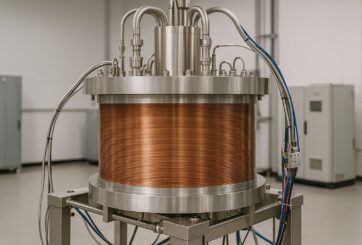
The hybrid magnet at the Steady High Magnetic Field Facility (SHMFF) in Hefei, China set a world record for the highest steady magnetic field by a working magnet when it produced a steady field of 45.22 tesla (T) on Aug. 12. It broke the previous world record of 45 tesla set in 1999 by a hybrid magnet at the National High Magnetic Field Laboratory of the United States. This 45.22-tesla hybrid magnet is composed of a resistive insert nested in…
Below Europa’s thick icy crust is a massive, global ocean where the snow floats upwards onto inverted ice peaks and submerged ravines. The bizarre underwater snow is known to occur below ice shelves on Earth, but a new study shows that the same is likely true for Jupiter’s moon, where it may play a role in building its ice shell. The underwater snow is much purer than other kinds of ice, which means Europa’s ice shell could be much less…
A new method for shaping matter into complex shapes, with the use of ‘twisted’ light, has been demonstrated in research at the University of Strathclyde. When atoms are cooled to temperatures close to absolute zero (-273 degrees C), they stop behaving like particles and start to behave like waves. Atoms in this condition, which are known as Bose–Einstein condensates (BECs), are useful for purposes such as realisation of atom lasers, slow light, quantum simulations for understanding the complex behaviour of…
International research team led by Göttingen University controls interaction of charge carriers. An international research team led by the University of Göttingen has detected novel quantum effects in high-precision studies of natural double-layer graphene and has interpreted them together with the University of Texas at Dallas using their theoretical work. This research provides new insights into the interaction of the charge carriers and the different phases, and contributes to the understanding of the processes involved. The LMU in Munich and…
Physicists love to smash particles together and study the resulting chaos. Therein lies the discovery of new particles and strange physics, generated for tiny fractions of a second and recreating conditions often not seen in our universe for billions of years. But for the magic to happen, two beams of particles must first collide. Researchers at the U.S. Department of Energy’s Fermi National Accelerator Laboratory have announced the first successful demonstration of a new technique that improves particle beams. This…
UChicago scientists create method to efficiently calculate quantum phase transitions. From water boiling into steam to ice cubes melting in a glass, we’ve all seen the phenomenon known as a phase transition in our everyday lives. But there’s another type of phase transition that’s much harder to see, but just as stark: quantum phase transitions. When cooled to near absolute zero, certain materials can undergo these quantum phase transitions, which can make a physicist’s jaw drop. The material can flip from being…
Our modern understanding of the physical world is based on gauge theories: mathematical models from theoretical physics that describe the interactions between elementary particles (such as electrons or quarks) and explain quantum mechanically three of the fundamental forces of nature: the electromagnetic, weak, and strong forces. The fourth fundamental force, gravity, is described by Einstein’s theory of general relativity, which, while not yet understood in the quantum regime, is also a gauge theory. Gauge theories can also be used to…
Stampede2 supercomputer simulates star seeding, heating effects of primordial black holes. Just milliseconds after the universe’s Big Bang, chaos reigned. Atomic nuclei fused and broke apart in hot, frenzied motion. Incredibly strong pressure waves built up and squeezed matter so tightly together that black holes formed, which astrophysicists call primordial black holes. Did primordial black holes help or hinder formation of the universe’s first stars, eventually born about 100 million years later? Supercomputer simulations helped investigate this cosmic question, thanks…
 Feedback


