
On Nature Photonics a new research, that shows the unprecedented performances of an extremely thin nonlinear material. A new bidimensional semiconductor shows the highest nonlinear optical efficiency over nanometer thicknesses. This is the result of a new study recently published in Nature Photonics by Xinyi Xu, PhD student of Columbia University, and Chiara Trovatello, postdoctoral research scientist at the Physics Department of Politecnico di Milano, together with Prof. Giulio Cerullo from the Physics Department of Politecnico di Milano, Dmitri N. Basov and…
Quantum materials: entanglement of many atoms discovered for the first time. Be it magnets or superconductors: materials are known for their various properties. However, these properties may change spontaneously under extreme conditions. Researchers at the Technische Universität Dresden (TUD) and the Technische Universität München (TUM) have discovered an entirely new type of such phase transitions. They display the phenomenon of quantum entanglement involving many atoms, which previously has only been observed in the realm of few atoms. The results were…
Linear analysis plays a central role in science and engineering. Even when dealing with nonlinear systems, understanding the linear response is often crucial for gaining insight into the underlying complex dynamics. In recent years, there has been a great interest in studying open systems that exchange energy with a surrounding reservoir. In particular, it has been demonstrated that open systems whose spectra exhibit non-Hermitian singularities called exceptional points can demonstrate a host of intriguing effects with potential applications in building…
EP-WXT Pathfinder, the experimental version of a module that will eventually be part of the wide-field X-ray telescope (WXT) aboard the astronomical satellite Einstein Probe (EP), released its first results Aug. 27 from an earlier test flight. These include an 800-second X-ray time-lapse photograph of a region of the Galactic center, a dense area at the core of our home galaxy, the Milky Way. These mark the first wide-field X-ray snapshots of our universe available to the public so far,…
Application of Non-Bravais lattices to light control technology. A novel light-manipulating technology has been developed by an international team, including Kyoto University, that can be applied to lasers, sensors, and nonlinear optics. The technique tightly confines near-infrared light within a nanodisk periodic structure. By breaking the symmetry of the periodic square lattice of silicon nanodisks, the team has demonstrated experimentally and computationally their ability to systematically control bound states in the continuum, or BICs. These light distribution states result from…
Simulations show steam kills bacteria on a plate in 25 seconds without soap. Conventional dishwashers often do not kill all the harmful microorganisms left on plates, bowls, and cutlery. They also require long cycle times that use large quantities of electricity, and the soap pumped in and out is released into water sources, polluting the environment. Superheated steam dishwashers could provide a more effective, environmentally friendly solution. In Physics of Fluids, by AIP Publishing, researchers from the Technical University of…
Physicists at the Max Planck Institute of Quantum Optics have managed to entangle more than a dozen photons efficiently and in a defined way. They are thus creating a basis for a new type of quantum computer. In order to effectively use a quantum computer, a larger number of specially prepared – in technical terms: entangled – basic building blocks are needed to carry out computational operations. A team of physicists at the Max Planck Institute of Quantum Optics in…
Simple simulation accidentally leads to X-shaped galaxy for first time. When astronomers use radio telescopes to gaze into the night sky, they typically see elliptical-shaped galaxies, with twin jets blasting from either side of their central supermassive black hole. But every once in a while — less than 10% of the time — astronomers might spot something special and rare: An X-shaped radio galaxy, with four jets extending far into space. Although these mysterious X-shaped radio galaxies have confounded astrophysicists…
Physicists from TU Delft, ETH Zürich and the University of Tübingen have built a quantum scale heat pump made from particles of light. This device brings scientists closer to the quantum limit of measuring radio frequency signals, useful in for example the hunt for dark matter. Their work will be published as an open-access article in Science Advances on 26 August. If you bring two objects of different temperature, such as putting a warm bottle of white wine into a…
LunaH-Map is designed to find and map water ice at the Moon’s South Pole. The Lunar Polar Hydrogen Mapper (LunaH-Map) mission is one of the tiniest NASA planetary science missions but has big science goals. Previous missions and studies have identified the presence of water-ice at the Moon’s poles. However, there are still unanswered questions about how much water-ice is contained within permanently shadowed regions. It is also unknown how much water-ice might be retained at depth throughout illuminated regions…
Scientists from the Max Planck Institute for the Science of Light and the Friedrich-Alexander-Universität Erlangen-Nürnberg in cooperation with Sandia National Laboratories have successfully created photon pairs at several different frequencies using resonant metasurfaces. A photon is the quantum (the minimum amount involved in an interaction) of any form of electromagnetic radiation, such as light. Photons are essential to a number of current research fields and technologies, like quantum state engineering, which in turn represents the cornerstone of all quantum photonic…
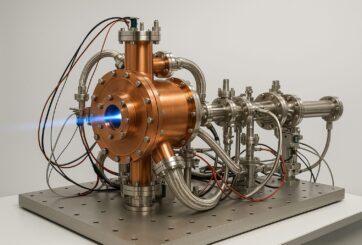
New add-on could enhance the research opportunities at X-ray lasers. The Photo Injector Test Facility at DESY in Zeuthen (PITZ) has reached a major milestone: a free-electron laser (FEL) driven by the photoinjector has generated its first laser light in the Terahertz (THz) wavelength regime. Pulses with a wavelength of about 0.1 millimetres were produced with a repetition rate of up to one Megahertz. The laser is the first high-power Terahertz FEL worldwide working according to the so-called SASE principle,…
New optics-on-a-chip device paves the way to helping characterize fast chemical, material, and biological processes. The Science Optical microelectromechanical systems (MEMS) are tiny microchip-size devices that control light and communications. Separately, time-resolved X-ray probes are devices that help scientists study highly transient phenomena. These phenomena are short-lived and involve fast structural and functional changes. Scientists have now developed X-ray optics based on specially designed and fabricated MEMS that can harness extremely short X-ray pulses. The new devices are much smaller…
An international team of researchers led by Charles Cadieux, a Ph.D. student at the Université de Montréal and member of the Institute for Research on Exoplanets (iREx), has announced the discovery of TOI-1452 b, an exoplanet orbiting one of two small stars in a binary system located in the Draco constellation about 100 light-years from Earth. The exoplanet is slightly greater in size and mass than Earth and is located at a distance from its star where its temperature would…
Astronomers frequently observe carbon monoxide in planetary nurseries. The compound is ultra-bright and extremely common in protoplanetary disks — regions of dust and gas where planets form around young stars — making it a prime target for scientists. But for the last decade or so, something hasn’t been adding up when it comes to carbon monoxide observations, says Diana Powell, a NASA Hubble Fellow at the Center for Astrophysics | Harvard & Smithsonian. A huge chunk of carbon monoxide is missing in all observations…
Lasers are everywhere. Devices that use them transmit information and enable the existence of long-distance communications and the internet; they aid doctors performing surgeries and engineers manufacturing advanced tools and technologies; and day-to-day, we encounter lasers as we scan our groceries and watch DVDs. “In the 60-some years since they were invented, lasers have absolutely transformed our lives,” said Giulio Cerullo, a nonlinear optics researcher at Politecnico di Milano in Italy. Today, with the help of new research from Cerullo…
 Feedback


