
New results may lead to advances in nanotechnology, molecular electronics
Scientists from the U.S. Department of Energy’s Brookhaven National Laboratory, Bar-Ilan University, and Harvard University have grown ultrathin films of organic chain molecules on the surface of liquid mercury and discovered that the molecules form ordered structures. Similar to sixty years ago when fundamental studies of silicon paved the way to the semiconductor-electronics age, these results help to build
14 January 2005, after its seven-year journey through the Solar System on board the Cassini spacecraft, ESA’s Huygens probe has successfully descended through the atmosphere of Titan, Saturn’s largest moon, and safely landed on its surface.
The first scientific data arrived at the European Space Operations Centre (ESOC) in Darmstadt, Germany, this afternoon at 17:19 CET. Huygens is mankind’s first successful attempt to land a probe on another world in the outer Solar System. “This
Middleweight matchup to provide control data in exploration of new form of matter
Scientists searching for evidence that a particle accelerator at the U.S. Department of Energy’s Brookhaven National Laboratory has created a new form of matter not seen since the Big Bang and eager to study its properties have begun using a new experimental probe, collisions between two beams of copper ions. The use of intermediate size nuclei is expected to result in intermediate energy density
Results from experiments at CERN and the Jyväskylä Accelerator Laboratory in Finland, reported in Nature today, cast new light on the primary reaction that creates carbon in stars. All the carbon in the Universe, including that needed for carbon-based life forms such as ourselves, has been made in the hearts of stars through what is known as the “triple alpha reaction”. The new findings modify the rate at which the reaction occurs and have broad implications for astrophysics, from the formation
Turn out the light!
A collaborative team of researchers has discovered what turns the lights out from space. Using sophisticated features on a transmission electron microscope, John P. Bradley, Ph.D., Director of the Institute for Geophysics and Planetary Physics at Lawrence Livermore National Laboratory, has discovered that organic carbon and amorphous silicates in interstellar grains embedded within interplanetary dust particles (IDPs) are the carriers of the astronomical 2175 Å
Astronomers are announcing today the first results of a search for extrasolar planets and brown dwarfs in an unlikely place–the stellar graveyard. The report, titled “Searching for Extrasolar Planets in the Stellar Graveyard,” is being presented at the American Astronomical Society meeting in San Diego, California, by John Debes, a graduate student at Penn State; Steinn Sigurdsson, associate professor of astronomy and astrophysics at Penn State University; Bruce Woodgate, of the NASA Goddard Spa
An ancient mystery may have been solved by LSU Associate Professor of Physics and Astronomy Bradley E. Schaefer.
Schaefer has discovered that the long-lost star catalog of Hipparchus, which dates back to 129 B.C., appears on a Roman statue called the Farnese Atlas. Hipparchus was one of the greatest astronomers of antiquity and his star catalog was the first in the world, as well as the most influential. The catalog was lost early in the Christian era, perhaps in the fire at the gr
As big fish eat little fish in the Earth’s vast oceans, so too do supermassive black holes gorge on smaller black holes and neutron stars, making themselves more massive in the process. Using sophisticated computer modeling, Penn State scientists have calculated the rate of this black-hole snacking, called “extreme-mass-ratio inspirals.” They expect to see several events per year with the Laser Interferometer Space Antennae (LISA), a joint NASA – European Space Agency mission now in develop
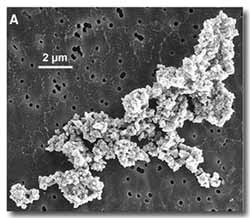
Carbon and silicate grains in interplanetary dust particles are helping scientists solve a 40-year-old astronomical mystery.
Using a transmission electron microscope, researchers from Lawrence Livermore National Laboratory have detected a 5.7-electron volt or 2175 Å (angstrom) wavelength feature in interstellar grains that were embedded within interplanetary dust particles (IDPs). They found that this feature is carried by carbon and amorphous silicate grains that are abundant in
For the first time, astronomers have been able to combine the deepest optical images of the universe, obtained by the Hubble Space Telescope, with equally sharp images in the near-infrared part of the spectrum using a sophisticated new laser guide star system for adaptive optics at the W. M. Keck Observatory in Hawaii. The new observations, presented at the American Astronomical Society (AAS) meeting in San Diego this week, reveal unprecedented details of colliding galaxies with massive black hol
Professor Glennys R. Farrar, a physicist at New York University, today announced that, for the first time, a source of ultra-high energy cosmic rays has been isolated and studied, a major breakthrough in the field. Ultra-high energy cosmic rays–which rarely hit the earth–are believed to be the result of extremely powerful cosmic phenomena, such as the creation or accretion of massive black holes. In addition to elucidating the origin of these remarkable particles and the systems that crea
Observations eventually expected lead to increased understanding of interstellar dust and gas
Using NASA’s orbiting Far Ultraviolet Spectroscopic Explorer, a team of astronomers from The Johns Hopkins University and elsewhere has taken an unprecedented peek beneath the “skirts” of the tunic-clad Orion the Hunter and come away with observations that may lead to enhanced knowledge of how interstellar dust absorbs and scatters ultraviolet starlight. “Understanding interstellar dust i
Huge gas disk may be similar to stuff of early universe
An astronomer studying small irregular galaxies has discovered a remarkable feature in one of them that may provide key clues to understanding how galaxies form and the relationship between the gas and the stars within galaxies.
Liese van Zee of Indiana University Bloomington, using the National Science Foundation’s Very Large Array radio telescope in New Mexico, found that a small galaxy 16 million light-yea
Hubble astronomers have uncovered, for the first time, a population of infant stars in the Milky Way satellite galaxy, the Small Magellanic Cloud (SMC, visible to the naked eye in the southern constellation Tucana), located 210,000 light-years away.
The exquisite sharpness of the NASA/ESA Hubble Space Telescope has plucked out an underlying population of infant stars embedded in the nebula NGC 346 that are still forming from gravitationally collapsing gas clouds. They have not
Astronomers using the Gemini South 8-meter telescope in Chile have observed new details in the dusty disk surrounding the nearby star Beta Pictoris which show that a large collision between planetary-sized bodies may have occurred there as recently as the past few decades.
The mid-infrared observations provide the best evidence yet for the occurrence of energetic encounters between planetesimals (small bodies formed of rock or ice) during the process of planetary formation. Amaz
Major Observing Programme Leads to New Theory of Galaxy Formation
Most present-day large galaxies are spirals, presenting a disc surrounding a central bulge. Famous examples are our own Milky Way or the Andromeda Galaxy. When and how did these spiral galaxies form? Why do a great majority of them present a massive central bulge?
An international team of astronomers [1] presents new convincing answers to these fundamental questions. For this, they rely on an extensive data
 Feedback


