
Surrounded by a vast ocean underneath a thick ice shell, Enceladus is a hot candidate for potentially harboring alien life. A team of researchers led by the University of Arizona concluded that a future mission could provide answers even without landing on the tiny world. The mystery of whether microbial alien life might inhabit Enceladus, one of Saturn’s 83 moons, could be solved by an orbiting space probe, according to a new study led by University of Arizona researchers. In…
Researchers have uncovered a previously hidden heating process that helps explain how the atmosphere that surrounds the Sun called the “solar corona” can be vastly hotter than the solar surface that emits it. The discovery at the U.S. Department of Energy’s (DOE) Princeton Plasma Physics Laboratory (PPPL) could improve tackling a range of astrophysical puzzles such as star formation, the origin of large-scale magnetic fields in the universe, and the ability to predict eruptive space weather events that can disrupt…
Electromagnetic noise poses a major problem for communications, prompting wireless carriers to invest heavily in technologies to overcome it. But for a team of scientists exploring the atomic realm, measuring tiny fluctuations in noise could hold the key to discovery. “Noise is usually thought of as a nuisance, but physicists can learn many things by studying noise,” said Nathalie de Leon, an associate professor of electrical and computer engineering at Princeton University. “By measuring the noise in a material, they…
An international team of scientists led by Lucile Turc, an Academy Research Fellow at the University of Helsinki and supported by the International Space Science Institute in Bern has studied the propagation of electromagnetic waves in near-Earth space for three years. The team has studied the waves in the area where the solar wind collides with Earth’s magnetic field called foreshock region, and how the waves are transmitted to the other side of the shock. The results of the study are…
– breaking the single channel scattering limit. Recently, the National Science Review published the study of Huaping Wang’s group at Zhejiang University online. Inspired by electromagnetic metamaterials, the research team designed and fabricated a water wave superscattering device based on degeneracy resonance by using the similarity of water wave equation and electromagnetic wave equation under shallow water conditions, which was realized it experimentally. Water waves are a very intuitive fluctuating phenomenon that is widely observed in the natural world. Understanding…
The new method bridges the quantum and classical worlds and could improve measurements in quantum computers and other applications. We see the world around us because light is being absorbed by specialized cells in our retina. But can vision happen without any absorption at all – without even a single particle of light? Surprisingly, the answer is yes. Imagine that you have a camera cartridge that might contain a roll of photographic film. The roll is so sensitive that coming…
Chemical processes are all around us. From novel materials to more effective medicines or plastic products – chemical reactions play a key role in the design of the things we use every day. Scientists constantly search for better ways to control these reactions, for example to develop new materials. Now an international research team led by the MPSD has found an explanation why chemical reactions are slowed down inside mirrored cavities, where molecules are forced to interact with light. Its…
This study comes from Prof. Duanduan Wan and Prof. Meng Xiao group at the School of Physics of Wuhan University. This work provides a simple while intuitive example by demonstrating with both theory and circuit experiments an “exceptional nexus” (“EX”), a higher-order exceptional point (HOEP). This HOEP is realized within only two coupled resonators with the aid of nonlinear gain. Moreover, such a HOEP exhibits an ultra-enhanced signal-to-noise ratio. The recent advances in non-Hermitian physics, such as sensitivity enhancement, skin…
The use of light to produce transient phases in quantum materials is fast becoming a novel way to engineer new properties in them, such as the generation of superconductivity or nanoscale topological defects. However, visualizing the growth of a new phase in a solid is not easy, due in-part to the wide range of spatial and time scales involved in the process. Although in the last two decades scientists have explained light-induced phase transitions by invoking nanoscale dynamics, real space…
Positrons can be produced by bombarding high-current and high-energy electrons into a target made of heavy metal, such as tungsten. However, not only positrons but also substantially equal numbers of electrons are produced in the target and they are simultaneously captured by electric and magnetic forces in the positron capture section, which is subsequently located after the target. Positrons are separated from electrons by magnetic force just after the capture section. It is very difficult to independently detect positrons and…
A research group led by Prof. WU Kaifeng from the Dalian Institute of Chemical Physics (DICP), Chinese Academy of Sciences recently reported the successful initialization, coherent quantum-state control, and readout of spins at room temperature using solution-grown quantum dots, which represents an important advance in quantum information science. The study was published in Nat. Nanotechnol. on Dec 19th. Quantum information science is concerned with the manipulation of the quantum version of information bits (called qubits). When people talk about materials…
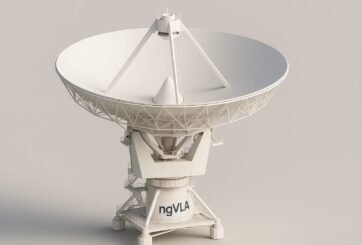
The design for the Next Generation Very Large Array (ngVLA) prototype antenna has passed an intensive, five-day review, clearing the way to begin manufacturing the prototype antenna. The review in Wiesbaden, Germany was attended by scientists and engineers from the National Science Foundation (NSF), the NSF’s National Radio Astronomy Observatory (NRAO), and mtex antenna technology GmbH, the firm contracted to develop the design and produce the prototype. The NRAO and mtex representatives presented details of the design to a panel…
A scientific team at the Facility for Rare Isotope Beams (FRIB) at Michigan State University (MSU) has developed a new optical detector. This development will enable scientific users to help generate new insights and breakthroughs in nuclear physics. The team’s findings are detailed in an “Editor’s Pick” paper published in Review of Scientific Instruments. The Energy Loss Optical Scintillation System (ELOSS) represents an advancement in both instrumentation and capabilities in experimental nuclear physics. The new detector allows researchers to study isotopes…
Astronomers say they have solved an outstanding problem that challenged our understanding of how the Universe evolved – the spatial distribution of faint satellite galaxies orbiting the Milky Way. These satellite galaxies exhibit a bizarre alignment – they seem to lie on an enormous thin rotating plane – called the “plane of satellites” This seemingly unlikely arrangement had puzzled astronomers for over 50 years, leading many to question the validity of the standard cosmological model that seeks to explain how…
The EU Commission is providing 2.14 million euros in funding to take the GENE simulation code developed at the Max Planck Institute for Plasma Physics (IPP) to a new level. By using exascale supercomputers, it enable digital twins of nuclear fusion experiments such as ITER in future. IPP, the Max Planck Computing and Data Facility (MPCDF) and the Technical University of Munich will work together on the project. Plasma physics has been one of the most important drivers for the…
New computer simulations can go where experiments reach their limits. Scientists from the Center of Applied Space Technology and Microgravity (ZARM) at the University of Bremen have developed a computer code that enables accurate predictions of the disintegration of droplets in turbulent flows. Surprisingly it shows that there is no point in time when a liquid drop cannot break up into even smaller drops. The results are published in the journal Science Advances and the open source computer code is…
 Feedback


