
These particles cannot travel through the atmosphere to harm humans on Earth, but they can affect electronic systems in satellites and on the ground.Experimental NASA research models, based on observations from NASA’s Solar Terrestrial Relations Observatory show that the CME left the sun at speeds of around 380 miles per second, which is a fairly common speed for CMEs….
Astronomers at the University of Arizona, the Arcetri Observatory near Florence, Italy and the Carnegie Observatory have developed a new type of camera that…
That is important because a star’s surface gravity is one of the key properties that astronomers use to calculate a star’s physical properties and assess its…
During their formative years, stars both take in and blast away tremendous amounts of matter. When this ejected material collides with the surrounding gas it…
Furthermore, they say the algorithm could be used to calculate complex measurements such as radar cross sections, an ability integral to the development of…
These particles cannot travel through the atmosphere to harm humans on Earth, but they can affect electronic systems in satellites and on the ground.Experimental NASA research models, based on observations from NASA’s Solar Terrestrial Relations Observatory show that the CME left the sun at speeds of around 570 miles per second, which is a fairly typical speed for CMEs….
Reporting today (Tuesday, Aug. 20) in the journal Physical Review Letters, a team led by computational physicist Philip Marcus shows how variations in gas…
“This is a major step in replenishing an aging TDRS fleet which is essential in providing communications to support space exploration,” said Badri Younes,…
A project called ACTPol in Chile, and another called SuMIRe in Hawaii, are launching massive observation campaigns that will image and map the positions of…
Conventional lenses, made of shaped glass, are limited in how precisely they can redirect beams of incoming light and make them meet at a point. Now, a team…
The team used two cameras, Wide Field Camera 3 (WFC3), and Advanced Camera for Surveys (ACS), plus observations from the Hubble’s Cosmic Assembly Near-infrared…
The hot gas cloud is likely caused by a collision between a dwarf galaxy and a much larger galaxy called NGC 1232. If confirmed, this discovery would mark the…
Carrying Earthly greetings on a gold plated phonograph record and still-operational scientific instruments – including the Low Energy Charged Particle detector…
Just how stars and black holes in the Universe are able to form from rotating matter is one of the big questions of astrophysics. What we do know is that…
Because this field is gradually swallowed by the black hole, it can explain theories of how the black hole feeds and the radio through to X-ray emission…
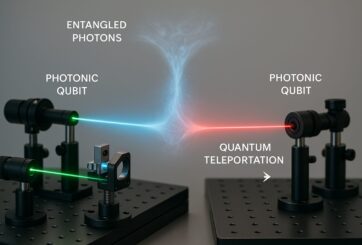
By means of the quantum-mechanical entanglement of spatially separated light fields, researchers in Tokyo and Mainz have managed to teleport photonic qubits…
 Feedback


