
Through nanotechnology, physicists Dr Raymond McQuaid, Dr Amit Kumar and Professor Marty Gregg from Queen's University's School of Mathematics and Physics,…
Radiation is one of the most dangerous risks to humans in space, and one of the most challenging to simulate here on Earth. The risk to human health…
In many ways, magnets are still mysterious. They get their (often powerful) effects from the microscopic interactions of individual electrons, and from the…
Jupiter is not only the largest planet of the Solar System, but it is also the oldest, say researchers from the University of Münster. They, for the first…
Liquids are the least understood state of matter and for a long time it has been believed that they can sustain both gas-like waves with long wavelengths and…
Developing new scientific devices pushing the limits of what we can observe and measure does not occur overnight. There are typically baby steps involved,…
“The goal of exoplanetary astronomy is to find planets that are similar to Earth in composition and potentially habitable,” said Quarles. “For thousands of…
A research team led by the Department of Energy's Oak Ridge National Laboratory has confirmed magnetic signatures likely related to Majorana fermions–elusive…
Researchers have studied how light can be used to “see” the quantum nature of an electronic material. They managed to do that by capturing light in a net of…
Thousands of processors, terabytes of data, and months of computing time have helped a group of researchers in Germany create some of the largest and highest…
“These are waves just like water waves,” said Fei, an Iowa State University assistant professor of physics and astronomy and an associate of the U.S….
The tiny cone-shaped “skimmers” used in experiments looking for exotic chemical-quantum phenomena resemble the intake mechanisms of aircraft engines, and they…
Researchers at the University of Campinas's Gleb Wataghin Physics Institute (IFGW-UNICAMP) in São Paulo State, Brazil, have theoretically developed a silicon…
The galaxy images, magnified through a phenomenon called gravitational lensing, reveal a tangled web of misshapen objects punctuated by exotic patterns such as…
A newly discovered Jupiter-like world is so hot that it's stretching the definition of the word “planet.”
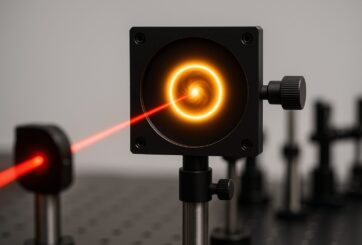
Researchers from CNR NANOTEC of Lecce in Italy, in collaboration with Polytechnique Montreal in Canada have shown that for light “dressed” with electrons, an…
 Feedback


