
Scientists and engineers are ready to fly an infrared mission called EXCITE (EXoplanet Climate Infrared TElescope) to the edge of space. EXCITE is designed to study atmospheres around exoplanets, or worlds beyond our solar system, during circumpolar long-duration scientific balloon flights. But first, it must complete a test flight during NASA’s fall 2024 scientific ballooning campaign from Fort Sumner, New Mexico. “EXCITE can give us a three-dimensional picture of a planet’s atmosphere and temperature by collecting data the whole time the world orbits its…
Physicists from the STAR Collaboration have observed a new antimatter hypernucleus, antihyperhydrogen-4, for the first time. This is the heaviest antimatter hypernucleus discovered in experiments to date. This study, led by researchers from the Institute of Modern Physics (IMP) of the Chinese Academy of Sciences, was published in Nature on Aug. 21. Current physics assumes that the properties of matter and antimatter are symmetrical and that equal amounts of matter and antimatter existed at the birth of the universe. However, some mysterious…
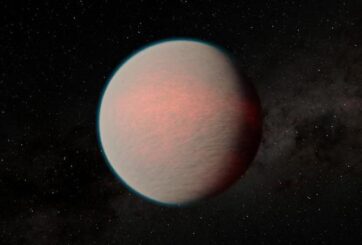
We know that the Earth has an iron core surrounded by a mantle of silicate bedrock and water (oceans) on its surface. Science has used this simple planet model until today for investigating exoplanets – planets that orbit another star outside our solar system. “It is only in recent years that we have begun to realise that planets are more complex than we had thought,” says Caroline Dorn, Professor for Exoplanets at ETH Zurich. Most of the exoplanets known today…
Researchers at the University of Helsinki have succeeded in something that has been pursued since the 1970s: explaining the X-ray radiation from the black hole surroundings. The radiation originates from the combined effect of the chaotic movements of magnetic fields and turbulent plasma gas. Using detailed supercomputer simulations, researchers at the University of Helsinki modeled the interactions between radiation, plasma, and magnetic fields around black holes. It was found that the chaotic movements, or turbulence, caused by the magnetic fields…
– new imaging method for neutral atomic beam microscopes developed by Swansea researchers. Microscope images could be obtained much more quickly – rather than one pixel at a time – thanks to a new imaging method for neutral atomic beam microscopes developed by Swansea University researchers. It could ultimately lead to engineers and scientists getting faster results when they are scanning samples. Neutral atomic beam microscopes are a major focus of research interest at present. They are capable of imaging…
Physicists use modeling to forecast a black hole’s feeding patterns with precision. The dramatic dimming of a light source ~ 860 million light-years away from Earth confirms the accuracy of a detailed model developed by a team of astrophysicists from Syracuse University, MIT and the Space Telescope Science Institute. Powerful telescopes like NASA’s Hubble, James Webb, and Chandra X-ray Observatory provide scientists a window into deep space to probe the physics of black holes. While one might wonder how you…
The electron shell of atoms acts as an “electromagnetic shield”, preventing direct access to the nucleus and its properties. A team in the group of Klaus Blaum, director at the Max Planck Institute for Nuclear Physics in Heidelberg, has now succeeded in precisely measuring the effect of this shielding in beryllium atoms. The magnetic moment of beryllium-9 could was also determined with 40 times better precision than before. Such precision measurements are not only relevant to fundamental physics. They also…
Nanoscale optoelectronics is a rapidly advancing field focused on developing electronic and photonic devices at the nanometer scale. These tiny devices have the potential to revolutionize technology, making components faster, smaller, and more energy-efficient. Achieving precise control over photoreactions at the atomic level is crucial for miniaturizing and optimizing these devices. Localized surface plasmons (LSPs), which are light waves generated on nanoscale material surfaces, have emerged as powerful tools in this domain, capable of confining and enhancing electromagnetic fields. Until…
Berlin-based Ferdinand-Braun-Institut (FBH) and the University of Glasgow to deepen cooperation, focusing on ultra-high-power photonic applications and enhanced exchange of photonics experts and students through the newly established Visiting Professorship of Paul Crump from FBH in Glasgow. Pushing the limits of high-power diode lasers! This is just one of the ambitious goals of the cooperation between the Ferdinand-Braun-Institut (FBH), Berlin, Germany and the University of Glasgow, United Kingdom (UK). The partnership, which began in 2020 has since evolved into a…
Researchers at Institute of Physics Chinese Academy of Sciences(IOPCAS) report the discovery of superconductivity (SC) with Tc ~116 K in new antinomy polyhydride SbH4, which has the second highest Tc among the covalent bonding dominated polyhydrides. The paper was published in National Science Review 11, nwad241 (2024). The experimental discovery of SC with Tc~203 K in SH3 has sparked great enthusiasm to exploring new high-temperature superconducting pollyhydride. Recently, pollyhydride superconductor exploration mainly focuses on the elements with low electronegativity, such…
Global coherence metric offers a reliable way to assess and manage light fields in less-than-ideal conditions. Light technology is at the heart of many cutting-edge innovations, from high-speed internet to advanced medical imaging. However, transmitting light through challenging environments, such as turbulent atmospheres or deformed optical systems, has always posed a significant hurdle. These complexities can distort and disrupt the light field, making it difficult to achieve clear and reliable results. Scientists have long sought ways to overcome these limitations,…
With funding by the US Department of Energy’s National Nuclear Security Administration, N’Gom is designing a probe to detect special nuclear materials remotely. Our nation’s security depends on the effective detection of nuclear materials at our borders and beyond. To address this challenge, Rensselaer Polytechnic Institute (RPI) physicist Moussa N’Gom, Ph.D., is leading research aimed at developing a quantum sensing probe to detect and characterize special nuclear materials precisely and without contact. Special nuclear materials are only mildly radioactive but…
EPFL researchers have published a programmable framework that overcomes a key computational bottleneck of optics-based artificial intelligence systems. In a series of image classification experiments, they used scattered light from a low-power laser to perform accurate, scalable computations using a fraction of the energy of electronics. As digital artificial intelligence systems grow in size and impact, so does the energy required to train and deploy them – not to mention the associated carbon emissions. Recent research suggests that if current…
… It’s just too deep to tap. Seismic data from the Insight lander indicates deep, porous rock filled with liquid water. Using seismic activity to probe the interior of Mars, geophysicists have found evidence for a large underground reservoir of liquid water — enough to fill oceans on the planet’s surface. The data from NASA’s Insight lander allowed the scientists to estimate that the amount of groundwater could cover the entire planet to a depth of between 1 and 2…
In order to make quantum computers usable, developing the control technology is crucial for scaled systems, yet it is still in its infancy. Project ARCTIC brings together 36 international partners from industry, academia and leading RTOs to establish a complete and comprehensive European supply chain and develop scalable, reliable, innovative control infrastructure for cryogenic quantum processors. The German Institutes Fraunhofer IPMS and Fraunhofer IAF contribute their extensive expertise in device characterization. The EU is funding the project with over €…
Two proposals for missions led by the University of Leicester receive £500,000 funding from UK Space Agency. How the Sun influences the atmosphere, space weather and habitability of a planet, as well as the space between the stars, could be investigated by two proposed UK space missions, led by the University of Leicester. A total of nearly £500,000 funding has been granted by the UK Space Agency to two teams based at Space Park Leicester, the University of Leicester’s £100…
 Feedback


