
To understand how planetary systems, including our own, take shape, you have to study their origins. Planet-forming or protoplanetary disks are formed in…
According to modern particle physics, matter produced when neutron stars merge is so dense that it could exist in a state of dissolved elementary particles….
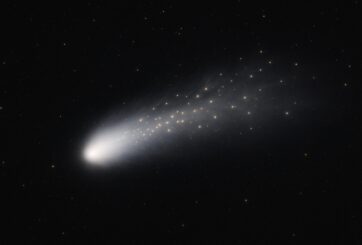
Hubble identified about 30 fragments on April 20, and 25 pieces on April 23. They are all enveloped in a sunlight-swept tail of cometary dust.
Researchers from China Academy of Engineering Physics, Nanjing University and University of Victoria demonstrated ultra-sensitive and stable X-ray detectors by…
When it began observations in 2000, TAMA300 was one of the world's first large-scale interferometric gravitational wave detectors. At that time TAMA300 had the…
It took more than 100 years until the existence of gravitational waves predicted by Albert Einstein in 1915 as part of his general theory of relativity was…
A new method provides a 3-dimensional image using confocal laser scanning microscopy (CLSM). This novel approach allows for much faster measurements.
When a figure skater starts to perform a pirouette and raises her arms, she turns around her own axis increasingly faster due to the conservation of angular…
Researchers at the Max Planck Institute for Dynamics and Self-Organization show that two microscopic non-equilibrium chemically active particles, such as…
For the first time, the entire lunar surface has been completely mapped and uniformly classified by scientists from the USGS, in collaboration with NASA and…
A pencil shaped semiconductor, measuring only a few hundred nanometers in diameter, is what researches from the Center for Quantum Devices, Niels Bohr…
Graphene Flagship researchers at RWTH Aachen University, Germany and ONERA-CNRS, France, in collaboration with researchers at the Peter Grunberg Institute,…
The advent of artificial intelligence, machine learning and the internet of things is expected to change modern electronics and bring forth the fourth…
An international team of scientists have found an easy way to trigger an unusual state of matter called a Bose-Einstein condensate. The new method, recently…
A German-Chinese research team has discovered a new effect that for the first time enables the creation of extremely small magnetic structures, known as…
Carbon nanotubes (CNTs), a model one-dimensional (1D) material made up entirely of carbon atoms, have attracted considerable attention ever since their…
 Feedback


