
A pair of orbiting black holes millions of times the Sun’s mass perform a hypnotic pas de deux in a new NASA visualization. The movie traces how the black holes distort and redirect light emanating from the maelstrom of hot gas – called an accretion disk – that surrounds each one. Viewed from near the orbital plane, each accretion disk takes on a characteristic double-humped look. But as one passes in front of the other, the gravity of the foreground…
Spin waves could unlock the next generation of computer technology, a new component allows physicists to control them. Researchers at Aalto University have developed a new device for spintronics. The results have been published in the journal Nature Communications, and mark a step towards the goal of using spintronics to make computer chips and devices for data processing and communication technology that are small and powerful. Traditional electronics uses electrical charge to carry out computations that power most of our…
It is always exciting to find new isotopes with extreme neutron/proton numbers in nuclear physics research. In the region of heavy nuclei, α-decay is one of the pervasive decay modes and plays an essential role in searching for new isotopes. However, even after about a century of studying α-decay, scientists still cannot perfectly describe how the α-particle is formed at the surface of the nucleus before its emission. In the α-decay process, the α-particle can be regarded not only as…
Experiments at the University of Stuttgart cast doubts on the existence of quantum spin liquids – report in Science. A quantum spin liquid is a state of matter in which interacting quantum spins do not align even at lowest temperatures, but remain disordered. Research on this state has been going on for almost 50 years, but whether it really exists has never been proven beyond doubt. An international team led by physicist Prof. Martin Dressel at the University of Stuttgart…
Uncovering dynamics of ultrasmall, ultrafast groups of atoms … Our high-speed, high-bandwidth world constantly requires new ways to process and store information. Semiconductors and magnetic materials have made up the bulk of data storage devices for decades. In recent years, however, researchers and engineers have turned to ferroelectric materials, a type of crystal that can be manipulated with electricity. In 2016, the study of ferroelectrics got more interesting with the discovery of polar vortices — essentially spiral-shaped groupings of atoms — within…
In April 2019, scientists released the first image of a black hole using the Event Horizon Telescope (EHT). However, that remarkable achievement was just the beginning of the science story to be told. New results are being released today that promise to give unparalleled insight into this black hole, and to improve tests of Einstein’s General Theory of Relativity. The collaborative effort includes a substantial contribution from the Max-Planck-Institut für Radioastronomie including observations with the 100-m radio telescope in Effelsberg….
Building a satellite with artificial intelligence on board that is trained in space: For this project, Professor Hakan Kayal from Würzburg is receiving 2.6 million euros from the German Federal Ministry for Economic Affairs and Energy. Suddenly, circular holes were visible on the surface of Mars that were not there before. On photos of Saturn’s moon Enceladus, geysers were discovered that hurl powerful fountains of steam towards space. And on the images sent to Earth by the Mars rover Curiosity,…
Researchers present results of experiments with atom interferometry on a sounding rocket / Further rocket missions set to follow. Extremely precise measurements are possible using atom interferometers that employ the wave character of atoms for this purpose. They can thus be used, for example, to measure the gravitational field of the Earth or to detect gravitational waves. A team of scientists from Germany has now managed to successfully perform atom interferometry in space for the first time – on board…
Solutions that conduct electricity, ‘electrolytes’, are ubiquitous not only in batteries and capacitors but also in biofluids including blood plasma; of great practical importance is thus to understand how electrolytes can be utilised to control living cells or other objects that are immersed in them. In a new study published in Physical Review Letters, researchers from the Max Planck Institute for Dynamics and Self-Organization (MPIDS) in Göttingen, and the University of Oxford uncover how forces with unprecedented controllability can be…
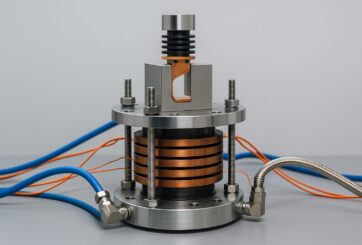
New material improves magnetic cooling near absolute zero … Cooling is a long-standing technological challenge. Standard cooling cycle based on vapor compression exploits expensive helium gas to reach temperatures near absolute zero. Adiabatic demagnetization known since nearly a century could be a viable alternative if compact and durable paramagnetic materials were available. A team of researchers from the University of Augsburg used their recent experience in creating quantum-disordered magnetic states to design a promising new material for adiabatic demagnetization cooling….
Researchers at Utrecht University and at TU Wien (Vienna) create special light waves that can penetrate even opaque materials as if the material was not even there. Why is sugar not transparent? Because light that penetrates a piece of sugar is scattered, altered and deflected in a highly complicated way. However, as a research team from TU Wien (Vienna) and Utrecht University (Netherlands) has now been able to show, there is a class of very special light waves for which…
Two FRIB researchers create computer model to help explain and make nuclear discoveries. Michigan State University’s Witold Nazarewicz has a simple way to describe the complex work he does at the Facility for Rare Isotope Beams (frib.msu.edu), or FRIB. “I study theoretical nuclear physics,” said Nazarewicz, John A. Hannah Distinguished Professor of Physics and chief scientist at FRIB. “Nuclear theorists want to know what makes the nucleus tick.” There is a nucleus in every atom. Atoms, in turn, make up…
Nobel laureate in physics Richard Feynman once described turbulence as “the most important unsolved problem of classical physics.” Understanding turbulence in classical fluids like water and air is difficult partly because of the challenge in identifying the vortices swirling within those fluids. Locating vortex tubes and tracking their motion could greatly simplify the modeling of turbulence. But that challenge is easier in quantum fluids, which exist at low enough temperatures that quantum mechanics — which deals with physics on the…
Extremely structured electromagnetic pulse carries not only the ultimate human dream of ultra-fast and ultra-intense energy extraction but also numerous extraordinary fundamental physical effects. As a traditional viewpoint, Electromagnetic pulses are typically treated as space-time (or space-frequency) separable solutions of Maxwell’s equations, where spatial and temporal (spectral) dependence can be treated separately. However, recent advances in structured light and topological optics have highlighted the nontrivial wave-matter interactions of pulses with complex space-time separability (STNS), as well as their potential for…
Machine-learning methods lead to discovery of rare “quadruply imaged quasars” that can help solve cosmological puzzles. With the help of machine-learning techniques, a team of astronomers has discovered a dozen quasars that have been warped by a naturally occurring cosmic “lens” and split into four similar images. Quasars are extremely luminous cores of distant galaxies that are powered by supermassive black holes. Over the past four decades, astronomers had found about 50 of these “quadruply imaged quasars,” or quads for…
Astronomers have found evidence that the first exoplanet that was identified transiting its star could have migrated to a close orbit with its star from its original birthplace further away. Analysis by international team including University of Warwick of the first transiting exoplanet that was discovered has revealed six different chemicals in its atmosphere. It is the first time that so many molecules have been measured, and points to an atmosphere with more carbon present than oxygen This chemical fingerprint…
 Feedback


