



Feeding 9 Billion: Innovations in Agricultural Modeling
European astronomers have produced the most accurate three-dimensional map to date of star-forming regions within our Milky Way galaxy, using data from the European Space Agency’s Gaia space telescope. The new map offers an unprecedented look at the dense, cloudy regions where new stars are born, shedding light on the young, hot stars that sculpt these cosmic nurseries.
Studying star-forming regions is challenging because thick clouds of gas and dust obscure them from view, and their distances are difficult to measure directly.
Gaia cannot see these clouds outright, but it can measure both the positions of stars and the “extinction” of starlight — how much light is dimmed by dust. Using this data, scientists created 3D maps that reveal the location of dust and, indirectly, how much ionised hydrogen gas is present — a key marker of active star formation.
The new 3D map draws on Gaia observations of 44 million ordinary stars and 87 massive O-type stars, covering space up to 4,000 light-years from the Sun.
O stars are rare, very hot, and extremely bright, shining intensely in ultraviolet light. Their energetic radiation strips electrons from hydrogen atoms, ionising the surrounding gas and leaving behind clouds of charged particles — known as HII regions. These regions are key indicators of where stars are currently forming.
While many telescopes have captured views of these areas from Earth’s perspective, Gaia now allows researchers to visualise their true three-dimensional structure — as if looking at the Milky Way from the outside.
“Gaia provides the first accurate view of what our section of the Milky Way would look like from above,” explains Lewis McCallum, astronomer at the University of St Andrews, UK, and first author of two papers describing the new 3D model.
“There has never been a model of the distribution of the ionised gas in the local Milky Way that matches other telescope’s observations of the sky so well. That’s why we are confident that our top-down view and fly-through movies are a good approximation of what these clouds would look like in 3D.”
McCallum’s map features well-known star-forming regions such as the Gum Nebula, North America Nebula, California Nebula, and the Orion–Eridanus superbubble, now seen in fully navigable 3D for the first time.
This new perspective is already offering insights into how massive stars influence their environments. McCallum’s team noticed that some star-forming clouds appear to be venting gas and dust into a vast cavity within the interstellar medium.
“This map nicely shows how radiation of massive stars ionises the surrounding interstellar medium and how dust and gas interact with this radiation. The 3D model provides a detailed look at the processes that shape our local galactic environment and helps astronomers understand interactions between the warm and cold components of the local Universe,” explained Sasha Zeegers, ESA Research Fellow and an expert on interstellar dust.
“It required huge computational power to generate the map out to ‘just’ 4000 light-years from the Sun in high resolution [2]. We hope that the map can be expanded further out once Gaia has released its new set of data,” says Lewis McCallum.
“Gaia’s distance measurements of the nearby hot stars, and the 3D maps of dust – obtained from measuring the extinction and positions of millions of ordinary stars using Gaia data – are both crucial ingredients of this new map. Gaia’s fourth data release will contain data of even better quality and quantity, making it possible to further advance our knowledge of star-forming regions,” confirms Johannes Sahlmann, ESA’s Gaia Project Scientist.
Original Publication
Authors: Lewis McCallum, Kenneth Wood, Robert Benjamin, Dhanesh Krishnarao and Anna F McLeod.
Journal: Monthly Notices of the Royal Astronomical Society
DOI: 10.1093/mnras/staf1022
Article Publication Date: 21-Jun-2025
The estimated star formation rate is 370 solar masses per year, which is about four times lower than previous estimates.
O stars can ionize large volumes of diffuse gas, but their ability to do so depends on their environment; some can ionize gas over hundreds of parsecs, while others are more limited.
Supernovae create structures like bubbles and shells in the interstellar medium, and their effects can lead to non-equilibrium ionization, which is important for understanding the emission lines observed in the sky.




Researchers have achieved a breakthrough in solar physics by providing the first direct evidence of small-scale torsional Alfvén waves in the Sun’s corona – elusive magnetic waves that scientists have been searching for since the 1940s. Researchers have achieved a breakthrough in solar physics by providing the first direct evidence of small-scale torsional Alfvén waves in the Sun’s corona – elusive magnetic waves that scientists have been searching for since the 1940s. The discovery, published today in Nature Astronomy, was…
Using a global network of telescopes, astronomers have detected the lowest-mass dark object yet found in the universe. Finding more such objects and understanding their nature could rule out some theories about the nature of dark matter, the mystery substance that makes up about a quarter of the universe. The work is described in two papers published Oct. 9 in Nature Astronomy and Monthly Notices of the Royal Astronomical Society. Because the object does not emit any light or other radiation, it was…
Scientists digging through data collected by the Cassini spacecraft have found new complex organic molecules spewing from Saturn’s moon Enceladus. This is a clear sign that complex chemical reactions are taking place within its underground ocean. Some of these reactions could be part of chains that lead to even more complex, potentially biologically relevant molecules. Published today in Nature Astronomy, this discovery further strengthens the case for a dedicated European Space Agency (ESA) mission to orbit and land on Enceladus….
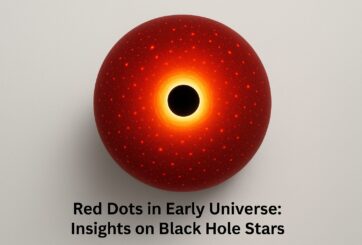
UNIVERSITY PARK, Pa. — Tiny crimson specks discovered by NASA’s James Webb Space Telescope (JWST) could represent an entirely new class of cosmic object — massive black holes wrapped in star-like atmospheres — offering fresh insights into how the first galaxies may have formed. Unexpected Red Dots Challenge Existing Theories When JWST began sending data in 2022, astronomers were startled by the presence of tiny “little red dots” scattered across the early universe. Initially, researchers, including a team from Penn…
 Feedback
