
Young stars ejecting plasma could give us clues into the Sun’s past Kyoto, Japan — Down here on Earth we don’t usually notice, but the Sun is frequently ejecting huge masses of plasma into space. These are called coronal mass ejections (CMEs). They often occur together with sudden brightenings called flares, and sometimes extend far enough to disturb Earth’s magnetosphere, generating space weather phenomena including auroras or geomagnetic storms, and even damaging power grids on occasion. Scientists believe that when…

A German aviation magazine honored the team of Wolfram Schiffmann, Professor of Computer Architecture at the FernUniversität in Hagen, for its emergency…
To just solve a puzzle or play a game, artificial intelligence can require software running on thousands of computers. That could be the energy that three…
Astonishing, but true: if you wind a mechanical watch, it becomes heavier. The same thing happens when you charge your smartphone. This can be explained by the…
In his latest line of research, Cun-Zheng Ning, a professor of electrical engineering in the Ira A. Fulton Schools of Engineering at Arizona State University,…
Quantum photonics involves a new type of technology that relies on photons, the elementary particle of light. These photons can potentially carry quantum bits…
Here's a new chapter in the story of the miniaturisation of machines: researchers in a laboratory in Singapore have shown that a single atom can function as…
NASA missions like the space telescope Kepler have helped us document thousands of exoplanets – planets that orbit around other stars. And current NASA…
In a new article published in Physical Review Letters and highlighted as an Editor's suggestion, ICFO researchers Pau Gomez, Ferran Martin, Chiara Mazzinghi,…
The care industry in Germany is facing numerous challenges: Apart from a continuing shortage of staff, the strains on medical workers have also been increasing…
Scientists have never before succeeded in making so-called skyrmions – 100 nanometre small vortex structures that occur in magnetic material – visible in 3D….
To understand how planetary systems, including our own, take shape, you have to study their origins. Planet-forming or protoplanetary disks are formed in…
According to modern particle physics, matter produced when neutron stars merge is so dense that it could exist in a state of dissolved elementary particles….
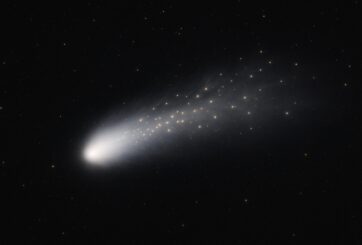
Hubble identified about 30 fragments on April 20, and 25 pieces on April 23. They are all enveloped in a sunlight-swept tail of cometary dust.
Researchers from China Academy of Engineering Physics, Nanjing University and University of Victoria demonstrated ultra-sensitive and stable X-ray detectors by…
When it began observations in 2000, TAMA300 was one of the world's first large-scale interferometric gravitational wave detectors. At that time TAMA300 had the…
It took more than 100 years until the existence of gravitational waves predicted by Albert Einstein in 1915 as part of his general theory of relativity was…
 Feedback


