
Young stars ejecting plasma could give us clues into the Sun’s past Kyoto, Japan — Down here on Earth we don’t usually notice, but the Sun is frequently ejecting huge masses of plasma into space. These are called coronal mass ejections (CMEs). They often occur together with sudden brightenings called flares, and sometimes extend far enough to disturb Earth’s magnetosphere, generating space weather phenomena including auroras or geomagnetic storms, and even damaging power grids on occasion. Scientists believe that when…

Physicists use antiferromagnetic rust to carry information over long distances at room temperature. Be it with smartphones, laptops, or mainframes: The transmission, processing, and storage of information is currently based on a single class of material – as it was in the early days of computer science about 60 years ago. A new class of magnetic materials, however, could raise information technology to a new level. Antiferromagnetic insulators enable computing speeds that are a thousand times faster than conventional electronics,…
High-precision measurements of the strong interaction between stable and unstable particles. The positively charged protons in atomic nuclei should actually repel each other, and yet even heavy nuclei with many protons and neutrons stick together. The so-called strong interaction is responsible for this. Prof. Laura Fabbietti and her research group at the Technical University of Munich (TUM) have now developed a method to precisely measure the strong interaction utilizing particle collisions in the ALICE experiment at CERN in Geneva. The…
First Bend and then Turn The water on Earth makes our planet inhabitable. It absorbs the Sun’s energy and releases it in the form of heat. An international research collaboration headed by the Max Planck Institute for Polymer Research (MPI-P) has now shown how and how fast the stored energy in the water molecules is released to heat strongly depends on the radiation’s energy. The scientists found that the energy of a bent water molecule can be rapidly released by…
JILA researchers have developed tools to “turn on” quantum gases of ultracold molecules, gaining control of long-distance molecular interactions for potential applications such as encoding data for quantum computing and simulations. The new scheme for nudging a molecular gas down to its lowest energy state, called quantum degeneracy, while suppressing chemical reactions that break up molecules finally makes it possible to explore exotic quantum states in which all the molecules interact with one another. The research is described in the…
Investigation of femtosecond time-resolved x-ray scattering signals reveals a faster chiral compared to collinear magnetic order dynamics A joint research project of Johannes Gutenberg University Mainz (JGU), the University of Siegen, Forschungszentrum Jülich, and the Elettra Synchrotron Trieste has achieved a new milestone for the ultra-fast control of magnetism. The international team has been working on magnetization configurations that exhibit chiral twisting. Chirality is a symmetry breaking, which occurs, for example, in nature in molecules that are essential for life….
A team of researchers from Italy, Norway, and Germany has demonstrated that the properties of molecules undergo significant changes when interacting with quantized electromagnetic fields in optical cavities. Using novel theoretical methodologies and computational simulations, the team revealed that the ground- and excited-state chemistry of molecules can be modified by a confinement in space. They show how the transfer of electrons inside the system can be controlled by modulating the frequency of the cavity field. Their newly-developed methodology could have…
Neural networks are some of the most important tools in artificial intelligence (AI): they mimic the operation of the human brain and can reliably recognize texts, language and images, to name but a few. So far, they run on traditional processors in the form of adaptive software, but experts are working on an alternative concept, the “neuromorphic computer”. In this case, the brain’s switching points – the neurons – are not simulated by software but reconstructed in hardware components. A…
Orbiting instrument hints at how stored magnetic energy heats solar atmosphere. A phenomenon first detected in the solar wind may help solve a long-standing mystery about the sun: why the solar atmosphere is millions of degrees hotter than the surface. Images from the Earth-orbiting Interface Region Imaging Spectrograph, aka IRIS, and the Atmospheric Imaging Assembly, aka AIA, show evidence that low-lying magnetic loops are heated to millions of degrees Kelvin. Researchers at Rice University, the University of Colorado Boulder and…
Computer scientists develop a design tool that opens up the use of a cost-efficient technology for curved glass panels. The tool is based on a deep neural network and allows for the free-form design of beautiful glass façades Curved glass façades can be stunningly beautiful, but traditional construction methods are extremely expensive. Panes are usually made with “hot bending”, where glass is heated and formed using a mold or specialized machines, an energy-intensive process that generates excess waste in the…
Astronomers have caught a rare look at a rapidly fading shroud of gas around an aging star. Archival data from NASA’s Hubble Space Telescope reveal that the nebula Hen 3-1357, nicknamed the Stingray nebula, has faded precipitously over just the past two decades. Witnessing such a swift rate of change in a planetary nebula is exceeding rare, say researchers. Images captured by Hubble in 2016, when compared to Hubble images taken in 1996, show a nebula that has drastically dimmed…
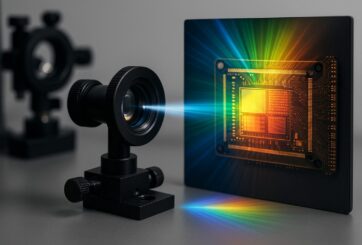
International research team describes 50 years of photonic artificial intelligence / Publication in “Nature” In a recent nature perspective, international experts in the field of optical neural networks, optical deep learning and photonic computing have put their expertise together to review the path from pathbreaking optical neural networks and optical computing realizations in the past fifty years and how they advanced to photonic artificial intelligence applications. The team, which includes the physicist Prof. Cornelia Denz from the Institute of Applied…
Researchers have developed new 3D-printed microlenses with adjustable refractive indices – a property that gives them highly specialized light-focusing abilities. This advancement is poised to improve imaging, computing and communications by significantly increasing the data-routing capability of computer chips and other optical systems, the researchers said. The study was led by University of Illinois Urbana-Champaign researchers Paul Braun and Lynford Goddard and is the first to demonstrate the ability to adjust the direction in which light bends and travels through…
Hypersonic flight is conventionally referred to as the ability to fly at speeds significantly faster than the speed of sound and presents an extraordinary set of technical challenges. As an example, when a space capsule re-enters Earth’s atmosphere, it reaches hypersonic speeds–more than five times the speed of sound–and generates temperatures over 4,000 degrees Fahrenheit on its exterior surface. Designing a thermal protection system to keep astronauts and cargo safe requires an understanding at the molecular level of the complicated…
Instead of inserting a card or scanning a smartphone to make a payment, what if you could simply touch the machine with your finger? A prototype developed by Purdue University engineers would essentially let your body act as the link between your card or smartphone and the reader or scanner, making it possible for you to transmit information just by touching a surface. The prototype doesn’t transfer money yet, but it’s the first technology that can send any information through…
A new tool that uses light to map out the electronic structures of crystals could reveal the capabilities of emerging quantum materials and pave the way for advanced energy technologies and quantum computers, according to researchers at the University of Michigan, the University of Regensburg and the University of Marburg. A paper on the work is published in Science. Applications include LED lights, solar cells and artificial photosynthesis. “Quantum materials could have an impact way beyond quantum computing,” said Mackillo…
Physicists report accelerated electrons linked with cosmic rays. More than 40 years since they launched, the Voyager spacecraft are still making discoveries. In a new study, a team of physicists led by the University of Iowa report the first detection of bursts of cosmic ray electrons accelerated by shock waves originating from major eruptions on the sun. The detection, made by instruments onboard both the Voyager 1 and Voyager 2 spacecraft, occurred as the Voyagers continue their journey outward through…
 Feedback


