
Young stars ejecting plasma could give us clues into the Sun’s past Kyoto, Japan — Down here on Earth we don’t usually notice, but the Sun is frequently ejecting huge masses of plasma into space. These are called coronal mass ejections (CMEs). They often occur together with sudden brightenings called flares, and sometimes extend far enough to disturb Earth’s magnetosphere, generating space weather phenomena including auroras or geomagnetic storms, and even damaging power grids on occasion. Scientists believe that when…

The transmission electron microscope (TEM) can image molecular structures at the atomic scale by using electrons instead of light, and has revolutionized materials science and structural biology. The past decade has seen a lot of interest in combining electron microscopy with optical excitations, trying, for example, to control and manipulate the electron beam by light. But a major challenge has been the rather weak interaction of propagating electrons with photons. In a new study, researchers have successfully demonstrated extremely efficient…
An adaptive optimization protocol engineers arbitrary high-dimensional states to enable quantum information tasks that require finding optimal values of experimental parameters under noisy conditions. The adoption of high-dimensional quantum states in quantum information protocols enables better performances in applications ranging from secure quantum communications to fault-tolerant quantum computation. Development of universal protocols able to engineer arbitrary high-dimensional quantum states would be a significant achievement. Several strategies and platforms have been proposed and developed to this end. Quantum-walk (QW) dynamics have…
Flexible tentaclelike manipulators driven by air pressure can be designed to grasp, manipulate soft objects. Traditional robots can have difficulty grasping and manipulating soft objects if their manipulators are not flexible in the way elephant trunks, octopus tentacles, or human fingers can be. In Applied Physics Reviews, by AIP Publishing, investigators from Shanghai Jiao Tong University in China developed a type of multiple-segment soft manipulator inspired by these biological systems. The soft manipulators are based on pneu-nets, which are pneumatically…
Results to provide data for NASA’s upcoming Psyche mission. An asteroid impact can be enough to ruin anyone’s day, but several small factors can make the difference between an out-of-this-world story and total annihilation. In AIP Advances, by AIP Publishing, a researcher from the National Institute of Natural Hazards in China developed a computer simulation of asteroid collisions to better understand these factors. The computer simulation initially sought to replicate model asteroid strikes performed in a laboratory. After verifying the…
Despite damaged equipment, supply chain delays, COVID restrictions and event a blizzard, LaserSETI successfully installed its second observatory at Haleakala Observatory. Last summer the SETI Institute began installing a second LaserSETI Observatory, this time 10,000 feet above sea level at Haleakala Observatory, thanks to the University of Hawai’i’s Institute of Astronomy (IfA). As a result of challenges involving equipment damaged during shipping, supply chain delays for replacement parts, equipment malfunctions and even a blizzard in Hawai’i, the installation was delayed…
A novel algorithm allows for efficient and accurate verification of quantum devices. Technologies that take advantage of novel quantum mechanical behaviors are likely to become commonplace in the near future. These may include devices that use quantum information as input and output data, which require careful verification due to inherent uncertainties. The verification is more challenging if the device is time dependent when the output depends on past inputs. For the first time, researchers using machine learning dramatically improved the…
DAILI successfully launched aboard the SpaceX Falcon 9 rocket at 5:07 a.m. EST on Dec. 21, 2021 from Launch Complex 39A at NASA’s Kennedy Space Center in Florida. The Daily Atmospheric Ionospheric Limb Imager (DAILI) CubeSat is scheduled to launch aboard SpaceX’s CRS-24, the 24th cargo resupply mission for NASA to the International Space Station (ISS). Launching no earlier than Dec. 21 at 5:06 a.m. EST on a Falcon 9 rocket from NASA’s Kennedy Space Center in Florida, DAILI, a 6U CubeSat…
Scientists at Sandia National Labs invent new yardstick for benchmarking performance. What does a quantum computer have in common with a top draft pick in sports? Both have attracted lots of attention from talent scouts. Quantum computers, experimental machines that can perform some tasks faster than supercomputers, are constantly evaluated, much like young athletes, for their potential to someday become game-changing technology. Now, scientist-scouts have their first tool to rank a prospective technology’s ability to run realistic tasks, revealing its…
The metric system was introduced in Germany 150 years ago. The world can sometimes reach a consensus. At least when it comes to measuring things. Today, it seems obvious to us to measure distances in meters, electric current in amperes and weights in kilograms. The story of this global achievement started with the French Revolution at the end of the 18th century. The French Revolution set many things in motion, it abolished some others, and it led to the creation…
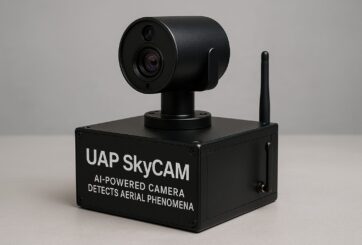
A new camera system has gone into test operation at the University of Würzburg. It is designed to detect unidentified aerial phenomena using artificial intelligence methods. Time and again, people see strange luminous phenomena or other phenomena in the sky that they cannot explain. “Most of these observations concern known phenomena or objects such as birds, aircraft, satellites or clouds. But for a very small proportion, the cause remains unexplained even after intensive investigation by experts,” says Hakan Kayal, Professor…
Unlike the jumble of frequencies produced by the light that surrounds us in daily life, each frequency of light in a specialized light source known as a “soliton” frequency comb oscillates in unison, generating solitary pulses with consistent timing. Each “tooth” of the comb is a different color of light, spaced so precisely that this system is used to measure all manner of phenomena and characteristics. Miniaturized versions of these combs – called microcombs – that are currently in development…
“Until now researchers have encoded and stabilized. We now show that we can compute as well.” Researchers at QuTech—a collaboration between the TU Delft and TNO—have reached a milestone in quantum error correction. They have integrated high-fidelity operations on encoded quantum data with a scalable scheme for repeated data stabilization. The researchers report their findings in the December issue of Nature Physics. More qubits Physical quantum bits, or qubits, are vulnerable to errors. These errors arise from various sources, including…
Physicists construct theories to describe nature. Let us explain it through an analogy with something that we can do in our everyday life, like going on a hike in the mountains. To avoid getting lost, we generally use a map. The map is a representation of the mountain, with its houses, rivers, paths, etc. By using it, it is rather easy to find our way to the top of the mountain. But the map is not the mountain. The map…
Researchers study the interaction between lithium atoms and barium ion isolated in ultrahigh vacuum and trapped using light traps Externally applied magnetic field allows control of processes at the quantum level “We’re learning a bit more about the possibilities for controlling the quantum mechanical properties of the wave-particle duality.” A team led by Prof. Dr. Tobias Schätz, Professor of Atomic and Quantum Physics at the Institute of Physics at the University of Freiburg, Dr. Pascal Weckesser, Fabian Thielemann and colleagues,…
The Leibniz Institute for Astrophysics Potsdam (AIP) announces the completion of a major three-publication survey of one of the richest accessible open star clusters. The final study features a method of deriving the rotation periods of stars from just one observation of the stellar activity rather than repeated observations over several weeks which are needed to directly measure the rotation period. The method has possible implications for the determination of the ages of stars. Open clusters are star clusters that…
The Fraunhofer-Gesellschaft and the Dutch research center QuTech—a collaboration of TU Delft and TNO—are joining forces in the fields of quantum communication and quantum information networks. Together, they are positioning themselves as leading organizations for the development and transfer of quantum technologies to strengthen Europe’s innovative power and pave the way for the quantum internet. Today, the partners have signed a memorandum of understanding for close cooperation. In a long-term, strategic partnership, the Fraunhofer-Gesellschaft and QuTech will work together structurally…
 Feedback


