
Researchers at PSI have compared the electron distribution below the oxide layer of two semiconductors. The investigation is part of an effort to develop particularly stable quantum bits –and thus, in turn, particularly efficient quantum computers. They have now published their latest research, which is supported in part by Microsoft, in the scientific journal Advanced Quantum Technologies. By now, the future of computing is inconceivable without quantum computers. For the most part, these are still in the research phase. They…
The study, which received the International Paper Award 2021 of the “American Association for the Surgery of Trauma”, was published online in the Journal of Trauma and Acute Care Surgery on 14 December 2021. Communicating without a voice Being voiceless is a very frustrating experience for patients in intensive care – especially when they consider themselves to be sufficiently aware to communicate with those around them. Intensive care staff therefore often have to use alternative methods of non-verbal communication as…
Collision-avoidance system gets us closer to robots that can fix satellites or spacecraft in orbit. What do you call a broken satellite? Today, it’s a multimillion-dollar piece of dangerous space junk. But a new collision-avoidance system developed by students at the University of Cincinnati is getting engineers closer to developing robots that can fix broken satellites or spacecraft in orbit. UC College of Engineering and Applied Science doctoral students Daegyun Choi and Anirudh Chhabra presented their project at the Science…
There are 6,500 satellites in orbit, but only about half of them are functional. Once a satellite breaks down or runs out of fuel, it is essentially useless. Repairs, maintenance and upgrades are nearly impossible in orbit. It’s launch once, use once. But as satellites have become more robust, their operators often find that fleets outlast their projected lifespans and need new technology, repairs, refueling or maintenance to stay competitive, relevant and operational. Researchers from Carnegie Mellon University will head…
Chromium defects in silicon carbide may provide a new platform for quantum information. The Science Quantum computers may be able to solve science problems that are impossible for today’s fastest conventional supercomputers. Quantum sensors may be able to measure signals that cannot be measured by today’s most sensitive sensors. Quantum bits (qubits) are the building blocks for these devices. Scientists are investigating several quantum systems for quantum computing and sensing applications. One system, spin qubits, is based on the control of…
University of Göttingen computational neuroscientist receives ERC starting grant of 1.5 million euros. The computational neuroscientist Professor Alexander Ecker from the University of Göttingen and the Max Planck Institute for Dynamics and Self-Organization (MPIDS) has received a Starting Grant from the European Research Council (ERC). The ERC has awarded his project “Deep Neuron Embeddings: Data-driven multi-modal discovery of cell types in the neocortex” a total of 1.5 million euros over five years. Ecker and his team want to find out…
Researchers led by the University of Tsukuba present an improved way to model interactions between matter and light at the atomic scale. Light–matter interactions form the basis of many important technologies, including lasers, light-emitting diodes (LEDs), and atomic clocks. However, usual computational approaches for modeling such interactions have limited usefulness and capability. Now, researchers from Japan have developed a technique that overcomes these limitations. In a study published this month in The International Journal of High Performance Computing Applications, a…
How much does a country’s vehicle fleet consume on average? How does it change from year to year? With the increasing number of electric vehicles and more and more “crossover” models that can hardly be assigned to one vehicle segment, analysis is becoming increasingly difficult. Empa researchers analyze databases using deep learning methods – and can make precise statements: In which region of the country do the fattest cars drive? What can car buyers do to reduce CO2 consumption? In…
An international team of researchers have used a unique tool inserted into an electron microscope to create a transistor that’s 25,000 times smaller than the width of a human hair. The research, published in the journal Science, involves researchers from Japan, China, Russia and Australia who have worked on the project that began five years ago. QUT Centre for Materials Science co-director Professor Dmitri Golberg, who led the research project, said the result was a “very interesting fundamental discovery” which…
Puzzling result forces physicists to rethink ‘spin-triplet’ superconductivity. A Rice University-led study is forcing physicists to rethink superconductivity in uranium ditelluride, an A-list material in the worldwide race to create fault-tolerant quantum computers. Uranium ditelluride crystals are believed to host a rare “spin-triplet” form of superconductivity, but puzzling experimental results published this week in Nature have upended the leading explanation of how the state of matter could arise in the material. Neutron-scattering experiments by physicists from Rice, Oak Ridge National…
A novel algorithm allows for efficient and accurate verification of quantum devices. Technologies that take advantage of novel quantum mechanical behaviors are likely to become commonplace in the near future. These may include devices that use quantum information as input and output data, which require careful verification due to inherent uncertainties. The verification is more challenging if the device is time dependent when the output depends on past inputs. For the first time, researchers using machine learning dramatically improved the…
DAILI successfully launched aboard the SpaceX Falcon 9 rocket at 5:07 a.m. EST on Dec. 21, 2021 from Launch Complex 39A at NASA’s Kennedy Space Center in Florida. The Daily Atmospheric Ionospheric Limb Imager (DAILI) CubeSat is scheduled to launch aboard SpaceX’s CRS-24, the 24th cargo resupply mission for NASA to the International Space Station (ISS). Launching no earlier than Dec. 21 at 5:06 a.m. EST on a Falcon 9 rocket from NASA’s Kennedy Space Center in Florida, DAILI, a 6U CubeSat…
Scientists at Sandia National Labs invent new yardstick for benchmarking performance. What does a quantum computer have in common with a top draft pick in sports? Both have attracted lots of attention from talent scouts. Quantum computers, experimental machines that can perform some tasks faster than supercomputers, are constantly evaluated, much like young athletes, for their potential to someday become game-changing technology. Now, scientist-scouts have their first tool to rank a prospective technology’s ability to run realistic tasks, revealing its…
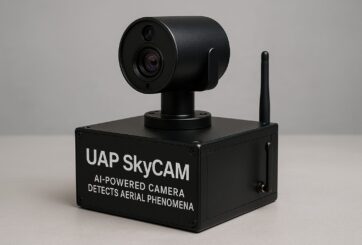
A new camera system has gone into test operation at the University of Würzburg. It is designed to detect unidentified aerial phenomena using artificial intelligence methods. Time and again, people see strange luminous phenomena or other phenomena in the sky that they cannot explain. “Most of these observations concern known phenomena or objects such as birds, aircraft, satellites or clouds. But for a very small proportion, the cause remains unexplained even after intensive investigation by experts,” says Hakan Kayal, Professor…
“Until now researchers have encoded and stabilized. We now show that we can compute as well.” Researchers at QuTech—a collaboration between the TU Delft and TNO—have reached a milestone in quantum error correction. They have integrated high-fidelity operations on encoded quantum data with a scalable scheme for repeated data stabilization. The researchers report their findings in the December issue of Nature Physics. More qubits Physical quantum bits, or qubits, are vulnerable to errors. These errors arise from various sources, including…
Physicists construct theories to describe nature. Let us explain it through an analogy with something that we can do in our everyday life, like going on a hike in the mountains. To avoid getting lost, we generally use a map. The map is a representation of the mountain, with its houses, rivers, paths, etc. By using it, it is rather easy to find our way to the top of the mountain. But the map is not the mountain. The map…
 Feedback


