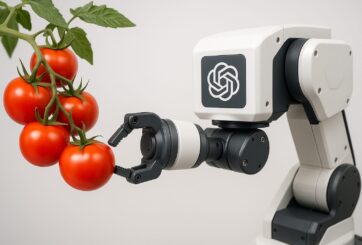
EPFL researchers have used the popular large language model Chat-GPT-3 to develop a robotic gripper for harvesting tomatoes, in a first demonstration of the artificial intelligence tool’s potential for collaborating with humans. With their ability to process vast amounts of text data, and to use this information to answer prompts, neural networks known as large language models (LLMs) like Chat-GPT have been making headlines for their potential to change the way we write, learn, and even make art. Now, EPFL researchers…

Quantum information (QI) processing may be the next game changer in the evolution of technology, by providing unprecedented computational capabilities, security and detection sensitivities. Qubits, the basic hardware element for quantum information, are the building block for quantum computers and quantum information processing, but there is still much debate on which types of qubits are actually the best. Research and development in this field is growing at astonishing paces to see which system or platform outruns the other. To mention…
DFKI develops innovative AI technologies for autonomous robots to recover munitions. More than one million tons of munitions dumped in the North and Baltic Seas during and after the two world wars posing a threat to both humans and the environment. So far, trained divers had to recover the ammunition. In the future, however, robots will take on this challenging and potentially dangerous task. The technologies required for this are being developed by the Robotics Innovation Center of the German…
Quantum computing uses the principles of quantum mechanics to encode and elaborate data, meaning that it could one day solve computational problems that are intractable with current computers. While the latter work with bits, which represent either a 0 or a 1, quantum computers use quantum bits, or qubits – the fundamental units of quantum information. “With applications ranging from drug discovery to optimization and simulations of complex biological systems and materials, quantum computing has the potential to reshape vast…
A new antenna technology developed at Utah State University will soon be tested by a national wireless provider for a pilot study that could revolutionize the telecommunications industry. Bedri Cetiner, a professor of electrical engineering, patented a new antenna called a multifunctional reconfigurable antenna that can adapt to locate a signal’s direction and frequency. For more than a century, conventional antenna equipment was only capable of broadcasting and receiving signals in all directions. Cetiner’s design is more efficient because it…
Researches from Stuttgart are pioneers in E-band-research. This month, the EIVE nanosatellite will be sent into space on an exploration tour. A research team based at the University of Stuttgart is investigating rapid data transmission in a frequency band that has hardly been utilized so far. This is a milestone for future high-speed data communication networks in space. Later this month, after four years of development and testing, a research team based at the University of Stuttgart will send the…
… could improve performance of quantum computers and artificial intelligence. U of M researchers’ device is more energy efficient and versatile than past models. A University of Minnesota Twin Cities-led team has developed a new superconducting diode, a key component in electronic devices, that could help scale up quantum computers for industry use and improve the performance of artificial intelligence systems. Compared to other superconducting diodes, the researchers’ device is more energy efficient; can process multiple electrical signals at a…
Aircraft that routinely fly over bodies of water around the world to monitor pollution could in future not only detect oil and chemical spills on the high seas, in coastal waters and on beaches, but also plastic waste floating on the surface of the water. In the PlasticObs+ project, a consortium led by the German Research Center for Artificial Intelligence (DFKI) is working to develop the first airborne monitoring of larger, contiguous marine areas that continuously detects plastic in waters…
Imagine being able to try on different clothes on a virtual avatar and see how they look from every angle. Or adjusting the direction your pet is looking in your favorite photo. You could even change the perspective of a landscape picture. These types of photo edits have always been challenging, even for experts. A novel AI tool now promises that with just a few mouse clicks, anyone can achieve edits like these effortlessly. The method is being developed by…
Successfully implementing tomorrow’s automation today. Offering companies a clear competitive advantage and making them fit to meet the challenges of the production of the future: this is the performance promise that Fraunhofer IPA will be exhibiting at the automatica trade fair from June 27 to June 30, 2023. Here, visitors will experience applications in robotics, automation, artificial intelligence and cleanroom technologies and gain new insights through regular expert sessions and “Interactive Live” interviews. The Fraunhofer Institute for Manufacturing Technology and…
Improved speed, precision and flexibility — it is important to take advantage of every possible opportunity in optimizing production. To this end, researchers at the Fraunhofer Institute for Material and Beam Technology IWS have developed SURFinpro, a solution that uses artificial intelligence and optical measurement technology to detect, classify and visualize defects in real time, and report them to the plant carrying out the production. The experts will be presenting their system from June 27 to 30, 2023, at Laser…
Scientists decode the chemical profile of tantalum surface oxides to understand loss and improve qubit performance. Whether it’s baking a cake, building a house, or developing a quantum device, the quality of the end product significantly depends on its ingredients or base materials. Researchers working to improve the performance of superconducting qubits, the foundation of quantum computers, have been experimenting using different base materials in an effort to increase the coherent lifetimes of qubits. The coherence time is a measure…
Quantum computers might be able to crack currently unsolvable tasks, but it is not easy to expand them to the necessary size. A new technique from a team of Darmstadt physicists could overcome this hurdle. Darmstadt physicists have developed a technique that could overcome one of the biggest hurdles in building a practically-relevant quantum computer. They make use of an optical effect here discovered by British photo pioneer William Talbot in 1836. The team led by Malte Schlosser and Gerhard…
Researchers at the Niels Bohr Institute have, collaborating with the University of Münster and Ruhr-Universität Bochum, developed new technology capable of processing the enormous amounts of information quantum systems generate. Deterministic single photon light sources, creating quantum bits at extreme rates and speed are now coupled to specially designed, integrated photonic circuits, capable of processing quantum information with adequate speed and quality without degrading the susceptible quantum states. This means that the first steps have been taken towards the development…
1.7 Petabits, equal to more than 10 million home broadband connections. Invented in Japan with Macquarie University support. An optical fibre about the thickness of a human hair can now carry the equivalent of more than 10 million fast home internet connections running at full capacity. A team of Japanese, Australian, Dutch, and Italian researchers has set a new speed record for an industry standard optical fibre, achieving 1.7 Petabits over a 67km length of fibre. The fibre, which contains…
Researchers at Osaka University develop a new centipede-like robot and show how its motion can be switched from straight and curved walking, which may assist with search and rescue operations or planetary exploration. Researchers from the Department of Mechanical Science and Bioengineering at Osaka University have invented a new kind of walking robot that takes advantage of dynamic instability to navigate. By changing the flexibility of the couplings, the robot can be made to turn without the need for complex…
 Feedback


