
New study reveals how human astroviruses bind to humans cells and paves the way for new therapies and vaccines Human astroviruses are a leading viral cause of the stomach bug—think vomiting, diarrhea, and fever. It often impacts young children and older adults, leading to vicious cycles of sickness and malnutrition, particularly for those in low and middle income countries. It’s very commonly found in wastewater studies, meaning it’s frequently circulating in communities. As of now, there are no vaccines for…

Century-old tuberculosis vaccine extends survival of mice with hard-to-treat liver cancer. A UC Davis Health study found that a single dose of Bacillus Calmette-Guérin (BCG), the vaccine for tuberculosis (TB), reduced liver tumor burden and extended the survival of mice with liver cancer. The study, published in Advanced Science, is the first to show the promising effects of the vaccine in treating liver cancer. Hepatocellular carcinoma (HCC) is the most common type of liver cancer. It is also the third…
Researchers from Jena uncover new mechanism for regulating cell division in the bacterial pathogen Klebsiella. Klebsiella pneumoniae is one of the most common and most dangerous bacterial pathogens impacting humans, causing infections of the gastrointestinal tract, pneumonia, wound infections and even blood poisoning. With the aim of discovering therapeutically exploitable weaknesses in Klebsiella, a research team from the Balance of the Microverse Cluster of Excellence at the University of Jena, Germany has taken a close look at the molecular biology…
To synthesize potential drugs or natural products, you need natural substances in specific mirror-image variants and with a high degree of purity. For the first time, chemists at the University of Bonn have succeeded in producing all eight possible variants of polypropionate building blocks from a single starting material in a relatively straightforward process. Their work has now been published in the prestigious journal “Angewandte Chemie.” Polypropionates are natural products that can help save lives. They are needed to make…
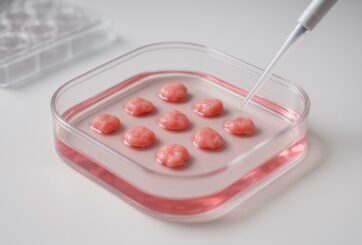
Project leader Dr.-Ing. Abdolrahman Omidinia Anarkoli and working group leader Prof. Dr. Ing. Laura De Laporte at the DWI – Leibniz Institute for Interactive Materials, have been awarded a Proof of Concept Grant from the European Research Council (ERC) for their project “AnisoPlate”. Their aim is to investigate the technical and commercial potential of their newly developed device. With this technology, they want to produce three-dimensional, hydrogel-based human tissue models in high throughput that exhibit a controllable spatial orientation and…
… is a big step forward. Lung cancer is one of the most common cancers and has one of the lowest survival rates in the world. Cytokines, which are small signaling proteins, such as interleukin-12 (IL-12), have demonstrated considerable potential as robust tumor suppressors. However, their applications are limited due to a multitude of severe side effects. In a paper published Jan. 11 by Nature Nanotechnology, Biomedical Engineering Professor Ke Cheng and his research group demonstrate that using nanobubbles, called exosomes, through an inhalation treatment method…
… for diverse populations to tackle health disparities. Improved genetic tests more accurately assess disease risk regardless of genetic ancestry. To prevent an emerging genomic technology from contributing to health disparities, a scientific team funded by the National Institutes of Health has devised new ways to improve a genetic testing method called a polygenic risk score. Since polygenic risk scores have not been effective for all populations, the researchers recalibrated these genetic tests using ancestrally diverse genomic data. As reported…
Catalyzing Fine Chemicals in Future Using Iron & Co. At the Leibniz Institute for Catalysis in Rostock, Dr Johannes Fessler has developed new methods for the synthesis of drug precursors using catalysts made of iron, manganese and cobalt. Each of these three chemical elements has the potential to replace a number of noble metals that are commonly used in organic chemistry to catalyze fine chemicals. Platinum and palladium, for example, are expensive due to their rare occurrence, their extraction is…
MHH junior researcher investigates the influence of the immune system on age-related disorders of sensory neurones. The peripheral nervous system includes sensory and motor nerve cells that run through our body in bundles like power cables. Motor nerve cells transmit instructions from the brain to the muscles. Sensory nerve cells inform us about our position in the environment and what is happening in our body. They transmit stimuli from the sensory organs to the brain – i.e. what we see,…
Neuroscientists from Bonn, New York, and Freiburg discover interactions between so-called “ripples” and nerve cells during human memory processes. Spatial navigation and spatial memory play a central role in our lives. Without these abilities, we would hardly be able to find our way around our surroundings and would find it difficult to remember past events. However, the neuronal basis of spatial memory is far from being fully understood. A research group led by Prof. Lukas Kunz, who has recently joined…
A new bonding method enabling instant and effective adhesion of hydrogels has potential to broadly advance new biomaterials solutions for multiple unmet clinical needs. Hydrogels are versatile biomaterials conquering an increasing number of biomedical areas. Consisting of water-swollen molecular networks that can be tailored to mimic the mechanical and chemical features of various organs and tissues, they can interface within the body and on its outer surfaces without causing any damage to even the most delicate parts of the human…
Researchers expand ways to improve the selectivity of catalytic reactions. Researchers from the Harvard John A. Paulson School of Engineering and Applied Sciences (SEAS), Harvard Department of Chemistry & Chemical Biology, and Utrecht University have reported on a previously elusive way to improve the selectivity of catalytic reactions, adding a new method of increasing the efficacy of catalysts for a potentially wide range of applications in various industries including pharmaceuticals, cosmetics and much more. The research is published in Nature Catalysis. The chemical industry relies on catalysts for over 90 percent of its processes and…
Like humans struggling to get through the COVID-19 pandemic, bacterial cells need social distancing to thwart viruses. But in some situations, such as inside elevators or within the candy-colored bacterial structures known as “pink berries,” staying apart just isn’t feasible. Looking like spilled Nerds or Pop Rocks, the communal, multicellular pink berries litter the submerged surface of salt marshes in and around Woods Hole. New research conducted at the Marine Biological Laboratory (MBL) uncovers evidence that a genetic mechanism may…
…sounds alarm regarding circulation of this virus in urban environments. The opossum was found dead in a park in the center of Campinas, a large city in São Paulo state (Brazil), with the same viral variant as fruit-eating bats. These mammals are regularly detected in cities, where they are often attacked by dogs. A female White-eared opossum (Didelphis albiventris) found dead in 2021 in Bosque dos Jequitibás Park in the center of Campinas, one of the largest cities in São…
Neurological symptoms apparently not a result of SARS-CoV-2 infection of the brain. Scientists still are not sure how neurological symptoms arise in COVID-19. Is it because SARS-CoV-2 infects the brain? Or are these symptoms the result of inflammation in the rest of the body? A study by Charité – Universitätsmedizin Berlin has now produced evidence to support the latter theory. It was published today in the journal Nature Neuroscience.* Headaches, memory problems, and fatigue are just some of the neurological impacts that arise during coronavirus infection…
Researchers at the University of Regensburg, led by Professor Dr. Burkhard König, Institute of Organic Chemistry, have developed a new synthesis method: Light reaction on a water surface allows chemical syntheses without the use of organic solvents or other reaction additives. This makes the production of chemical products more efficient and environmentally friendly. The results of years of research have now been published in the internationally renowned journal Science. By forming chemical bonds between atoms, complex molecules such as those…
Scientists have observed so-called ‘roaming’ chemical reactions, those that at certain points move away from the lowest minimum energy ‘path of least resistance’, in highly excited energy states for the first time. Chemical reactions are supposed to occur along their minimum energy paths. In recent years, so-called roaming reactions that stray far from this path have begun to be observed, but only for chemical species in their ground state or, at most, their first excited state. However, researchers have now observed…
 Feedback


