
New study reveals how human astroviruses bind to humans cells and paves the way for new therapies and vaccines Human astroviruses are a leading viral cause of the stomach bug—think vomiting, diarrhea, and fever. It often impacts young children and older adults, leading to vicious cycles of sickness and malnutrition, particularly for those in low and middle income countries. It’s very commonly found in wastewater studies, meaning it’s frequently circulating in communities. As of now, there are no vaccines for…

The impact of environmental conditions on the dynamic structures of RNAs in living cells has been revealed by innovative technology developed by researchers at the John Innes Centre. The research, the result of a collaboration between the groups of Professor Dame Caroline Dean FRS and Dr Yiliang Ding, increases our understanding of what happens at cellular level in response to environmental signals. This raises the possibility that we may use this knowledge to fine-tune crops or develop RNA-based therapies for…
Engineering feat expands what researchers can accomplish with organoids. It could be the world’s tiniest EEG electrode cap, created to measure activity in a brain model the size of a pen dot. Its designers expect the device to lead to better understanding of neural disorders and how potentially dangerous chemicals affect the brain. This engineering feat, led by Johns Hopkins University researchers and detailed today in Science Advances, expands what researchers can accomplish with organoids, including mini brains—the lab-grown balls of…
By using the lymphatic system as a storage reservoir, researchers found they could optimize drug concentrations to simultaneously target two molecular signaling pathways responsible for cancer growth. A team of University of Michigan researchers is developing a new anti-cancer drug that is absorbed through the gut’s lymphatic system rather than blood vessels, potentially outmaneuvering the molecular signaling pathways that lead to drug resistance while increasing cancer-fighting ability and reducing side effects. In a study published today in Nature Communications, the team reports…
Bone health requires a balanced activity of various bone cell types including bone-forming osteoblasts and bone-resorbing osteoclasts. Osteoporosis occurs when osteoclasts dominate without adequate bone formation to compensate. In new research published in the Journal of Bone and Mineral Research, elevated blood levels of a certain chemokine, or small signaling protein, that promotes osteoclast formation were linked with a higher risk of hip fracture in men. The study included 55 men and 119 women who had experienced a hip fracture an…
When it comes to royalty, things are clear: The monarch’s first child inherits the crown. Siblings born later must make do with a less glamorous profession. This is quite similar for some nerve cells in the brain. In their case, it is not the order in which they are born, but at least the time of their emergence that determines their further career. This is shown by a recent study by the University of Bonn. The results were obtained in…
Research with stem cells is becoming increasingly important, because stem cells can develop into any body cell – skin cells, nerve cells or organ cells such as liver cells, the so-called hepatocytes. Stem cells can therefore be used, for example, in the therapy of organ damage or as an alternative to animal experiments. However, there are still major differences between hepatocytes obtained from a liver and those obtained from stem cells. Researchers at the Leibniz Research Centre for Working Environments…
Solar panels aren’t just for rooftops anymore – some buildings even have these power-generating structures all over their facades. But as more buildings and public spaces incorporate photovoltaic technologies, their monotonous black color could leave onlookers underwhelmed. Now, researchers reporting in ACS Nano have created solar panels that take on colorful hues while producing energy nearly as efficiently as traditional ones. Solar panels are typically a deep black color because their job is to absorb light, whereas a red car…
Transferring mitochondria bolsters neurons’ healing and improves recovery from a brain hemorrhage. After a brain hemorrhage, neural support cells called astrocytes enhance healing by transferring their mitochondria to damaged neurons. The healthy mitochondria stimulate the production of a free radical-fighting enzyme, according to new research published in JNeurosci. An artery in the brain bursts. Blood rushes into the tissue, inducing free radicals that cause even more damage. The hemorrhage damages mitochondria, the site of energy production in cells. Astrocytes transfer…
… and prevent recurrence in mice. An mRNA-based cancer vaccine is delivered directly into the lymphatic system for a more potent response. Researchers around the world have been working for years on developing vaccines against different types of cancer, but without much success. Now, Tufts School of Engineering researchers think they have found one that does work. They have devised a method of targeting cancer in mice with a vaccine that is so strong and precise, it eliminates tumors and…
Chemists successfully synthesize a cationic, low-valent aluminum complex salt via metathesis. The chemists Philipp Dabringhaus, Julie Willrett and Prof. Dr. Ingo Krossing from the Institute of Inorganic and Analytical Chemistry at the University of Freiburg have succeeded in synthesizing the low-valent cationic aluminum complex [Al(AlCp*)3]+ by a metathesis reaction. The team presents their research work in the journal Nature Chemistry. “In chemistry, cationic low-valent aluminum compounds are highly sought after due to their potential transition metal-like ambiphilic reactivity. However, numerous…
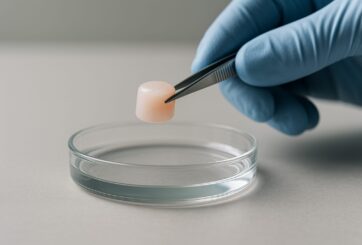
Lab-made cartilage gel outperforms the real thing. Human clinical trials may begin as soon as next year. Over-the-counter pain relievers, physical therapy, steroid injections — some people have tried it all and are still dealing with knee pain. Often knee pain comes from the progressive wear and tear of cartilage known as osteoarthritis, which affects nearly one in six adults — 867 million people — worldwide. For those who want to avoid replacing the entire knee joint, there may soon…
The stickiness of medical adhesives can be controlled by ultrasound, researchers find. Researchers have discovered that they can control the stickiness of adhesive bandages using ultrasound waves and bubbles. This breakthrough could lead to new advances in medical adhesives, especially in cases where adhesives are difficult to apply such as on wet skin. “Bandages, glues, and stickers are common bioadhesives that are used at home or in clinics. However, they don’t usually adhere well on wet skin. It’s also challenging…
Huntington’s chorea is a hereditary disease that leads to cognitive and motor impairments and death. Scientists at the University of Bremen have worked with international partners to elucidate the mechanism by which the mutated huntingtin protein can be kept at bay. “We have uncovered a mechanism by which the body’s own protein folding helpers keep the mutated huntingtin protein at bay,” explains project leader and professor Janine Kirstein at the University of Bremen. Protein-folding helpers allow proteins to take on…
Engineered cell receptors successfully reproduce their original’s functionality on demand. How do signals from outside the cell cause a response inside it? Such outside signals could be hormones or neurotransmitters. To notice them, the cell’s surface possesses receptors. One of the key classes of such receptors are so-called G protein-coupled receptors, or in short GPCRs. They are proteins placed on the cell’s membrane. Once an outside signal activates them, they trigger processes inside the cell with far-reaching impacts on cell…
New technique could relieve pain for individuals with various chronic and neurological conditions. A University of Minnesota Twin Cities-led team has found that electrical stimulation of the body combined with sound activates the brain’s somatosensory or “tactile” cortex, increasing the potential for using the technique to treat chronic pain and other sensory disorders. The researchers tested the non-invasive technique on animals and are planning clinical trials on humans in the near future. The paper is published in the Journal of…
Bioengineered corneal tissue for minimally invasive vision restoration in advanced keratoconus in two clinical cohorts. Researchers and entrepreneurs have developed an implant made of collagen protein from pig’s skin, which resembles the human cornea. In a pilot study, the implant restored vision to 20 people with diseased corneas, most of whom were blind prior to receiving the implant. The study jointly led by researchers at Linköping University (LiU) and LinkoCare Life Sciences AB has been published in Nature Biotechnology. The…
 Feedback


