
An international research group has engineered a novel high-strength flexible device by combining piezoelectric composites with unidirectional carbon fiber (UDCF), an anisotropic material that provides strength only in the direction of the fibers. The new device transforms kinetic energy from the human motion into electricity, providing an efficient and reliable means for high-strength and self-powered sensors. Details of the group’s research were published in the journal Small on Dec.14, 2023. Motion diction involves converting energy from the human motion into measurable electrical…
Installation of a tungsten divertor for long pulse operations. The aim is to opera The Korean artificial sun, KSTAR, has completed divertor upgrades, allowing it to operate for extended periods sustaining high-temperature plasma over the 100 million degrees. The Korea Institute of Fusion Energy announced the successful installation of the newly developed tungsten divertor for KSTAR. KSTAR, now equipped with the new divertor, commenced a plasma experiment on the 21st of December 2023. The divertor, a crucial plasma-facing component installed…
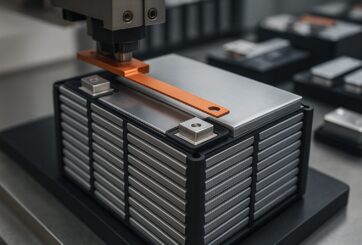
How the industry positions itself for cheap, sustainable and highly performant batteries. A new Fraunhofer ISI Lithium-Ion battery roadmap focuses on the scaling activities of the battery industry until 2030 and considers the technological options, approaches and solutions in the areas of materials, cells, production, systems and recycling. The study examines three trends in particular: The production of performance-optimized, low-cost and sustainable batteries. The market for lithium-ion batteries continues to expand globally: In 2023, sales could exceed the 1 TWh…
Fraunhofer IZM manages to automate measuring optical in-glass waveguides. The use of glass as substrate in electronics manufacturing enables the additional transmission of optical signals through the substrate material. This allows much higher rates of data transmission, which is vital for many scenarios like automotive, telecommunication, or AI applications. Researchers at Fraunhofer IZM have now managed to develop a system that can automatically measure propagation losses in integrated optical waveguides, all part of the research project “Integrated Electro-Photonic Panel Systems”…
Fraunhofer Institutes Establish New Branch for Aviation Research in Cottbus. Several Fraunhofer Institutes and the Brandenburg Technical University Cottbus-Senftenberg, under the leadership of Rolls-Royce Germany and other partners such as the research institution ACCESS, are collaborating on the future of hybrid electric flying. Supported by the state of Brandenburg and the Federal Ministry for Economic Affairs and Climate Protection, the partners are researching an entirely new propulsion system for medium-range aircraft with up to 35 passengers. The Clean Sky programs…
“HySecunda” aims to optimize production, storage, capacity building and certification of H2. South Africa could play an important role in the coming years as a reliable producer of green hydrogen — including as a supplier for Germany. However, the storage and distribution of this resource currently poses challenges. This is where the recently launched Fraunhofer joint research project HySecunda comes in, which is a cooperation between nine Fraunhofer institutes and the Fraunhofer Academy. The project aims to find optimized solutions…
Bubbles are an optimal way to carry heat, and Jonathan Boreyko’s team has engineered a surface that makes them jump to carry even more. Water is often the go-to resource for heat transfer, being used in large-scale cooling operations like data centers that power the internet and nuclear power plants that power cities. Discovering dynamic phenomena to make water-based heat transfer more energy and cost efficient is the ongoing work of Jonathan Boreyko, associate professor and John R. Jones III Faculty Fellow in mechanical engineering….
Clean technology for heavy industry… Steel production causes significant emissions of carbon dioxide. To decarbonize steel production and its high carbon dioxide emissions, Fraunhofer researchers, TS ELINO GmbH and Salzgitter AG are working on converting an existing steel mill to climate-neutral production methods. The aim is to produce steel by the direct reduction of iron ore with hydrogen, which would completely replace harmful coke as a reducing agent. The hydrogen required for this method is produced using electrolysis processes with…
There is an ever-present struggle to reduce carbon-based energy sources and replace them with low or no-carbon alternatives. The process of splitting water could be the resolution. Hydrogen production is a simple, safe, and effective method to produce more energy than gasoline can by the simple process of splitting water. Harvesting energy this way as opposed to relying heavily (or at all) on carbon-based energy sources is increasingly becoming the standard. Researchers have found a method to use transition metal…
The number of incidents involving damaged electronic devices on board aircraft has increased in recent years. Most of these are caused by lithium-ion batteries, which are found in laptops and other portable electronic devices. In the LOKI-PED project, the Fraunhofer Institute for High-Speed Dynamics, Ernst-Mach-Institut, EMI and the Fraunhofer Institute for Building Physics IBP are collaborating with Airbus to assess the fire and smoke risks associated with lithium-ion batteries in cockpits and cabins. The objective is to make it safer…
Environmentally friendly coating technologies. Damp, cold conditions are the enemy of wind power. If a layer of ice forms on the rotor blades, this can result in rotational imbalance and, hence, increased wear. In such cases, the turbines often have to be shut down for several days, leading to massive losses for the operators due to the pause in electricity production. Now, for the first time, a Fraunhofer team has succeeded in using drones to protect rotor blades against ice….
Diamond device shows highest breakdown voltage. To reach the world’s goal of carbon neutrality by 2050, there must be a fundamental change in electronic materials to create a more reliable and resilient electricity grid. A diamond might be a girl’s best friend, but it might also be the solution needed to sustain the electrification of society needed to reach carbon neutrality in the next 30 years. Researchers at the University of Illinois Urbana-Champaign have developed a semiconductor device made using…
A computational study conducted in Brazil could help extend the working lives of these batteries, which are widely used by utilities and manufacturers. An article by researchers at the Center for Development of Functional Materials (CDMF) in Brazil describes a successful strategy to mitigate charge capacity loss in vanadium redox flow batteries, which are used by electric power utilities among other industries and can accumulate large amounts of energy. The article is published in the Chemical Engineering Journal. CDMF is a Research, Innovation and Dissemination Center (RIDC)…
Key to better manufacturing… Artificial Intelligence methods guide researchers in developing improved manufacturing processes for highly efficient solar cells – a blueprint for other research areas. Perovskite tandem solar cells combine a perovskite solar cell with a conventional solar cell, for example based on silicon. These cells are considered a next-generation technology: They boast an efficiency of currently more than 33 percent, which is much higher than that of conventional silicon solar cells. Moreover, they use inexpensive raw materials and…
Reducing Size, Weight and Cost through Higher Switching Frequencies and Lower Losses. Within the Research Project “PV-MoVe”, researchers at the Fraunhofer IEE investigated how to use active switching loss reduction networks for power semi-conductors to enable smaller, more lightweight, and more cost-efficient photovoltaic converters. Using newly developed additional circuitry, switching frequencies for a 50 kW PV inverter could be increased by a factor of 2.5 – 3 for the DC input stage and by a factor of 10 – 12.5…
Web tool looks belowground for an economically viable renewable energy source. Geothermal power has a lot of promise as a renewable energy source that is not dependent on the sun shining or the wind blowing, but it has some challenges to wide adoption. One of these challenges is that there are a limited number of locations in the U.S. that naturally have the right conditions: hot rock relatively close to the surface and with plentiful groundwater to heat up. Closed-loop…
 Feedback


