
Using 3D technology and interdisciplinary expertise, a research team has explored Buddhist temples in the remote Dolpo region of Nepal and digitized them for posterity In the high-altitude and extremely remote region of Dolpo in north-west Nepal, there are numerous Buddhist temples whose history dates back to the 11th century. The structures are threatened by earthquakes, landslides and planned infrastructure projects such as the Chinese Belt and Road Initiative. There is also a lack of financial resources for long-term maintenance….

Piezoelectric coatings play a key role in the manufacturing of ultrasound microscopes that examine ever smaller semiconductor components and biological cell structures. However, the increasing demands on the quality and reproducibility of these coatings place high demands on the complex coating processes, which require many parameters to be precisely coordinated. In order to meet this challenge, Fraunhofer FEP is developing a digital twin of the coating process for piezoelectric thin films. This enables the digital mapping and optimization of the…
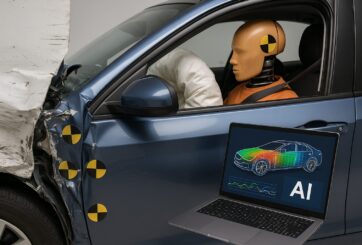
New machine learning methods are enabling better understanding and processing of crash test development data. The SAFECAR-ML project is developing an automated solution for documenting virtual crash tests based on artificial intelligence (AI). The aim is to simplify and enhance the efficiency of the design process. Shattering glass, twisted metal, and flying debris are rare sights in today’s automotive crash tests, as most crash simulations are performed digitally. However, documenting every modification in the design of virtual crash vehicle models…
“Doing instead of procrastinating”. This is the AI strategy presented by Prof. Constantin Haefner, Director of the Fraunhofer Institute for Laser Technology ILT, at the “AKL’24 – International Laser Technology Congress” in Aachen, Germany. Experts at the institute are putting this pragmatic strategy into practice in the German-Canadian AI-SLAM project, for example, in which an AI tool for the automated laser cladding of wear parts for the mining industry is being developed. AI-SLAM: Five letters stand for the ambitious German-Canadian…
Small drops, big impact: Over time, rain can damage the surfaces of rotor blades. This reduces the efficiency and profitability of wind turbines, especially at sea. Researchers from institutions of the U Bremen Research Alliance are developing repair solutions to extend the service life of rotor blades. Picture a large shower cubicle and you are not far off the test bench at the Fraunhofer Institute for Wind Energy Systems IWES in Bremerhaven. The only difference is that the water comes…
…takes sensor technology to extreme conditions. Researchers at Tampere University have developed the world’s first soft touchpad that can sense the force, area and location of contact without electricity. The device utilises pneumatic channels, enabling its use in environments such as MRI machines and other conditions that are unsuitable for electronic devices. Soft devices like soft robots and rehabilitation aids could also benefit from this new technology. Researchers at Tampere University have developed the world’s first soft touchpad that is…
Taking inspiration from bird feathers, Princeton engineers have found that adding rows of flaps to a remote-controlled aircraft’s wings improves flight performance and helps prevent stalling, a condition that can jeopardize a plane’s ability to stay aloft. “These flaps can both help the plane avoid stall and make it easier to regain control when stall does occur,” said Aimy Wissa, assistant professor of mechanical and aerospace engineering and principal investigator of the study, published in the Proceedings of the National…
Made in Lower Saxony l Germany. Resource-efficient, flexible automated production – Newly developed milling kinematics on a linear axis enables versatile and efficient machining of lightweight materials to metals up to steel with a production tolerance of up to 0.1 millimeter. The challenge of the successfully completed Lower Saxony LuFo project “Robots Made in Lower Saxony 2” (“RoMaNi 2”) was to close the gap between industrial robots and machine tools. The result of the R&D work led by Fraunhofer IFAM…
Initial tests at new battery recycling plant at TU Freiberg sucessful. A research team at TU Bergakademie Freiberg is using a new shredder system to investigate how battery cells can be shredded in such a way that as many of the raw materials they contain can be efficiently recovered. In the new plant, the researchers are also capturing highly volatile substances that were previously lost. Sensors and cameras record the processes and send the data to a database for analysis…
REEsilience partners Inserma and Mkango subsidiaries, HyProMag Ltd and HyProMag GmbH, are advancing innovative methods to recover rare earth materials from end-of-life products, reducing the need for virgin Rare Earth Elements (REEs) and minimising environmental impact: To this goal, they have now entered into an agreement to commercialise automated pre-processing of hard disk drives, loudspeakers and electric motors, aiming to deploy this technology globally and create a secure, sustainable supply of REEs. Rare Earth Elements (REEs) are essential components in…
Robotic, Modular and Agile System to Enable Production of Customized Battery Cells in Required Quantities. According to Germany’s Federal Ministry for Economic Affairs and Climate Action, battery cells are gaining in importance as a versatile and efficient means of storing energy. They are a driving force in advancing electromobility, for example, and a key technology of great strategic and economic significance for manufacturing companies. Current demand is mainly met through cost-driven mass production in Asia and North America, which also…
A Virginia Tech team has devised a new method for creating soft, flexible electric connections across and through circuit layers, paving the way for advanced soft robotics, wearable devices, and more. If a phone or other electronic device was made of soft materials, how would that change its use? Would it be more durable? If hospital health monitoring equipment was made of less rigid components, would it make it easier for patients to wear? While electronics of that type may…
Batteries are a key building block for a successful energy transition, whether for the electrification of transport, the stabilization of the power grid or balancing fluctuations in green electricity. The Fraunhofer Institute for Solar Energy Systems ISE has been conducting research along the entire battery value chain for many years. With the inauguration of the Center for Electrical Energy Storage on october 22, the institute has access to state-of-the-art laboratories which enable cutting-edge international research. Currently the institute’s research focus…
New Finnish consortium brings cleaner solutions to marine and off-road transport. The Flexible Clean Propulsion Technologies (Flex-CPT) project consortium, led by the University of Vaasa, Finland, aims to develop innovative, clean, and flexible solutions for maritime transport and off-road machinery. The goal is to reduce dependency on single fuel types, develop flexible hardware design, smart combustion control, efficient thermal management, and adaptive emission and hybrid energy management. These solutions will make it possible to use zero- and low-carbon fuels in the best…
Fraunhofer IPMS and BASF celebrate ten years of collaboration. More power, more energy-efficiency, more complexity – manufacturers of modern microchips are constantly facing new challenges, also regarding the electrical connections required. Fraunhofer IPMS and BASF have been working together on this problem for ten years. The teams have pooled their infrastructure and expertise and thus have made it possible to evaluate chemicals, processes and product tests for chip integration on an industrial scale. The Fraunhofer Institute for Photonic Microsystems IPMS…
Polaritons are coupled excitations of electromagnetic waves with either charged particles or vibrations in the atomic lattice of a given material. They are widely used in nanophotonics because of their ability to confine light at extremely small volumes, on the order of nanometers, which is essential to enhance light-matter interactions. Two-dimensional materials (that is, materials only one-atom thick) are commonly used for this purpose, since the polaritons they host show even more extreme confinement, lower energy losses -resulting in longer…
Together with Fiber Engineering GmbH, the DITF presents a process for the production of biodegradable plant pots. The products are cost effective and competitive. At the same time, the production process combats the spread of the invasive water hyacinth, whose biomass serves as the raw material for the plant pots. Combating an invasive species and reaping economic benefits at the same time? What sounds like a contradiction in terms has been successfully achieved by DITF scientists in a joint project…
 Feedback


