
Using 3D technology and interdisciplinary expertise, a research team has explored Buddhist temples in the remote Dolpo region of Nepal and digitized them for posterity In the high-altitude and extremely remote region of Dolpo in north-west Nepal, there are numerous Buddhist temples whose history dates back to the 11th century. The structures are threatened by earthquakes, landslides and planned infrastructure projects such as the Chinese Belt and Road Initiative. There is also a lack of financial resources for long-term maintenance….

A new paper lays out scientific methods for measuring and calculating Q in a sheared-flow-stabilized Z pinch. In the race to develop fusion energy, each unique approach requires its own specialized techniques to determine net energy gain, an equation balancing energy in and out that’s known by the letter Q. A new paper, published today in the journal Fusion Science and Technology, establishes the company’s method of measuring and calculating Q in Zap’s sheared-flow-stabilized Z-pinch fusion plasmas. The publication will be…
The world’s first fully integrated and functional microchip based on exotic two-dimensional materials has been fabricated at KAUST. The breakthrough demonstrates the potential of 2D materials to expand the functionality and performance of microchip-based technologies. Since the first fabrication of atomically thin layers of graphite — called graphene — in 2004, there has been intense interest in such materials for advanced and novel applications due to their exotic and promising physical properties. But, despite two decades of research, functional microdevices…
NASA grant funds aeroacoustic research… As noise levels in urban spaces swell, a multi-university partnership seeks to turn down the volume on urban air mobility vehicles. Drone delivery is rapidly taking off in major cities, with rotor-powered rideshares not far behind. The convenience promised by electric vertical take-off and landing vehicles generates a substantial buzz – not just from excitement but from all the noise generated by rotors filling the sky. To address key challenges facing the future of air…
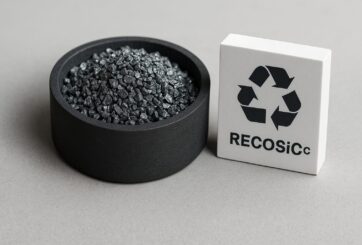
Ceramics recycling – energy-efficient and low in emissions… Silicon carbide is a popular industrial material for many applications. The extremely hard, heat-resistant material is used for refractory components and semiconductors, for instance. But its production is energy-intensive and emits a lot of carbon dioxide, as well as producing large amounts of by-products and waste products. Researchers at Fraunhofer Institute for Ceramic Technologies and Systems IKTS have developed RECOSiC©, an especially environmentally friendly recycling process that turns these by-products and waste…
A University of Virginia-led study about a class of materials called associative polymers appears to challenge a long-held understanding of how the materials, which have unique self-healing and flow properties, function at the molecular level. Liheng Cai, an assistant professor of materials science and engineering and chemical engineering at UVA, who led the study, said the new discovery has important implications for the countless ways these materials are used every day, from engineering recyclable plastics to human tissue engineering to…
Car2Human communication at LASER 2023… How do you decide whether a pedestrian needs to wait or it’s safe for them to cross the road in front of a car? In today’s world, car drivers and pedestrians simply exchange a brief eye contact or small hand gestures to express their intentions to one another. But how will future autonomous cars communicate? Researchers involved in the MaMeK project are seeking to answer that question. They will be presenting their findings at the…
Energy-flexible operation of pressure die-casting systems. Due to the high energy consumption of melting and holding furnaces, the price of the energy source represents a significant cost factor in the production of castings. The price of electricity fluctuates over the course of the day. As a result, companies should design their energy consumption flexibly. Together with its partners, the Fraunhofer Institute for Manufacturing Engineering and Automation IPA is developing a bivalent furnace that enables dynamic switching between gas and electricity….
Hamburg scientists at Helmut Schmidt University/UniBw H have succeeded in developing a particularly powerful thin-disk laser oscillator. Hamburg scientists at Helmut Schmidt University/UniBw H have succeeded in developing a particularly powerful thin-disk laser oscillator. Laser oscillators, unlike laser amplifiers, generate and amplify laser radiation simultaneously from a single box. The core part of the system consists of a laser-gain medium in a special thin-disk geometry and a unique configuration of mirrors to form the laser resonator. The laser emits 14…
New catalyst lowers cost for producing environmentally sustainable hydrogen from water. A plentiful supply of clean energy is lurking in plain sight. It is the hydrogen we can extract from water (H2O) using renewable energy. Scientists are seeking low-cost methods for producing clean hydrogen from water to replace fossil fuels, as part of the quest to combat climate change. Hydrogen can power vehicles while emitting nothing but water. Hydrogen is also an important chemical for many industrial processes, most notably…
With summer temperatures soaring, the spectre of water scarcity looms large. As a possible solution to increase the availability of clean, potable water, researchers at the Indian Institute of Science (IISc) have developed a novel thermal desalination system which can work using solar energy. The most common methods for desalination are membrane-based reverse osmosis and thermal desalination. However, both consume a lot of energy. Thermal desalination systems work by heating saltwater and then condensing the resulting vapour to obtain freshwater….
… enables application-oriented development of marine protective coatings. Marine benthic organisms colonize all available hard substrates – including offshore foundations, leading to altered flow conditions, increased loads, and more difficult inspection tasks. In order to realistically test the development of fouling-control coatings for this application, a test infrastructure was anchored on the seabed in a specially marked research area off the offshore island of Helgoland within the “ROBUST” project. Material and coating samples for the maritime industry can be tested…
States with decarbonization goals must plan, prepare, and test for long-duration energy storage. How can US states with aggressive decarbonization goals coupled with federal decarbonization goals have energy when they need it? Long-duration energy storage (LDES) is a likely candidate. LDES systems are large energy storage installations that can store renewable energy until needed and can provide a much-needed solution for a reliable and decarbonized grid. But planning needs to start now, according to new research from Pacific Northwest National…
In order to advance the automation and digital networking of public transportation in Munich, 16 partners, including the University of Stuttgart, have joined forces in the “MINGA” research project. Their goal: On-demand services to complement the subway, buses, and trams, two virtually connected electric solo buses, “bus platoons” to replace the current diesel buses, and an automated driverless solo bus. In six work packages, the partners plan to address: the planning, financing, and regulatory aspects of automated public transport, the…
Galvanometer scanners have been in use in laser material processing for decades. However, a team from the Fraunhofer Institute for Laser Technology ILT has now developed a new, particularly compact scanner module for applications in 3D printing, micromachining or medical technology. The researchers have already successfully tested it for various applications. The scanner will be on display at LASER World of Photonics 2023 in Munich. Smaller, lighter, more efficient and more sustainable – these are the demands placed on system…
The effects of the ground on propeller noise have been measured experimentally for the very first time by researchers in the Aeroacoustics research team at the University of Bristol. In findings, published in the Journal of Sound and Vibration, the team found clear differences in the noise characteristics of propellers when over ground, known as ‘Ground Effect’, compared to when operated normally. They noted an overall noise increase when measuring at angles above the ground, with hydrodynamic and acoustic interaction…
To pave the way for the industrial implementation of highly efficient perovskite-silicon PV modules, the tandem solar cells and modules must be reliably measured. Only then is it possible to make objective comparisons between different cells and modules and to make technological improvements. In contrast to conventional silicon PV modules, however, the calibration is considerably more challenging. A project consortium led by the Fraunhofer Institute for Solar Energy Systems ISE is therefore developing methods for characterizing perovskite-based tandem modules in…
 Feedback


