
Using 3D technology and interdisciplinary expertise, a research team has explored Buddhist temples in the remote Dolpo region of Nepal and digitized them for posterity In the high-altitude and extremely remote region of Dolpo in north-west Nepal, there are numerous Buddhist temples whose history dates back to the 11th century. The structures are threatened by earthquakes, landslides and planned infrastructure projects such as the Chinese Belt and Road Initiative. There is also a lack of financial resources for long-term maintenance….

A materials scientist at Friedrich Schiller University Jena, Germany has been awarded a prestigious “ERC Proof of Concept Grant” from the European Research Council to further develop and refine a process that enables thermal toughening of very thin glass. For decades, the process of thermal tempering has played a major role in increasing the strength of glass and thus guaranteeing greater durability. With this technique, conventional glass sheets are strengthened in a simple and highly efficient way. This has made…
Sunlight offers a potential solution in the search for an energy source that does not harm the planet, but this depends on finding a way to efficiently turn electromagnetic energy into electricity. Researchers from KAUST have shown how a known herbicide can improve this conversion in organic devices. While solar cells have traditionally been made from inorganic materials such as silicon, organic materials are starting to break through as an alternative because they are light, flexible and relatively inexpensive to…
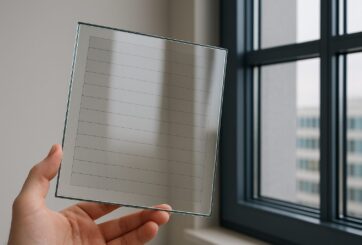
How tomorrow’s windows will generate electricity A new study led by scientists from Incheon National University in Korea shows how to make a fully transparent solar cell. Five years after the Paris climate agreement, all eyes are on the world’s progress on the road to a carbon-free future. A crucial part of this goal involves the energy transition from fossil fuels to renewable sources, such as sun, water, wind and wave energy. Among those, solar energy has always held the…
High-performance fibres that have been exposed to high temperatures usually lose their mechanical properties undetected and, in the worst case, can tear precisely when lives depend on them. For example, safety ropes used by fire brigades or suspension ropes for heavy loads on construction sites. Empa researchers have now developed a coating that changes color when exposed to high temperatures through friction or fire. The firefighter runs into the burning building and systematically searches room by room for people in…
Diamond is the hardest material in nature. But out of many expectations, it also has great potential as an excellent electronic material. A joint research team led by City University of Hong Kong (CityU) has demonstrated for the first time the large, uniform tensile elastic straining of microfabricated diamond arrays through the nanomechanical approach. Their findings have shown the potential of strained diamonds as prime candidates for advanced functional devices in microelectronics, photonics, and quantum information technologies. The research was…
Nature has figured out how to make great membranes. Biological membranes let the right stuff into cells while keeping the wrong stuff out. And, as researchers noted in a paper just published by the journal Science, they are remarkable and ideal for their job. But they’re not necessarily ideal for high-volume, industrial jobs such as pushing saltwater through a membrane to remove salt and make fresh water for drinking, irrigating crops, watering livestock or creating energy. Can we learn from…
Surface and coating technology Microscopy is at the forefront of the fight against the coronavirus. Special microscopes, which enable scientists to view minute cell structures, are an indispensable tool in the development of vaccines and new therapies. Such equipment comprises not only a microscope with high optical resolution but also a high-precision microscope stage. Hard-magnetic coatings from the Fraunhofer Institute for Surface Engineering and Thin Films IST also play a key role here. They help enable the examination of minuscule…
Graphene hybrid material reaches power density of batteries A team working with Roland Fischer, Professor of Inorganic and Metal-Organic Chemistry at the Technical University Munich (TUM) has developed a highly efficient supercapacitor. The basis of the energy storage device is a novel, powerful and also sustainable graphene hybrid material that has comparable performance data to currently utilized batteries. Usually, energy storage is associated with batteries and accumulators that provide energy for electronic devices. However, in laptops, cameras, cellphones or vehicles,…
Sustainable soundproofing As healthy and tasty as mushrooms might be, they are good for much more than just the dinner plate. The Fraunhofer Institute for Environmental, Safety and Energy Technology UMSICHT has now teamed up with the Fraunhofer Institute for Building Physics IBP to investigate the use of fungus-based materials for the fabrication of eco-friendly sound absorbers. The incessant chatter of office coworkers who are always on the phone or the loud music of a noisy neighbor are a source…
Enhanced safety for autonomous driving In autonomous vehicles, it is advanced technology that takes the wheel, allowing passengers to sit back and enjoy the ride. Yet such systems have to meet stringent safety standards. For example, an autonomous vehicle must be able to recognize obstacles and other hazards – and apply the brakes in an emergency. Such a vehicle could be equipped with a new microscanner mirror from the Fraunhofer Institute for Photonic Microsystems IPMS. This performs a 3D scan…
– advance could improve carbon capture technology A fast, green and one-step method for producing porous carbon spheres, which are a vital component for carbon capture technology and for new ways of storing renewable energy, has been developed by Swansea University researchers. The method produces spheres that have good capacity for carbon capture, and it works effectively at a large scale. Carbon spheres range in size from nanometers to micrometers. Over the past decade they have begun to play an…
Since 1970 a worldwide unique test has been running in the Empa testing hall in Dübendorf, in which the long-term behaviour of bonded steel reinforcements on a concrete beam is being investigated. Investigations such as these have contributed to the fact that adhesive-bonded reinforcement is now state of the art as a strengthening method and that engineers have confidence in this retrofitting method. For half a century now, a long-term experiment has been running in Empa’s largest testing laboratory at…
Oak Ridge National Laboratory researchers have developed a new family of cathodes with the potential to replace the costly cobalt-based cathodes typically found in today’s lithium-ion batteries that power electric vehicles and consumer electronics. The new class called NFA, which stands for nickel-, iron- and aluminum-based cathode, is a derivative of lithium nickelate and can be used to make the positive electrode of a lithium-ion battery. These novel cathodes are designed to be fast charging, energy dense, cost effective, and…
Research team develops new material system to convert and generate terahertz waves. On the electromagnetic spectrum, terahertz light is located between infrared radiation and microwaves. It holds enormous potential for tomorrow’s technologies: Among other things, it might succeed 5G by enabling extremely fast mobile communications connections and wireless networks. The bottleneck in the transition from gigahertz to terahertz frequencies has been caused by insufficiently efficient sources and converters. A German-Spanish research team with the participation of the Helmholtz-Zentrum Dresden-Rossendorf (HZDR)…
Converting polyethylene packaging into high-value products incentivizes plastics recycling. While many cities and eight states have banned single-use plastics, bags and other polyethylene packaging still clog landfills and pollute rivers and oceans. One major problem with recycling polyethylene, which makes up one-third of all plastic production worldwide, is economic: Recycled bags end up in low-value products, such as decks and construction material, providing little incentive to reuse the waste. A new chemical process developed at the University of California, Berkeley,…
Electrons inhabit a strange and topsy-turvy world. These infinitesimally small particles have never ceased to amaze and mystify despite the more than a century that scientists have studied them. Now, in an even more amazing twist, physicists have discovered that, under certain conditions, interacting electrons can create what are called “topological quantum states.” This finding, which was recently published in the journal Nature, has implications for many technological fields of study, especially information technology. Topological states of matter are particularly…
 Feedback


