
UCLA researchers study the disease’s systemic effects. UCLA researchers are the first to create a version of COVID-19 in mice that shows how the disease damages organs other than the lungs. Using their model, the scientists discovered that the SARS-CoV-2 virus can shut down energy production in cells of the heart, kidneys, spleen and other organs. “This mouse model is a really powerful tool for studying SARS-CoV-2 in a living system,” said Dr. Arjun Deb, a co-senior author of a…
Oldenburg chemical scientists publish results of three interconnected research projects. How do molecular catalysts – molecules which, like enzymes, can trigger or accelerate certain chemical reactions – function, and what effects do they have? A team of chemists at the University of Oldenburg has come closer to the answers using a model molecule that functions like a molecular nanobattery. It consists of several titanium centres linked to each other by a single layer of interconnected carbon and nitrogen atoms. The…
Computer scientists develop a design tool that opens up the use of a cost-efficient technology for curved glass panels. The tool is based on a deep neural network and allows for the free-form design of beautiful glass façades Curved glass façades can be stunningly beautiful, but traditional construction methods are extremely expensive. Panes are usually made with “hot bending”, where glass is heated and formed using a mold or specialized machines, an energy-intensive process that generates excess waste in the…
Leibniz Campus ComBioCat Creates the Basis for Green Chemistry. How can chemical processes for the production of commonplace chemicals be made more sustainable, environmentally friendly and economical than before? For example, without high temperatures and organic solvents? The Leibniz Institute for Catalysis in Rostock has found an answer for the industrially significant reaction of hydroformylation. The institute uses a structurally modified enzyme that catalytically controls the production of aldehydes, important basic chemicals, under mild reaction conditions. This basic research is…
Our bones have so-called mechanosensors that react to pressure and communicate with each other. “These sensors enable that bone is formed where it is mechanically necessary and broken down elsewhere,” says Richard Weinkamer from the Biomaterials Department. In their research they have come a decisive step closer to solving the mystery of where these mechanosensors are located: Hidden within a structure of canals inside the bone, a cell network “senses” external bone stress. This works by translating the mechanical loading…
Working committee particulate matter (AAF) recommends concrete countermeasures for indoor areas: masks, ventilation, air purification and overhead extraction. Aerosols and their spread play an essential role in the transmission of COVID-19. However, the risk of transmission could be significantly reduced if more could be done to reduce indoor airborne viruses. The Working committee particulate matter (AAF) has therefore issued an statement with concrete recommendations. These include window ventilation, exhaust ventilation, air purification systems and CO2 measuring devices for indoor areas…
Scientists reveal ‘flat band’ behavior in 2D ‘bitriangular’ lattice of germanium, confirming earlier theoretical prediction. Scientists have recently revealed, both theoretically and experimentally, that germanium atoms can arrange themselves into a 2D “bitriangular” lattice on zirconium diboride thin films grown on germanium single crystals to form a “flat band material” with an embedded “kagome” lattice. The result provides experimental support to a theoretical prediction of flat bands emerging from trivial atomic geometry and indicates the possibility of their existence in…
Hope for people whose illness or injuries mean they can’t exercise. It sounds too good to be true – and it is. But Jose Bianco Moreira and the CERG research group at the Norwegian University of Science and Technology (NTNU) are convinced that some of the positive health effects of physical exercise can be achieved using gene therapy and medication. “We’re not talking about healthy people and everyone who can exercise. They still have to train, of course,” says Moreira….
New clues lead to a better understanding of the evolution of the solar system and the origin of Earth as a habitable planet. In a new paper published in the journal Nature Communications Earth and Environment, researchers at the University of Rochester were able to use magnetism to determine, for the first time, when carbonaceous chondrite asteroids–asteroids that are rich in water and amino acids–first arrived in the inner solar system. The research provides data that helps inform scientists about…
Astronomers have caught a rare look at a rapidly fading shroud of gas around an aging star. Archival data from NASA’s Hubble Space Telescope reveal that the nebula Hen 3-1357, nicknamed the Stingray nebula, has faded precipitously over just the past two decades. Witnessing such a swift rate of change in a planetary nebula is exceeding rare, say researchers. Images captured by Hubble in 2016, when compared to Hubble images taken in 1996, show a nebula that has drastically dimmed…
A new machine learning approach offers important insights into catalysis, a fundamental process that makes it possible to reduce the emission of toxic exhaust gases or produce essential materials like fabric. In a report published in Nature Communications, Hongliang Xin, associate professor of chemical engineering at Virginia Tech, and his team of researchers developed a Bayesian learning model of chemisorption, or Bayeschem for short, aiming to use artificial intelligence to unlock the nature of chemical bonding at catalyst surfaces. “It…
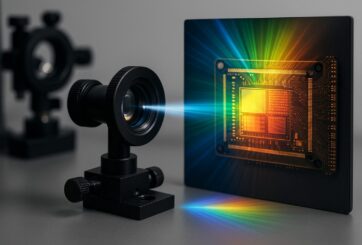
International research team describes 50 years of photonic artificial intelligence / Publication in “Nature” In a recent nature perspective, international experts in the field of optical neural networks, optical deep learning and photonic computing have put their expertise together to review the path from pathbreaking optical neural networks and optical computing realizations in the past fifty years and how they advanced to photonic artificial intelligence applications. The team, which includes the physicist Prof. Cornelia Denz from the Institute of Applied…
A multi-channel recording device developed at TU Graz for pathological lung sounds and associated automatic lung sound analysis could support existing screening methods for early detection of, for example, Covid-19 infections. This now requires clinical data and interdisciplinary collaboration. They whistle, hiss and crackle. Our bodies constantly make sounds that (fortunately) are not always audible to the naked ear. The occurrence of certain noises or changes in normal sounds can be an indication of illness. Using the example of the…
Neurobiologists at the German Primate Center developed a model that for the first time can completely represent the neuronal processes from seeing to grasping an object Every day we effortlessly make countless grasping movements. We take a key in our hand, open the front door by operating the door handle, then pull it closed from the outside and lock it with the key. What is a natural matter for us is based on a complex interaction of our eyes, different…
The group of Christiane Nüsslein-Volhard at the Max Planck Institute for Developmental Biology in Tübingen has identified a gene that is partly responsible for the different patterns found in closely related Danio species, as they report in the journal Nature Communications today. The gene, Obelix, codes for a potassium channel, belonging to a class of proteins that control numerous cellular processes, which are disturbed in a number of human diseases. „[…] from so simple a beginning endless forms most beautiful…
Researchers have developed new 3D-printed microlenses with adjustable refractive indices – a property that gives them highly specialized light-focusing abilities. This advancement is poised to improve imaging, computing and communications by significantly increasing the data-routing capability of computer chips and other optical systems, the researchers said. The study was led by University of Illinois Urbana-Champaign researchers Paul Braun and Lynford Goddard and is the first to demonstrate the ability to adjust the direction in which light bends and travels through…
 Feedback


